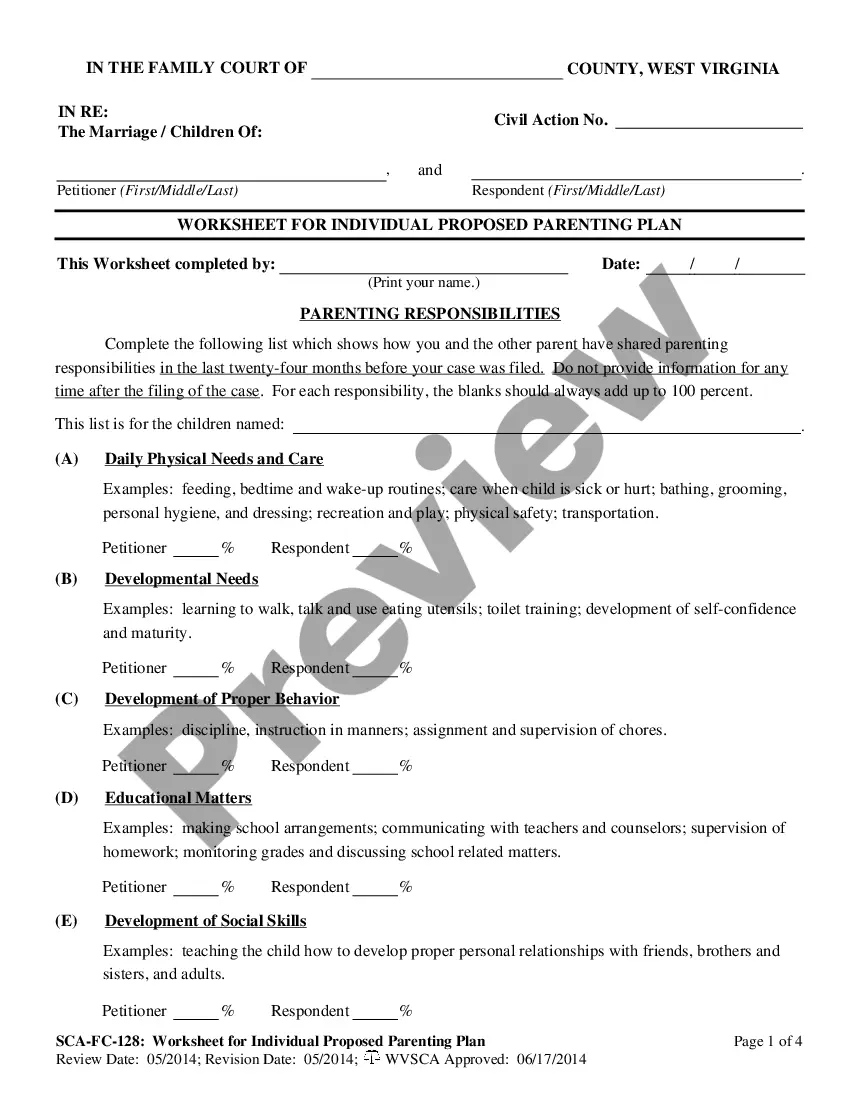
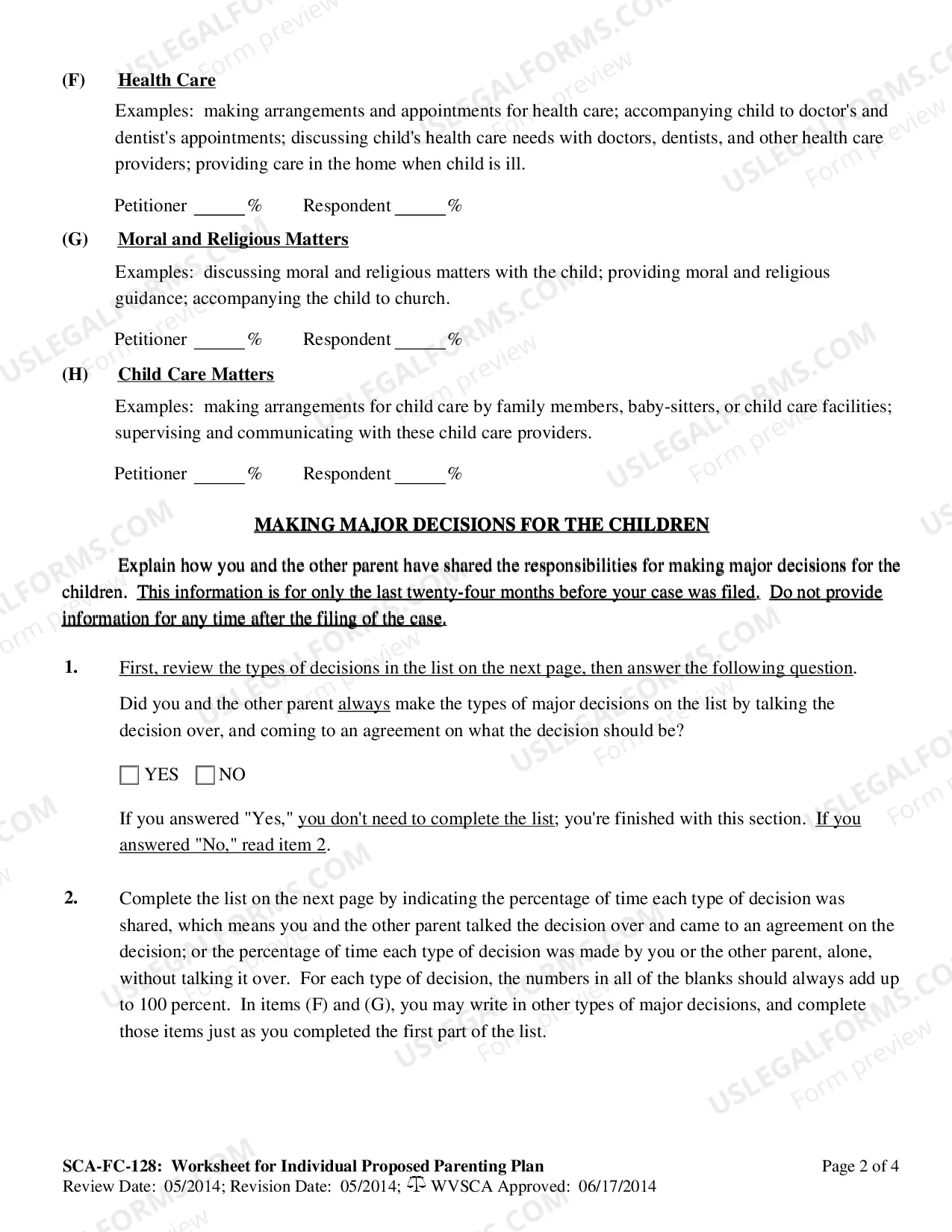
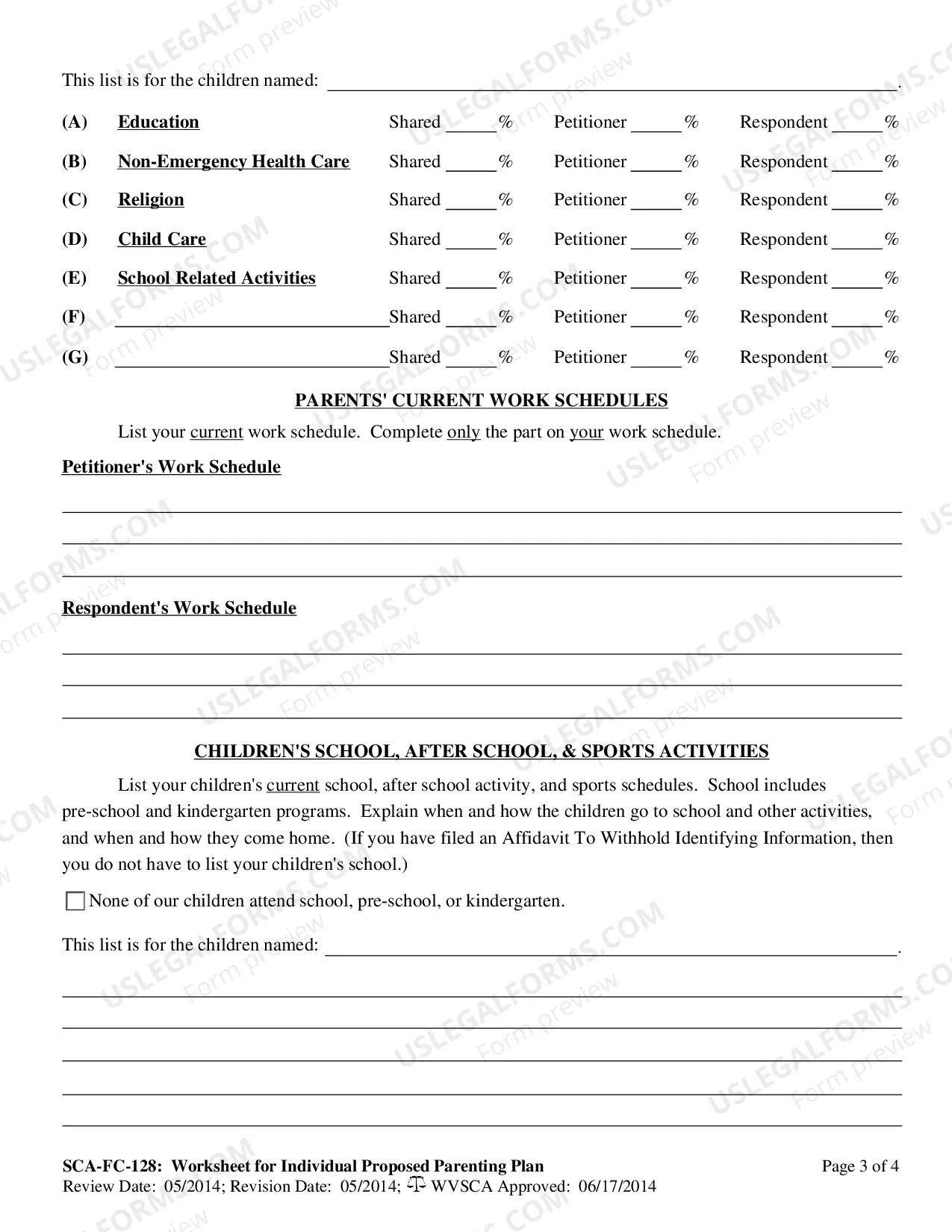
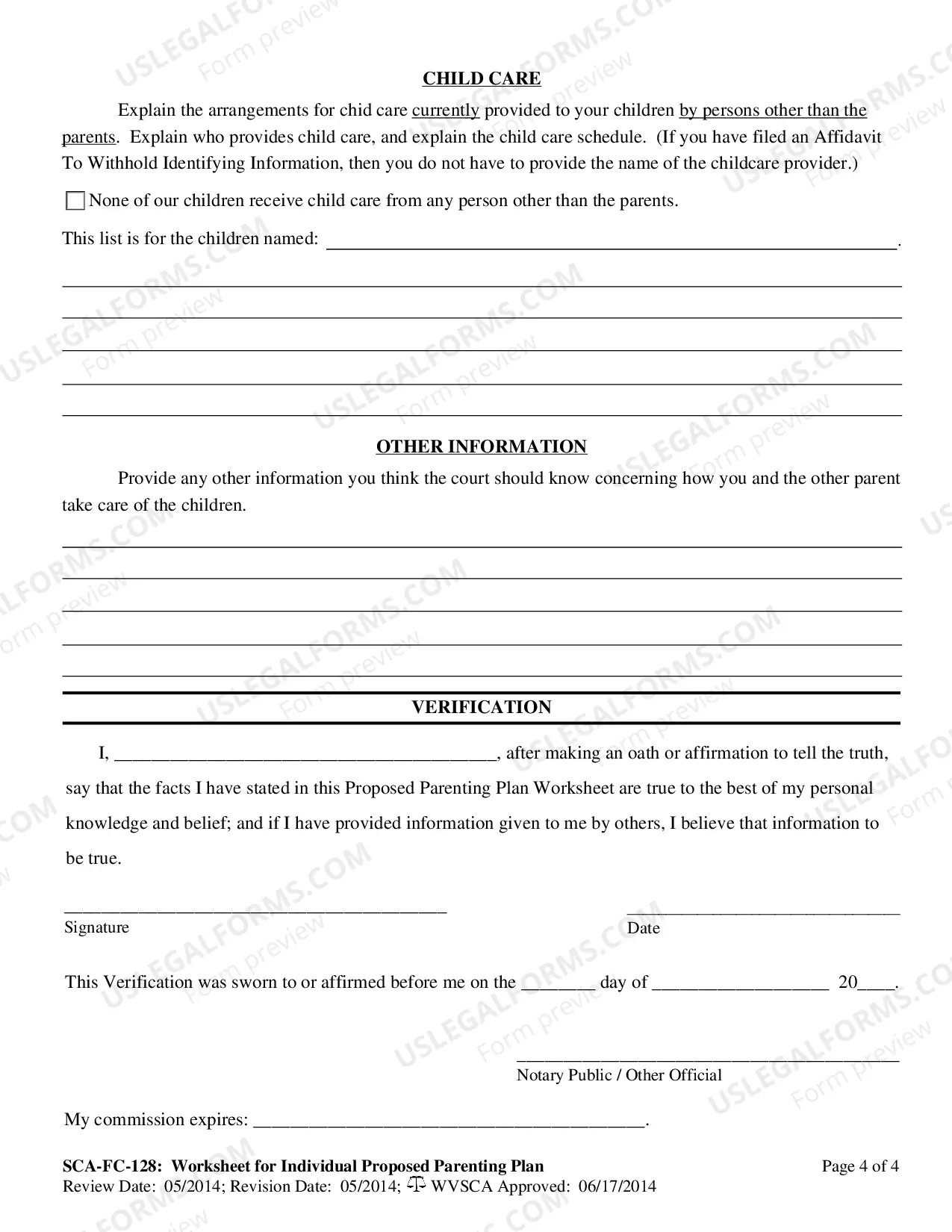
This is the worksheet that accompanies the Proposed Parenting Plan. The Proposed Parenting Plan is required for any West Virginia divorce that involves minor children.
Parenting Plan Form For Divorce
State:
West Virginia
Category:
Control #:
WV-SCA-FC-128
Format:
PDF
Instant download
This website is not affiliated with any governmental entity
Public form
Description
Free preview
Get your form ready online
Our built-in tools help you complete, sign, share, and store your documents in one place.
Built-in online Word editor
Make edits, fill in missing information, and update formatting in US Legal Forms—just like you would in MS Word.
Export easily
Download a copy, print it, send it by email, or mail it via USPS—whatever works best for your next step.
E-sign your document
Sign and collect signatures with our SignNow integration. Send to multiple recipients, set reminders, and more. Go Premium to unlock E-Sign.
Notarize online 24/7
If this form requires notarization, complete it online through a secure video call—no need to meet a notary in person or wait for an appointment.
Store your document securely
We protect your documents and personal data by following strict security and privacy standards.

Make edits, fill in missing information, and update formatting in US Legal Forms—just like you would in MS Word.

Download a copy, print it, send it by email, or mail it via USPS—whatever works best for your next step.

Sign and collect signatures with our SignNow integration. Send to multiple recipients, set reminders, and more. Go Premium to unlock E-Sign.

If this form requires notarization, complete it online through a secure video call—no need to meet a notary in person or wait for an appointment.

We protect your documents and personal data by following strict security and privacy standards.
Looking for another form?



Form popularity
FAQ
An uncooperative co-parent might consistently refuse to communicate about important decisions related to the children. For instance, they may ignore requests for updates on school events or health issues, making it challenging to create a consistent parenting environment. Utilizing a parenting plan form for divorce can help establish clear communication guidelines. It sets expectations, promotes collaboration, and serves to minimize misunderstandings.
One of the biggest mistakes in a custody battle is failing to focus on the child's best interests. When parents get caught up in their disputes, they often overlook the importance of a well-structured parenting plan form for divorce. By using a comprehensive parenting plan, you can outline your commitments clearly. This helps reduce conflict and shows the court your dedication to your child's well-being.
In a 60/40 split custody arrangement, one parent has the child for 60% of the time while the other parent has the child for 40%. This kind of split may work well in certain situations where parents can effectively co-parent. It is crucial to outline this arrangement clearly in a parenting plan form for divorce to ensure both parents understand their responsibilities. A well-structured parenting plan can help minimize conflicts and promote stability for the child.
A 70/30 split means that one parent has primary custody, while the other parent has visitation rights for 30% of the time. This arrangement can offer children stability with one primary home while also allowing them to spend significant time with the other parent. A parenting plan form for divorce is essential in laying out this arrangement clearly and legally.
The best parenting schedule largely depends on the needs of both parents and the children. A 70/30 custody split is often effective for working parents and allows children to maintain close relationships with both parents. Using a parenting plan form for divorce can help you tailor this schedule accurately to reflect your family's dynamics.
For a 70/30 custody split, one practical example might be alternating weekends between parents, with the weekday routine remaining consistent. Here, the children spend most of their weekdays in one home and every other weekend in the other. A parenting plan form for divorce can be very useful in detailing this arrangement clearly.
A common example of a 70/30 split includes one parent having the children Monday through Friday, while the other parent sees them on weekends. This arrangement fosters stability during the week and quality time on weekends. Utilizing a parenting plan form for divorce can help you structure this schedule to suit your family's needs.
In a 70/30 custody split, one parent typically has the children for 70% of the time, while the other parent has them for 30%. This usually translates to 5 days with one parent and 2 days with the other in a week. A practical approach is to use a parenting plan form for divorce to outline specific schedules effectively.