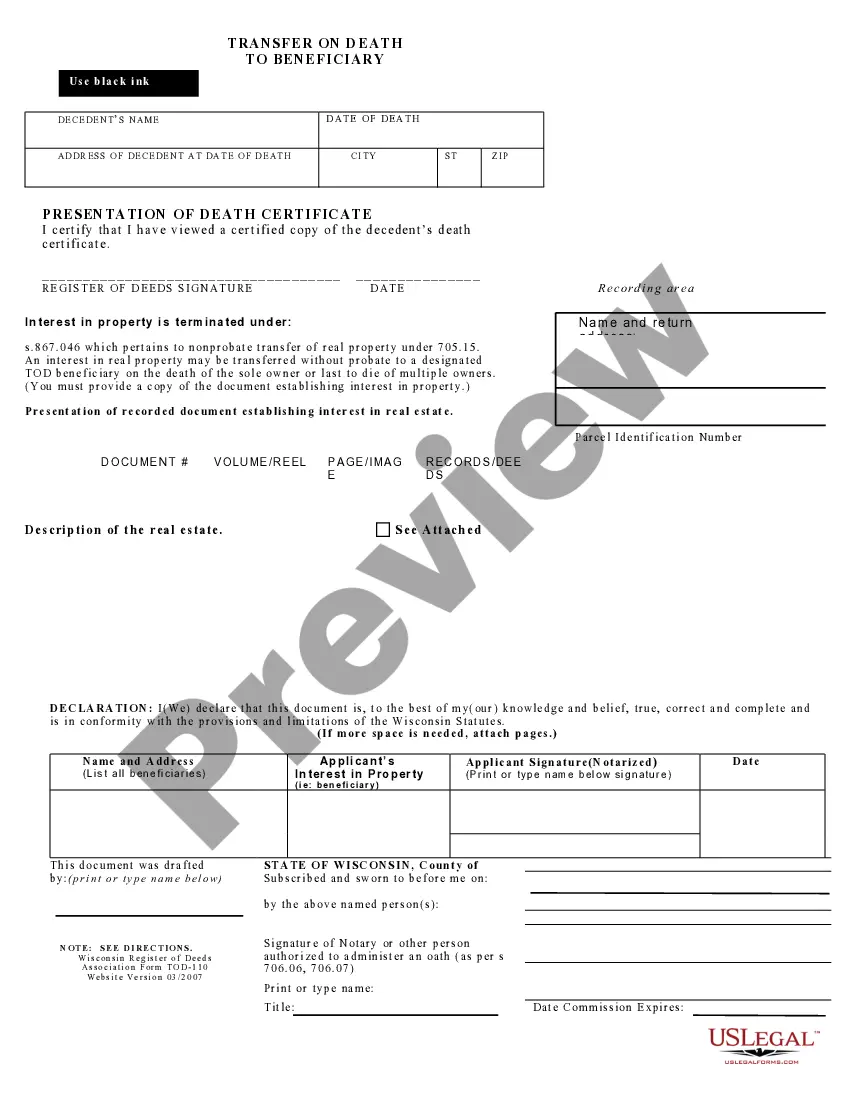
Wisconsin Tod 110 Form With 2 Points
Description

Get your form ready online
Our built-in tools help you complete, sign, share, and store your documents in one place.
Make edits, fill in missing information, and update formatting in US Legal Forms—just like you would in MS Word.
Download a copy, print it, send it by email, or mail it via USPS—whatever works best for your next step.
Sign and collect signatures with our SignNow integration. Send to multiple recipients, set reminders, and more. Go Premium to unlock E-Sign.
If this form requires notarization, complete it online through a secure video call—no need to meet a notary in person or wait for an appointment.
We protect your documents and personal data by following strict security and privacy standards.

Make edits, fill in missing information, and update formatting in US Legal Forms—just like you would in MS Word.

Download a copy, print it, send it by email, or mail it via USPS—whatever works best for your next step.

Sign and collect signatures with our SignNow integration. Send to multiple recipients, set reminders, and more. Go Premium to unlock E-Sign.

If this form requires notarization, complete it online through a secure video call—no need to meet a notary in person or wait for an appointment.

We protect your documents and personal data by following strict security and privacy standards.
Looking for another form?



How to fill out Wisconsin Transfer On Death Or TOD To Beneficiary - Official Form Used To Record Beneficiary's Interest Following Death Of Grantor?
Regardless of whether for commercial reasons or personal matters, everyone must handle legal circumstances sooner or later in their lives. Filling out legal forms requires meticulous attention, starting with selecting the correct form template.
For instance, if you select an incorrect version of the Wisconsin Tod 110 Form With 2 Points, it will be rejected once submitted. Therefore, it is crucial to obtain a trustworthy source of legal documents like US Legal Forms.
Once downloaded, you can complete the form using editing software or print it out and finish it manually. With a comprehensive US Legal Forms catalog available, you do not have to waste time searching for the right template online. Use the library’s intuitive navigation to find the suitable form for any circumstance.
- Locate the template you require using the search bar or catalog browsing.
- Review the form’s description to confirm it aligns with your situation, region, and county.
- Click on the form’s preview to inspect it.
- If it is not the correct document, return to the search feature to locate the Wisconsin Tod 110 Form With 2 Points template you seek.
- Download the file if it satisfies your needs.
- If you already possess a US Legal Forms account, click Log in to access previously saved documents in My documents.
- If you don't yet have an account, you may download the form by clicking Buy now.
- Select the relevant pricing option.
- Fill out the account registration form.
- Choose your payment method: you can utilize a credit card or PayPal account.
- Select the document format you desire and download the Wisconsin Tod 110 Form With 2 Points.
Form popularity
FAQ
A proof of heirship form in Wisconsin establishes the rightful heirs of a deceased person's estate. This document is vital in confirming who inherits property when there are no formal estate plans. Utilizing the Wisconsin tod 110 form can facilitate this process by ensuring that property transfers align with state requirements, streamlining the distribution of assets among heirs.
The transfer on death deed (TOD) in Wisconsin offers significant benefits, including avoiding probate and simplifying the transfer of property. By using a Wisconsin tod 110 form, property owners can designate beneficiaries, ensuring that their assets are transferred directly upon their death. This method provides a straightforward way to manage estate planning, allowing heirs to access property without lengthy legal processes.
In Wisconsin, the seller usually pays the real estate transfer tax when a property is sold. However, the terms can vary based on the agreement between the buyer and the seller. Understanding these details is critical, and using tools like the Wisconsin tod 110 form can help clarify tax responsibilities during the real estate transaction process.
A termination of decedent's interest in Wisconsin occurs when a property owner passes away, and their interest in the property needs to be resolved. This process typically involves transferring ownership to heirs or beneficiaries as outlined in the deceased's estate plan. The Wisconsin tod 110 form is crucial during this process as it assists in documenting the transfer of property effectively, ensuring a smooth transition and avoiding probate complications.
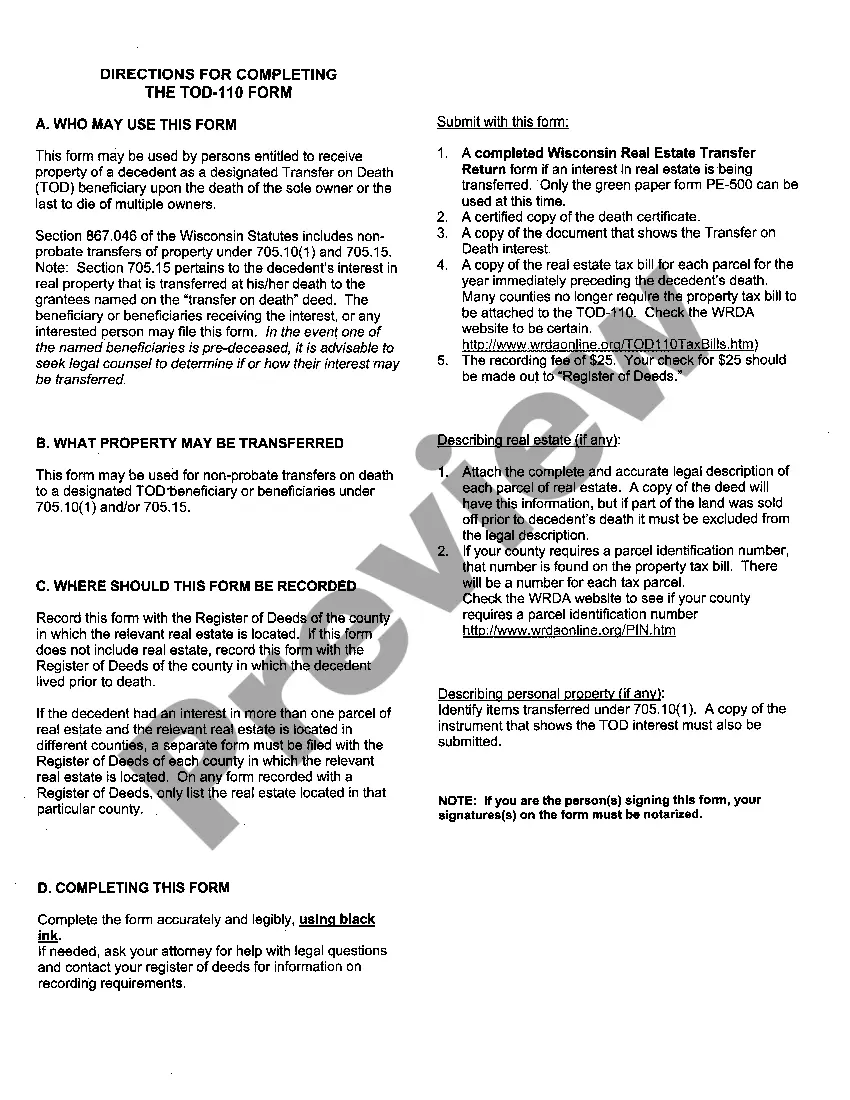
You can obtain a transfer on death deed document, like the Wisconsin tod 110 form, from various sources online. Legal websites, including uslegalforms, offer the form and provide guidance on completing it. Additionally, most county government websites will have downloadable versions of this form. Ensure you get the correct version that complies with Wisconsin laws.
One disadvantage of a transfer on death deed is that it does not manage property disputes or claims against the estate. While it allows for easy transfer, any debts or liens on the property may still complicate matters. Additionally, if a beneficiary predeceases you without an alternate arrangement, ownership can become unclear. Consider these factors when deciding on using the Wisconsin tod 110 form.
Filing a transfer on death deed in Wisconsin involves completing the Wisconsin tod 110 form correctly. After filling out the details, you must get the form notarized to validate your signature. Then, take the signed form to your local county register of deeds office to have it recorded. This process legally secures the transfer of your property to the designated beneficiaries.
The HT 110 form in Wisconsin is commonly referred to as the Wisconsin tod 110 form. This form is specifically designed for individuals who want to create a transfer on death deed for their real estate. It allows property owners to designate beneficiaries who will receive the property upon their death, making estate planning more straightforward. You can find this form on various legal websites, including uslegalforms.
It is not necessary to hire an attorney to complete a transfer on death deed in Wisconsin. You can use resources like the Wisconsin tod 110 form, which simplifies the process. However, obtaining legal advice can be beneficial, especially if your situation involves complex property matters. This can help ensure that all legal requirements are met accurately.
To file a transfer on death deed in Wisconsin, you need to complete the Wisconsin tod 110 form. Once you fill out this form, you should sign it in front of a notary. After notarization, submit the form to your local county register of deeds office for recording. This ensures that your property transfers smoothly to your beneficiaries upon your passing.