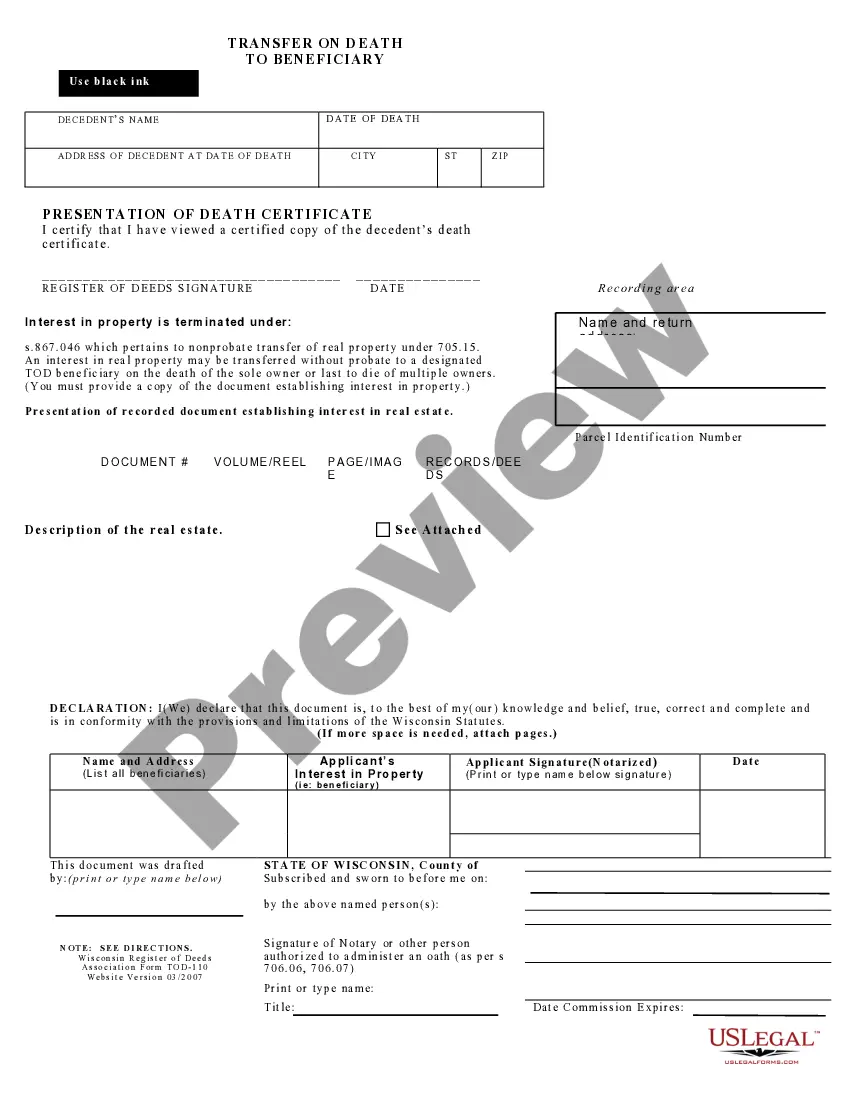
Wisconsin Tod 110 Form For Deeds
Description

Get your form ready online
Our built-in tools help you complete, sign, share, and store your documents in one place.
Make edits, fill in missing information, and update formatting in US Legal Forms—just like you would in MS Word.
Download a copy, print it, send it by email, or mail it via USPS—whatever works best for your next step.
Sign and collect signatures with our SignNow integration. Send to multiple recipients, set reminders, and more. Go Premium to unlock E-Sign.
If this form requires notarization, complete it online through a secure video call—no need to meet a notary in person or wait for an appointment.
We protect your documents and personal data by following strict security and privacy standards.

Make edits, fill in missing information, and update formatting in US Legal Forms—just like you would in MS Word.

Download a copy, print it, send it by email, or mail it via USPS—whatever works best for your next step.

Sign and collect signatures with our SignNow integration. Send to multiple recipients, set reminders, and more. Go Premium to unlock E-Sign.

If this form requires notarization, complete it online through a secure video call—no need to meet a notary in person or wait for an appointment.

We protect your documents and personal data by following strict security and privacy standards.
Looking for another form?

How to fill out Wisconsin Transfer On Death Or TOD To Beneficiary - Official Form Used To Record Beneficiary's Interest Following Death Of Grantor?
What is the most reliable service to obtain the Wisconsin Tod 110 Form For Deeds and other current versions of legal documents? US Legal Forms is the solution!
It boasts the largest assortment of legal forms for any purpose. Every template is professionally drafted and confirmed for adherence to federal and local regulations. They are categorized by area and state of use, making it easy to find the one you require.
US Legal Forms is an excellent choice for anyone needing assistance with legal documentation. Premium users can benefit even more by completing and electronically signing previously saved documents at any time using the built-in PDF editing tool. Explore it today!
- Veteran users of the site simply need to sign in to the system, verify that their subscription is active, and click the Download button next to the Wisconsin Tod 110 Form For Deeds to receive it.
- Once saved, the template is accessible for future use in the My documents section of your account.
- If you don't have an account yet, here are the steps you should follow to create one.
- Template compliance evaluation. Before acquiring any document, ensure it meets your usage requirements and complies with your state or county regulations. Review the document description and use the Preview feature if available.
Form popularity
FAQ
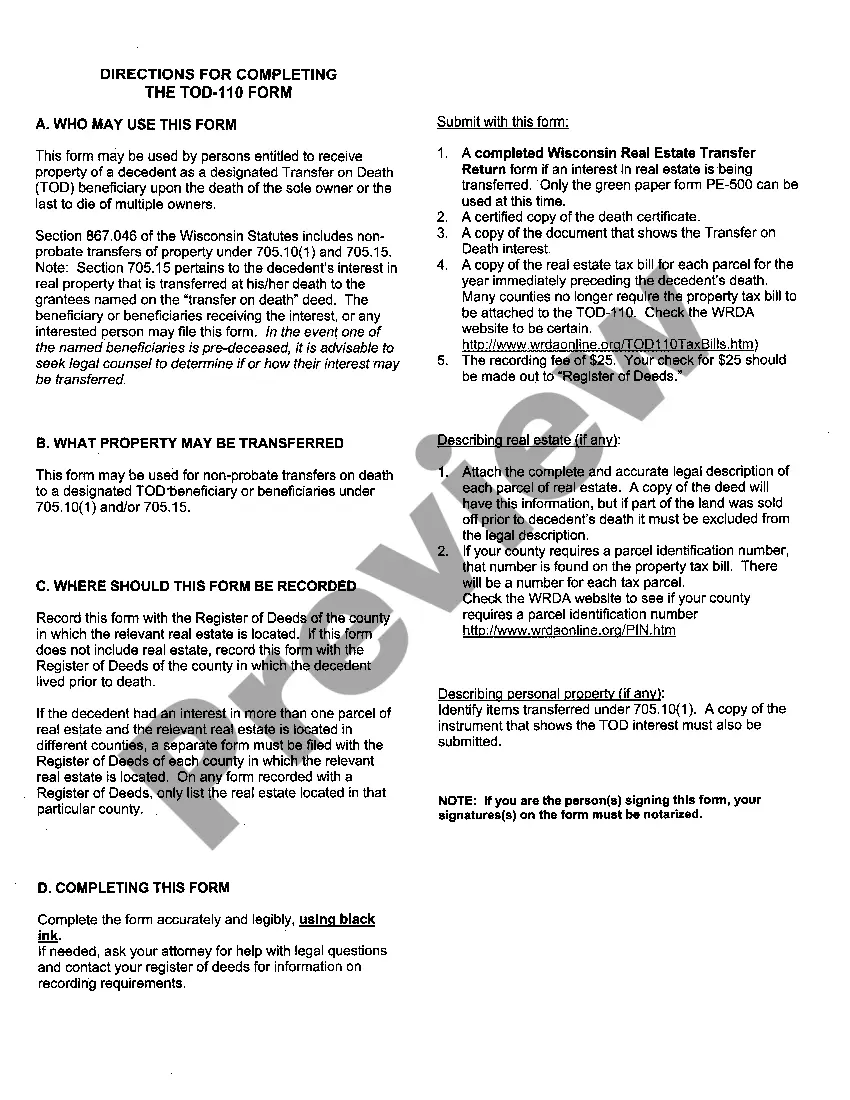
To transfer a deed in Wisconsin, you typically need to complete the appropriate form, such as the Wisconsin TOD 110 form for deeds. After filling out the form, you must sign it in front of a notary public, then file it with the county register of deeds. This process secures your property transfer and ensures the new owner's rights are effectively documented.
In Wisconsin, a quitclaim deed transfers whatever interest the owner has in a property without any warranties. This means that if you use the Wisconsin TOD 110 form for deeds, you are essentially saying, 'I am giving you this property, but I make no guarantees about its condition or title.' It is an easy option when transferring property to family or friends, making it a practical choice for informal transactions.
Transferring a property title between family members can be done smoothly using the Wisconsin TOD 110 form for deeds. This form allows you to designate family members as beneficiaries, thereby avoiding probate. By completing this form, you ensure that the property will automatically transfer to those beneficiaries upon your passing. It simplifies the process while keeping your family's interests secure.
After the death of a spouse, several important tasks need your attention, including updating legal documents and accounts. You may need to complete the Wisconsin TOD 110 form for deeds if your spouse owned property that should pass to you or another beneficiary. Additionally, it is essential to notify financial institutions and review any joint accounts. Taking these steps will help ensure a smoother transition during this challenging time.
A transfer on death deed in Wisconsin allows you to pass property directly to a designated beneficiary upon your death. This process uses the Wisconsin TOD 110 form for deeds, ensuring that the property does not go through probate. It streamlines the transfer and provides peace of mind knowing your property goes to the intended party. Be sure to complete and file the deed properly to activate this benefit.
It is generally advisable to remove a deceased spouse from a bank account to avoid complications. When one spouse passes away, their name can cause legal issues regarding access to funds. This process often involves providing a death certificate and potentially using the Wisconsin TOD 110 form for deeds, depending on account ownership. Consulting with a legal expert can help clarify your specific situation.
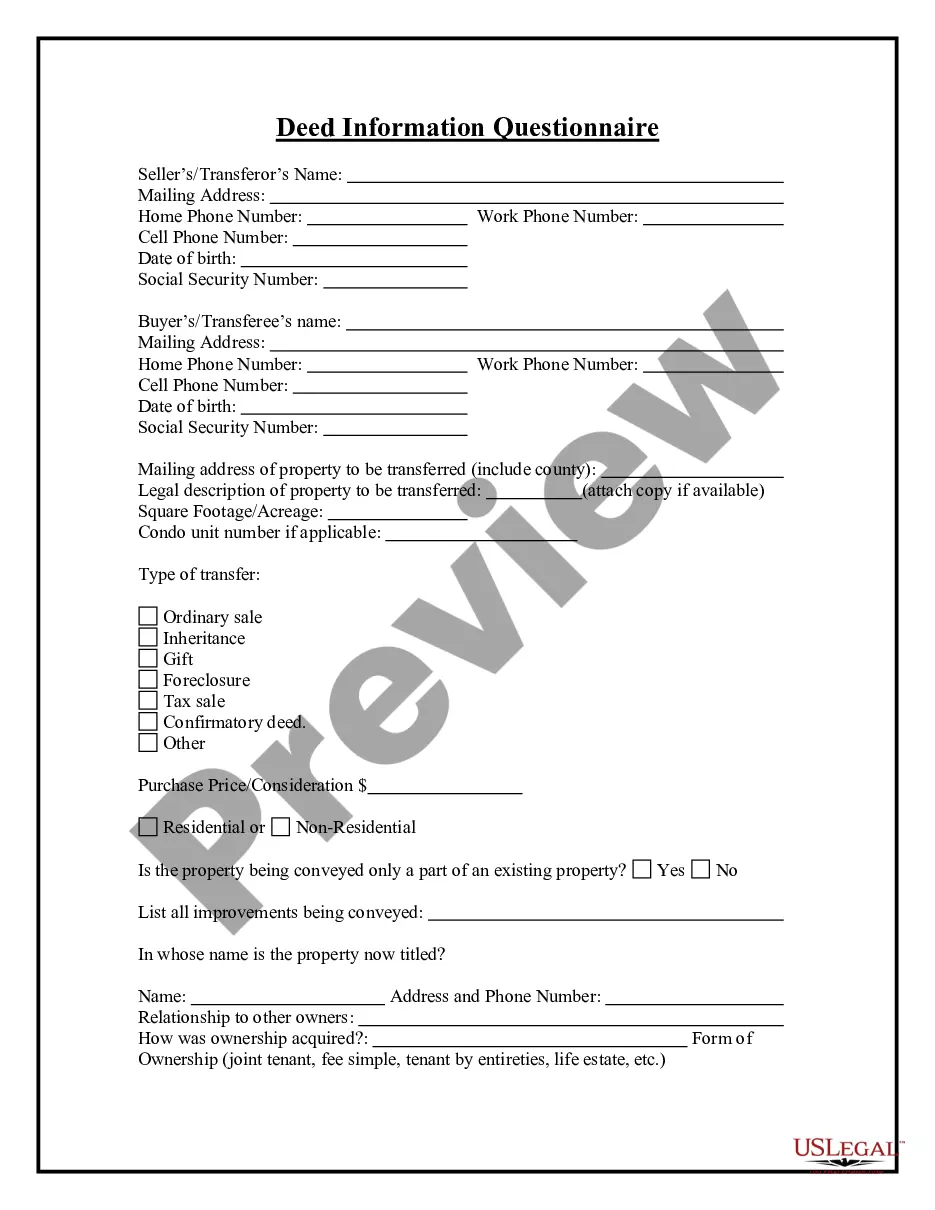
Filling out the Wisconsin TOD 110 form for deeds requires several key pieces of information. You will need to include your name, the name of the beneficiary, and a description of the property. Take your time to ensure all details are correct, as any errors could delay the process. After completing the form, remember to sign it and have it notarized for legal validity.
To add someone to your deed in Wisconsin, you will need to execute a new deed using the Wisconsin TOD 110 form for deeds. This document allows you to designate the new owner for your property upon your death. Make sure to complete the form accurately and have it notarized. Once completed, file the new deed with your local register of deeds office.
To transfer ownership of a property in Wisconsin, you must complete the Wisconsin TOD 110 form for deeds. This form allows the owner to designate a beneficiary who will receive the property upon the owner's death, simplifying the transfer process. After filling out the form, you need to sign it in front of a notary and then record it with the county register of deeds. This process not only ensures a smooth transfer but also avoids the complexities of probate.
The advantages of a transfer on death deed, particularly the Wisconsin TOD 110 form for deeds, include avoiding probate and simplifying property transfer. This form allows you to name a beneficiary who will inherit your property automatically upon your death. Additionally, it provides flexibility as the grantor retains full control over the property during their lifetime. Using this deed can lead to peace of mind for estate planning.