Exempt Person Homestead For Hope
Description

Get your form ready online
Our built-in tools help you complete, sign, share, and store your documents in one place.
Make edits, fill in missing information, and update formatting in US Legal Forms—just like you would in MS Word.
Download a copy, print it, send it by email, or mail it via USPS—whatever works best for your next step.
Sign and collect signatures with our SignNow integration. Send to multiple recipients, set reminders, and more. Go Premium to unlock E-Sign.
If this form requires notarization, complete it online through a secure video call—no need to meet a notary in person or wait for an appointment.
We protect your documents and personal data by following strict security and privacy standards.

Make edits, fill in missing information, and update formatting in US Legal Forms—just like you would in MS Word.

Download a copy, print it, send it by email, or mail it via USPS—whatever works best for your next step.

Sign and collect signatures with our SignNow integration. Send to multiple recipients, set reminders, and more. Go Premium to unlock E-Sign.

If this form requires notarization, complete it online through a secure video call—no need to meet a notary in person or wait for an appointment.

We protect your documents and personal data by following strict security and privacy standards.
Looking for another form?








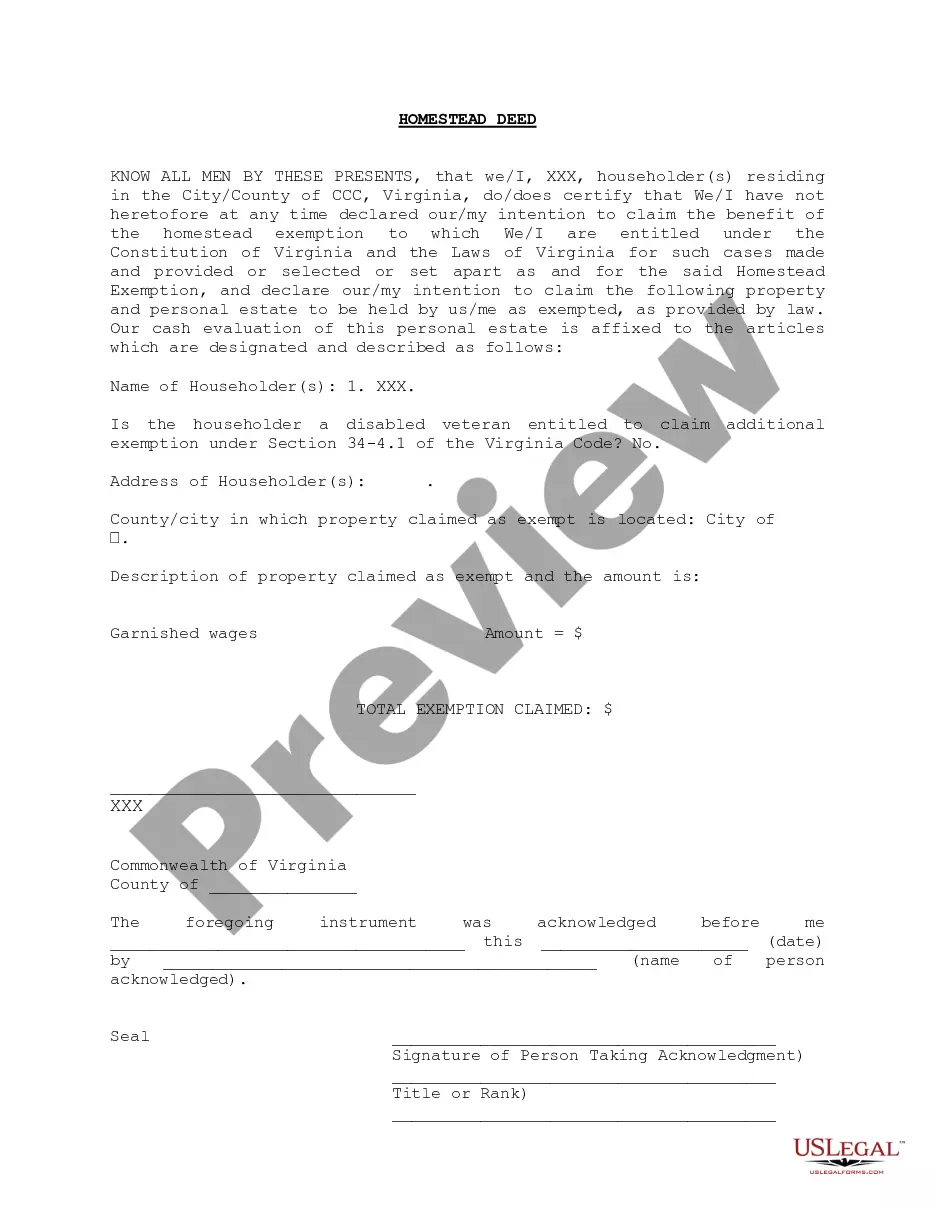
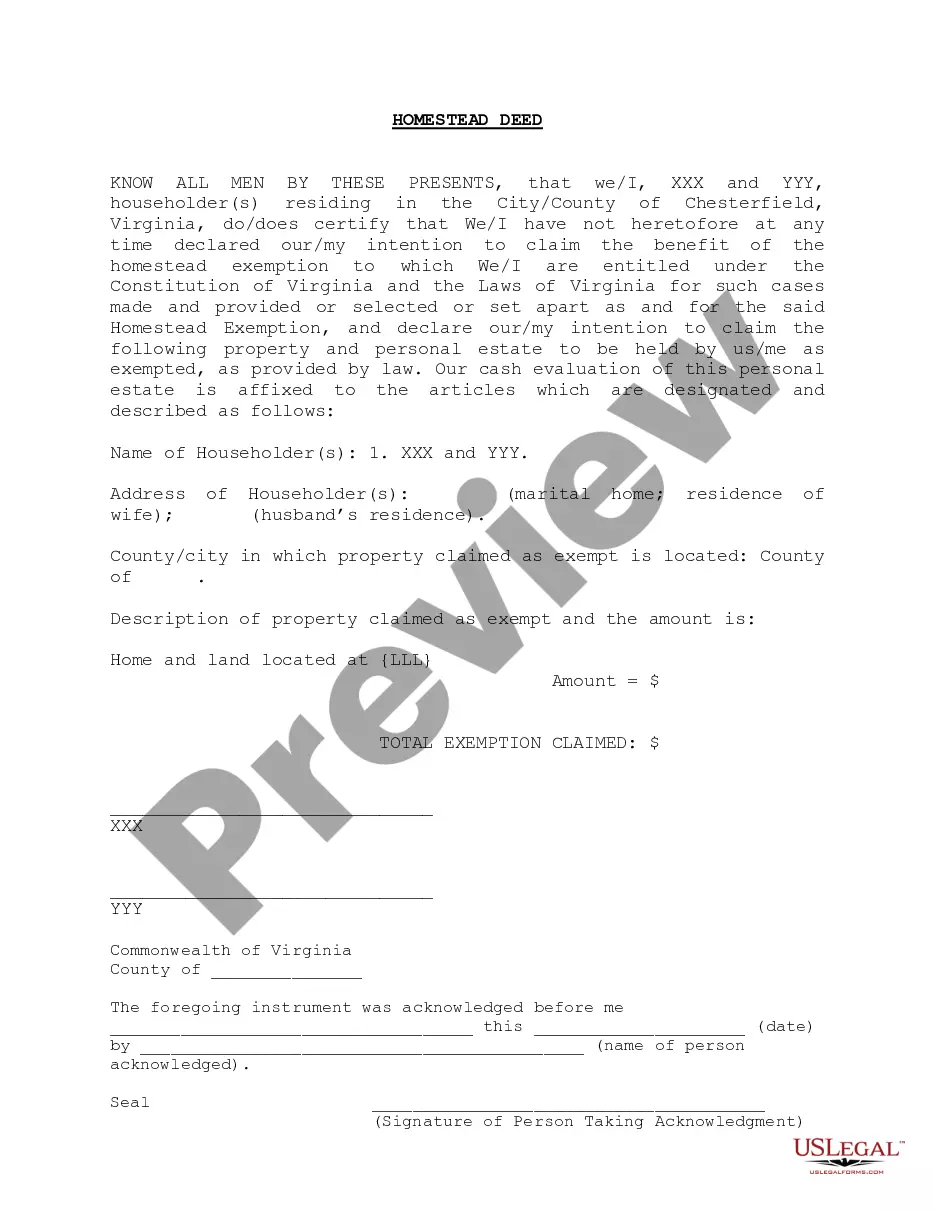
How to fill out Virginia Homestead Deed For Single - Home?
The Exempt Person Homestead For Hope that you see on this page is a reusable official template composed by qualified attorneys in compliance with federal and local statutes and regulations.
For over 25 years, US Legal Forms has assisted individuals, businesses, and lawyers with more than 85,000 authenticated, state-specific templates for any professional and personal circumstances. It’s the quickest, simplest, and most reliable method to acquire the documents you require, as the service ensures the utmost level of data security and anti-malware safeguards.
Enroll in US Legal Forms to have verified legal templates for all of life’s situations at your fingertips.
- Search for the document you require and review it. Look through the file you searched and preview it or check the form description to confirm it meets your needs. If it does not, utilize the search bar to find the correct one. Click Buy Now when you have identified the template you need.
- Sign up and Log In. Choose the pricing plan that fits you and establish an account. Use PayPal or a credit card to make a fast payment. If you already possess an account, Log In and check your subscription to continue.
- Obtain the editable template. Choose the format you prefer for your Exempt Person Homestead For Hope (PDF, Word, RTF) and download the sample to your device.
- Complete and sign the documentation. Print out the template to fill it out by hand. Alternatively, use an online multifunctional PDF editor to quickly and accurately fill out and sign your form with a legally-binding digital signature.
- Download your documentation one more time. Use the same document again whenever required. Open the My documents tab in your profile to redownload any previously acquired templates.
Form popularity
FAQ
To qualify for the Texas homestead exemption, you need to own the property and reside there on January 1st of the tax year. Additionally, you must file an application with your local appraisal district. For further assistance navigating this process, the Exempt person homestead for hope can provide valuable insights and resources tailored to Texas homeowners.
Typically, homeowners who occupy their property as their primary residence qualify for a homestead exemption. This includes individuals who are seniors, disabled, or veterans, who may have additional benefits available to them. If you want to understand your eligibility better, the Exempt person homestead for hope offers resources to clarify who can apply.
To qualify for a homestead exemption, you must own and occupy the property as your primary residence. Furthermore, you must be a legal resident of the state where you apply. Understanding the criteria is essential, and the Exempt person homestead for hope can help you navigate the requirements for your situation.
The Homestead Act does not apply to certain individuals, such as those who have been convicted of felonies or those who do not occupy the property as their primary residence. Additionally, landlords and business owners may not qualify, as the exemption is designed for personal residences. If you seek clarity on this topic, the Exempt person homestead for hope can guide you through specific exclusions.
You can obtain a homestead exemption form by visiting your local county or state tax office's website, where they often provide downloadable forms. Additionally, the US Legal Forms platform is an excellent resource, offering easy access to various legal documents, including homestead exemption forms. This can simplify your journey towards securing an exempt person homestead for hope.
To file a homestead exemption in Georgia, you typically need to provide proof of ownership, identification, and documentation that proves your residency status. The application must be submitted to your local county tax office. For a smooth process, consider using the US Legal Forms platform, which offers detailed instructions and forms tailored for filing an exempt person homestead for hope.
Ohio's homestead exemption allows eligible homeowners to reduce the taxable value of their primary residence, providing significant savings on property taxes. To qualify, you must meet specific criteria, including age or disability status. This program supports exempt person homestead for hope, helping residents maintain affordable housing while financially managing their properties.
In Hawaii, once you have successfully filed for a homestead exemption, you generally do not need to reapply each year. However, you must notify the county if your eligibility status changes, such as selling your home or no longer qualifying as an exempt person homestead for hope. Always double-check with your local tax office to ensure you meet all requirements.
To apply for a homestead exemption, you typically need to fill out a specific application form designated by your state or county. Each location may have different requirements, so it is essential to check your local government’s website for the correct form. For assistance, you can explore the US Legal Forms platform, which provides a variety of resources, including the necessary forms to facilitate your application for an exempt person homestead for hope.
Common mistakes when applying for a homestead exemption include failing to meet the residency requirement, not providing adequate documentation, and missing application deadlines. Additionally, some homeowners may overlook specific exemptions available to them due to age or disability. Being aware of these pitfalls can help you avoid delays in receiving your benefits. The US Legal Forms platform can assist you in identifying these common mistakes and guide you in completing your application properly.