Liability For Water Bill
Description
Get your form ready online
Our built-in tools help you complete, sign, share, and store your documents in one place.
Make edits, fill in missing information, and update formatting in US Legal Forms—just like you would in MS Word.
Download a copy, print it, send it by email, or mail it via USPS—whatever works best for your next step.
Sign and collect signatures with our SignNow integration. Send to multiple recipients, set reminders, and more. Go Premium to unlock E-Sign.
If this form requires notarization, complete it online through a secure video call—no need to meet a notary in person or wait for an appointment.
We protect your documents and personal data by following strict security and privacy standards.

Make edits, fill in missing information, and update formatting in US Legal Forms—just like you would in MS Word.

Download a copy, print it, send it by email, or mail it via USPS—whatever works best for your next step.

Sign and collect signatures with our SignNow integration. Send to multiple recipients, set reminders, and more. Go Premium to unlock E-Sign.

If this form requires notarization, complete it online through a secure video call—no need to meet a notary in person or wait for an appointment.

We protect your documents and personal data by following strict security and privacy standards.
Looking for another form?
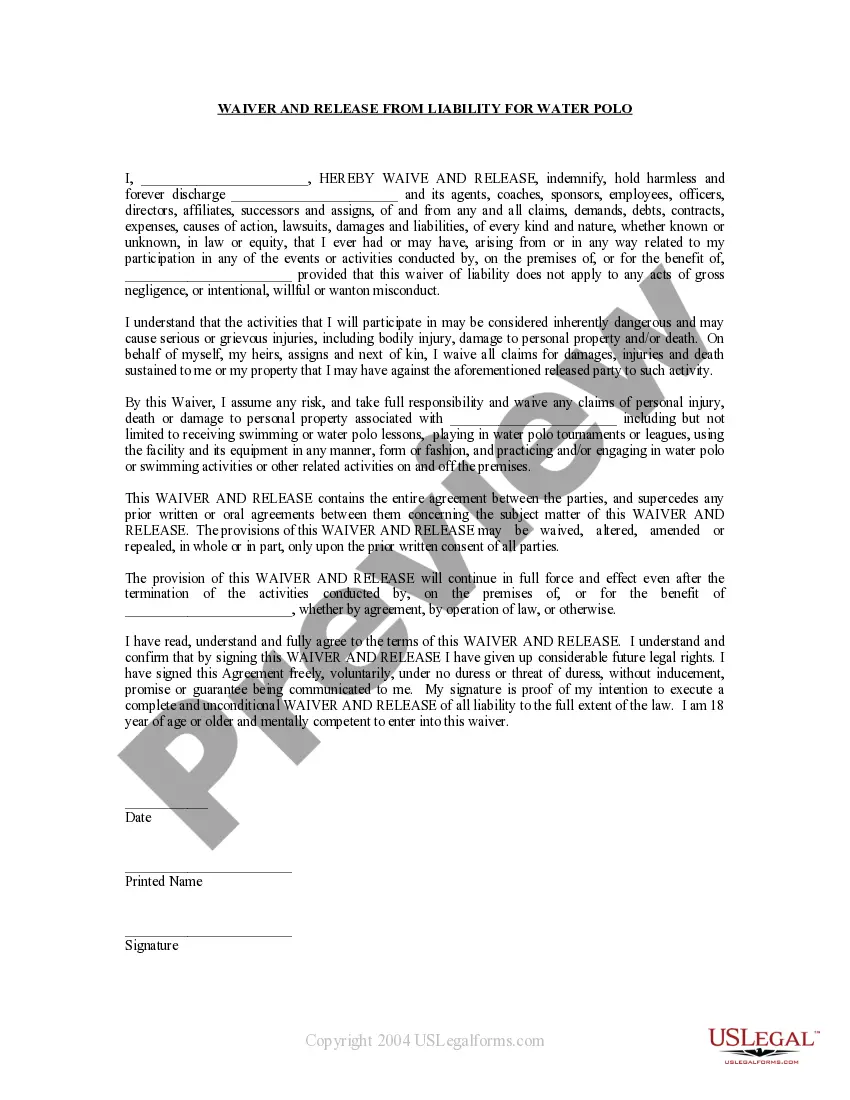
How to fill out Waiver And Release From Liability For Adult For Water Polo?
Creating legal documents from the ground up can sometimes be intimidating.
Certain situations may require extensive investigation and significant expenses.
If you're looking for a more straightforward and economical method of drafting Liability For Water Bill or any other paperwork without unnecessary obstacles, US Legal Forms is always accessible.
Our online repository of over 85,000 current legal templates encompasses nearly every dimension of your financial, legal, and personal affairs.
However, before directly proceeding to download the Liability For Water Bill, consider these suggestions: Review the document preview and descriptions to ensure you are viewing the appropriate form you require. Confirm that the form you choose complies with the statutes and regulations of your state and county. Select the correct subscription option to purchase the Liability For Water Bill. Download the file, then complete, certify, and print it. US Legal Forms boasts an impeccable reputation and over 25 years of expertise. Join us today and make form completion an easy and efficient process!
- With just a few clicks, you can immediately obtain state- and county-specific documents expertly prepared for you by our legal professionals.
- Utilize our service whenever you’re in need of a reliable and trustworthy solution for swiftly finding and downloading the Liability For Water Bill.
- If you’re already familiar with our website and have established an account with us, simply Log In to your account, find the form, and download it or re-download it anytime in the My documents section.
- Don’t possess an account? No issue. It takes minimal to no time to sign up and browse the library.
Form popularity
FAQ
When it comes to liability for water bill, you typically become responsible for the charges upon purchasing the property. However, it's essential to check your local laws and the terms of the sale, as some areas might have specific regulations regarding this issue. In many cases, unpaid bills from previous owners can become a lien against the property, impacting your ownership rights. To navigate these complexities, consider consulting resources on platforms like US Legal Forms, which can guide you through understanding your responsibilities.
A typical water bill in the United States can range from $30 to $100 per month, depending on factors such as location, usage, and household size. However, your liability for the water bill will vary based on your personal consumption and local rates. Understanding these charges allows you to budget accordingly and prevent unexpected costs. Utilize tools from platforms like USLegalForms to gain insights into calculating your expected water expenses.
A lien on a water bill signifies that the municipality has a legal claim against your property due to unpaid water charges. This means that if you do not settle your water bill, the local government can take action to recover the debt, potentially impacting your property ownership. Understanding your liability for the water bill is crucial, as it highlights the importance of timely payments. If you're dealing with a lien, consider accessing resources on the USLegalForms platform to explore your options.
Several factors can contribute to higher water bills, with usage being the most significant. Activities such as excessive outdoor watering, long showers, or running appliances inefficiently can lead to increased costs. It's also important to check for leaks, as they can significantly impact your liability for water bill expenses. Utilizing resources like US Legal Forms can help you understand water usage and manage your bills effectively.
Determining who is responsible for water damage can depend on various factors, including the source of the damage and lease agreements. Generally, property owners are liable for water damage that originates from their plumbing systems. However, tenants may bear liability for water damage caused by their use of appliances or fixtures. Knowing your liability for water bill and related incidents can protect you from unforeseen costs.
Yes, a water bill is considered a current liability. This means it is a financial obligation that you owe for services used within the current accounting period. Understanding your liability for water bill payments can help you manage your finances more effectively and avoid any unexpected fees. Keeping track of your water usage can also aid in budgeting for future bills.
Discussions on platforms like Reddit often reveal differing opinions about liability for water bills related to leaks. In general, landlords tend to be responsible for fixing leaks and covering the associated water bill costs unless the leak results from tenant negligence. Check your state laws and lease agreements to clarify your obligations.
The increase in your water bill due to a leak can vary widely, but it may rise by $50 to several hundred dollars a month, depending on the severity of the leak. Notably, the more substantial the leak, the greater the liability for water bills. Monitoring your water usage and acting quickly can help minimize these costs.
Water bills typically fall under the utilities expense category in personal or business budgets. Tracking this expense helps you stay informed about proper liability for water bill payments. By organizing your bills, you can manage your finances more effectively and spot discrepancies when they arise.
Responsibility for the water bill after a leak usually falls on the property owner unless otherwise stated in a lease agreement. Tenants should report leaks promptly to avoid unexpected charges and possible liability for water bill increases. Always verify your lease terms to understand your obligations.