Uniform Commercial Code Agreement Force Majeure
Description

Get your form ready online
Our built-in tools help you complete, sign, share, and store your documents in one place.
Make edits, fill in missing information, and update formatting in US Legal Forms—just like you would in MS Word.
Download a copy, print it, send it by email, or mail it via USPS—whatever works best for your next step.
Sign and collect signatures with our SignNow integration. Send to multiple recipients, set reminders, and more. Go Premium to unlock E-Sign.
If this form requires notarization, complete it online through a secure video call—no need to meet a notary in person or wait for an appointment.
We protect your documents and personal data by following strict security and privacy standards.

Make edits, fill in missing information, and update formatting in US Legal Forms—just like you would in MS Word.

Download a copy, print it, send it by email, or mail it via USPS—whatever works best for your next step.

Sign and collect signatures with our SignNow integration. Send to multiple recipients, set reminders, and more. Go Premium to unlock E-Sign.

If this form requires notarization, complete it online through a secure video call—no need to meet a notary in person or wait for an appointment.

We protect your documents and personal data by following strict security and privacy standards.
Looking for another form?
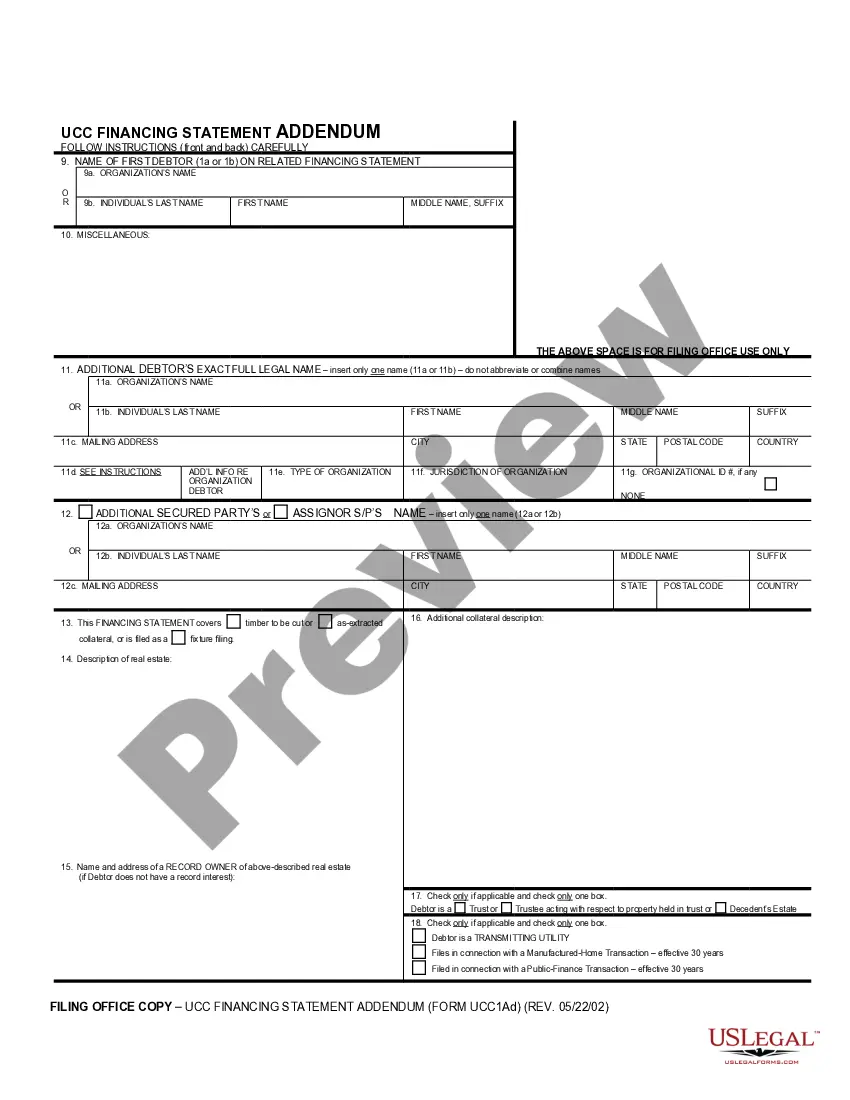
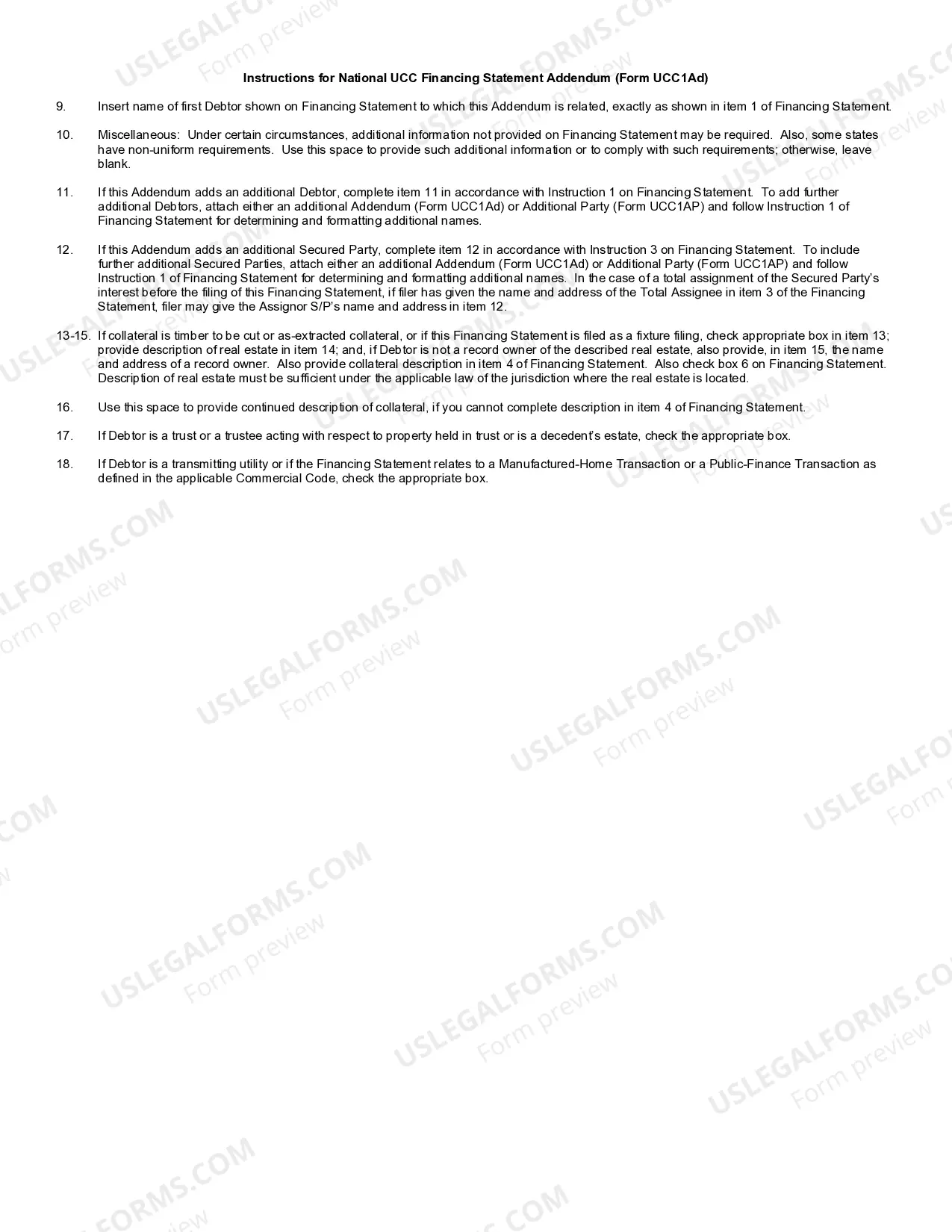
How to fill out UCC1-AD Financing Statement Addendum?
Whether for business purposes or for individual matters, everyone has to handle legal situations at some point in their life. Completing legal paperwork requires careful attention, beginning from selecting the appropriate form template. For instance, when you choose a wrong version of the Uniform Commercial Code Agreement Force Majeure, it will be rejected once you submit it. It is therefore essential to have a reliable source of legal documents like US Legal Forms.
If you have to obtain a Uniform Commercial Code Agreement Force Majeure template, stick to these easy steps:
- Get the sample you need by using the search field or catalog navigation.
- Examine the form’s description to ensure it matches your case, state, and county.
- Click on the form’s preview to view it.
- If it is the wrong form, go back to the search function to locate the Uniform Commercial Code Agreement Force Majeure sample you require.
- Download the file if it matches your needs.
- If you already have a US Legal Forms account, simply click Log in to gain access to previously saved documents in My Forms.
- In the event you don’t have an account yet, you can obtain the form by clicking Buy now.
- Choose the appropriate pricing option.
- Finish the account registration form.
- Pick your payment method: use a credit card or PayPal account.
- Choose the document format you want and download the Uniform Commercial Code Agreement Force Majeure.
- Once it is downloaded, you are able to complete the form with the help of editing applications or print it and complete it manually.
With a substantial US Legal Forms catalog at hand, you do not have to spend time seeking for the right sample across the internet. Use the library’s straightforward navigation to find the appropriate template for any occasion.
Form popularity
FAQ
What are the three elements of force majeure? In general, for an event to trigger a force majeure clause, it must be unforeseeable, external to the parties of the contract, and serious enough that it renders it impossible for the party to perform its contractual obligations.
Force majeure clause samples 10.2 The Party affected by Force Majeure shall not assume any liability under this Agreement. ... Section 15.12 Force Majeure. ... 6.4 If the agreement cannot be performed due to force majeure, the responsibility shall be exempted in part or in whole ing to the influence of force majeure.
What is an example of a force majeure event? Typical force majeure events include natural disasters (fire, storms, floods), governmental or societal actions (war, invasion, civil unrest, labor strikes), and infrastructure failures (transportation, energy).
Force majeure is a clause that is included in contracts to remove liability for unforeseeable and unavoidable catastrophes that interrupt the expected course of events and prevent participants from fulfilling obligations. These clauses generally cover both natural disasters and catastrophes created by humans.
Force majeure clauses set forth the circumstances in which a party owing a duty under the contract (the obligor) is excused from all or partial performance of that obligation, typically due to circumstances beyond the obligor's reasonable control.