Criminal Law With Example
Description

Get your form ready online
Our built-in tools help you complete, sign, share, and store your documents in one place.
Make edits, fill in missing information, and update formatting in US Legal Forms—just like you would in MS Word.
Download a copy, print it, send it by email, or mail it via USPS—whatever works best for your next step.
Sign and collect signatures with our SignNow integration. Send to multiple recipients, set reminders, and more. Go Premium to unlock E-Sign.
If this form requires notarization, complete it online through a secure video call—no need to meet a notary in person or wait for an appointment.
We protect your documents and personal data by following strict security and privacy standards.

Make edits, fill in missing information, and update formatting in US Legal Forms—just like you would in MS Word.

Download a copy, print it, send it by email, or mail it via USPS—whatever works best for your next step.

Sign and collect signatures with our SignNow integration. Send to multiple recipients, set reminders, and more. Go Premium to unlock E-Sign.

If this form requires notarization, complete it online through a secure video call—no need to meet a notary in person or wait for an appointment.

We protect your documents and personal data by following strict security and privacy standards.
Looking for another form?









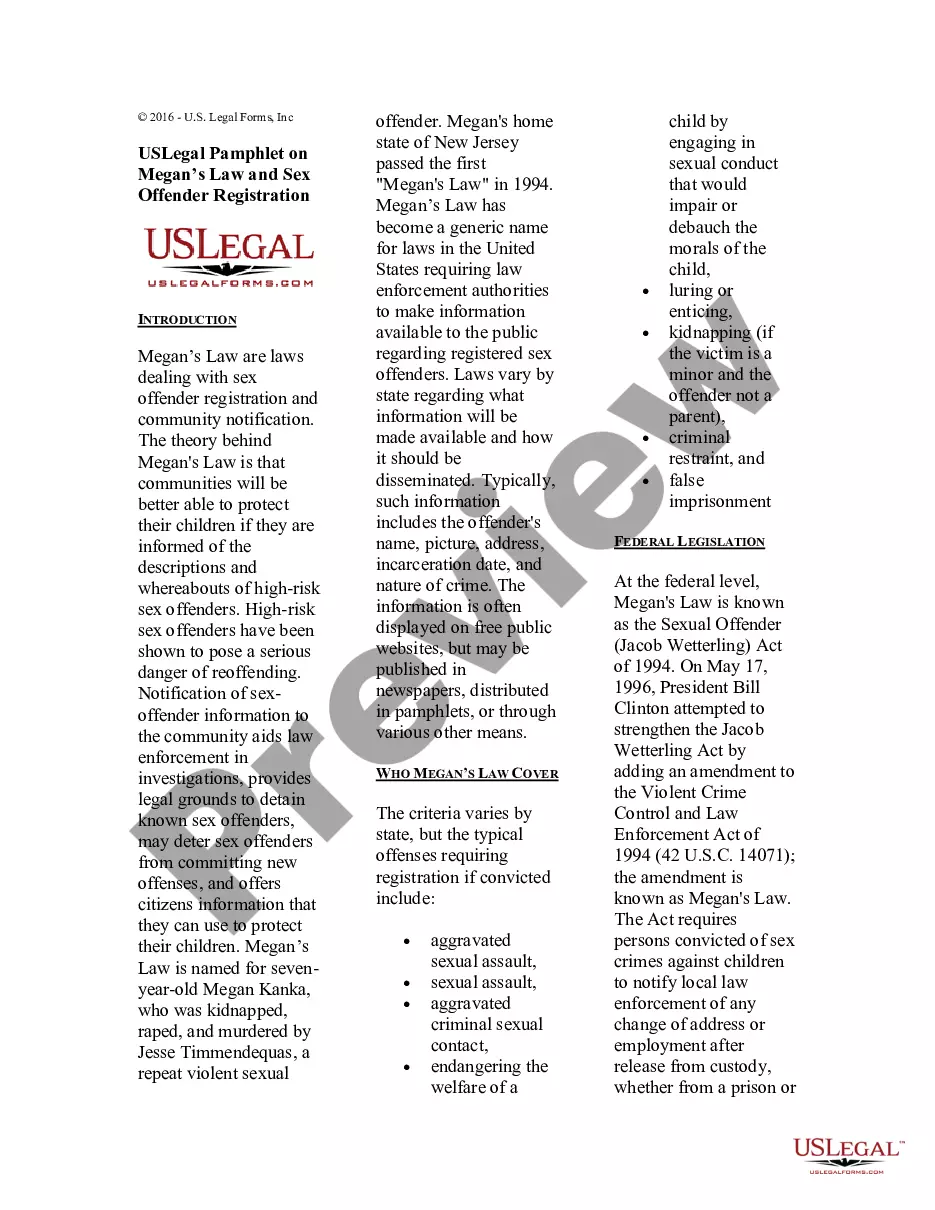
How to fill out USLegal Pamphlet On Megan's Law And Sex Offender Registration?
It's well-known that you cannot become a legal specialist in a single night, nor can you swiftly master how to draft Criminal Law With Example without possessing a specialized foundation.
Generating legal documents is a lengthy endeavor necessitating distinct education and expertise. So, why not entrust the development of the Criminal Law With Example to the experts.
With US Legal Forms, one of the most extensive legal template collections, you can discover everything from court documents to templates for internal communication.
You can retrieve your documents from the My documents section at any point. If you are a returning customer, you can simply Log In and locate and download the template from the same section.
Regardless of the intention behind your forms—whether financial, legal, or personal—our platform has you supported. Experience US Legal Forms today!
- Locate the document you require by utilizing the search bar located at the top of the webpage.
- Take a look at it (if this feature is available) and examine the accompanying description to determine if Criminal Law With Example meets your needs.
- Restart your search if you seek any additional forms.
- Establish a complimentary account and select a subscription option to acquire the form.
- Select Buy now. After processing the payment, you can obtain the Criminal Law With Example, fill it out, print it, and deliver or send it to the relevant individuals or organizations.
Form popularity
FAQ
The process of becoming a criminal lawyer typically takes about seven years. This includes four years for an undergraduate degree and an additional three years for law school. Afterward, you must pass the bar exam to practice law. This timeframe may vary depending on individual education paths and exam preparation.
To start your journey in criminal law, first focus on completing your undergraduate education, followed by attending law school. Engaging in relevant extracurricular activities, such as mock trial or debate, can also be beneficial. After law school, consider seeking internships or clerkships with law firms that specialize in criminal law, enhancing your practical skills and experience in real cases.
While there is no specific major required for a career in criminal law, many choose fields such as political science, criminal justice, or philosophy. These subjects can help build critical thinking and analytical skills essential for interpreting laws and courtroom procedures. Additionally, pursuing internships and relevant volunteer work can further strengthen your application to law school.
Entering the field of criminal law can be challenging, as it requires dedication and perseverance. You must achieve a law degree, pass the bar exam, and gain practical experience. Many aspiring criminal lawyers participate in internships or clinics to enhance their skills and understand the complexities of criminal law. For example, working with a public defender can provide valuable insights into real-world cases.
The five steps of a criminal case generally include the investigation, arrest, arraignment, trial, and sentencing. Initially, law enforcement investigates to gather evidence, leading to an arrest if warranted. The arraignment follows, where charges are formally presented. If the case goes to trial, both sides present evidence, followed by a verdict. Finally, if the defendant is found guilty, sentencing occurs, determining the punishment. Understanding these steps can empower you, and resources like uslegalforms are available to guide you through the process.
Criminal law defines actions considered illegal by society and outlines punishments for offenders. Examples include theft, assault, and drug offenses, which can lead to serious consequences if convicted. Understanding criminal law is essential for anyone facing legal issues. If you need specific advice or forms related to criminal law, platforms like uslegalforms can assist in navigating these complexities.
Pressing charges for assault can be a significant decision. Under criminal law, pressing charges can help prevent further incidents and hold the perpetrator accountable. Additionally, pursuing charges may allow you to seek restitution for damages and emotional distress. Evaluating the personal and legal implications is crucial, and discussing with a legal professional may provide clarity.
To press charges under criminal law, a certain level of evidence is necessary. Generally, law enforcement needs probable cause to believe that a crime has occurred. This does not require overwhelming evidence but rather enough to convince a reasonable person of the likelihood of a crime. If you're unsure, consulting with a legal expert can clarify what is needed.
The four criminal acts generally include theft, assault, robbery, and fraud. Each act represents a different type of violation against the law, leading to varying legal consequences. Recognizing these acts aids in understanding criminal law's role in maintaining order. If you seek further information on these topics, US Legal Forms can provide valuable assistance.
The four pillars of criminal law consist of the nature of crime, the legal proceedings involved, the role of punishment, and the concept of justice. Understanding these pillars helps clarify how laws operate and their impact on society. Each pillar supports the structure of effective legal systems. For clarity and guidance, consider using US Legal Forms as a reference.