Motion To Consolidate Sample For Trial
Description

Get your form ready online
Our built-in tools help you complete, sign, share, and store your documents in one place.
Make edits, fill in missing information, and update formatting in US Legal Forms—just like you would in MS Word.
Download a copy, print it, send it by email, or mail it via USPS—whatever works best for your next step.
Sign and collect signatures with our SignNow integration. Send to multiple recipients, set reminders, and more. Go Premium to unlock E-Sign.
If this form requires notarization, complete it online through a secure video call—no need to meet a notary in person or wait for an appointment.
We protect your documents and personal data by following strict security and privacy standards.

Make edits, fill in missing information, and update formatting in US Legal Forms—just like you would in MS Word.

Download a copy, print it, send it by email, or mail it via USPS—whatever works best for your next step.

Sign and collect signatures with our SignNow integration. Send to multiple recipients, set reminders, and more. Go Premium to unlock E-Sign.

If this form requires notarization, complete it online through a secure video call—no need to meet a notary in person or wait for an appointment.

We protect your documents and personal data by following strict security and privacy standards.
Looking for another form?



How to fill out Motion To Consolidate - Personal Injury?
Accessing legal document examples that conform to federal and state laws is essential, and the internet presents numerous alternatives to choose from.
However, what is the benefit of spending time searching for the suitable Motion To Consolidate Sample For Trial on the internet if the US Legal Forms online library already has such resources compiled in one location.
US Legal Forms is the largest online legal repository with over 85,000 editable templates created by attorneys for various business and personal scenarios. They are simple to navigate with all documents categorized by state and intended purpose.
All templates available through US Legal Forms are reusable. To re-download and complete previously acquired forms, access the My documents section in your profile. Enjoy the most extensive and user-friendly legal document service!
- Our specialists stay current with legal changes, ensuring that your form is always up-to-date and compliant when obtaining a Motion To Consolidate Sample For Trial from our site.
- Acquiring a Motion To Consolidate Sample For Trial is swift and straightforward for both existing and new users.
- If you already have an account with an active subscription, Log In and save the document template you need in your desired format.
- If you are a newcomer to our website, follow the steps outlined below.
- Study the template using the Preview feature or through the text outline to ensure it fits your needs.
Form popularity
FAQ
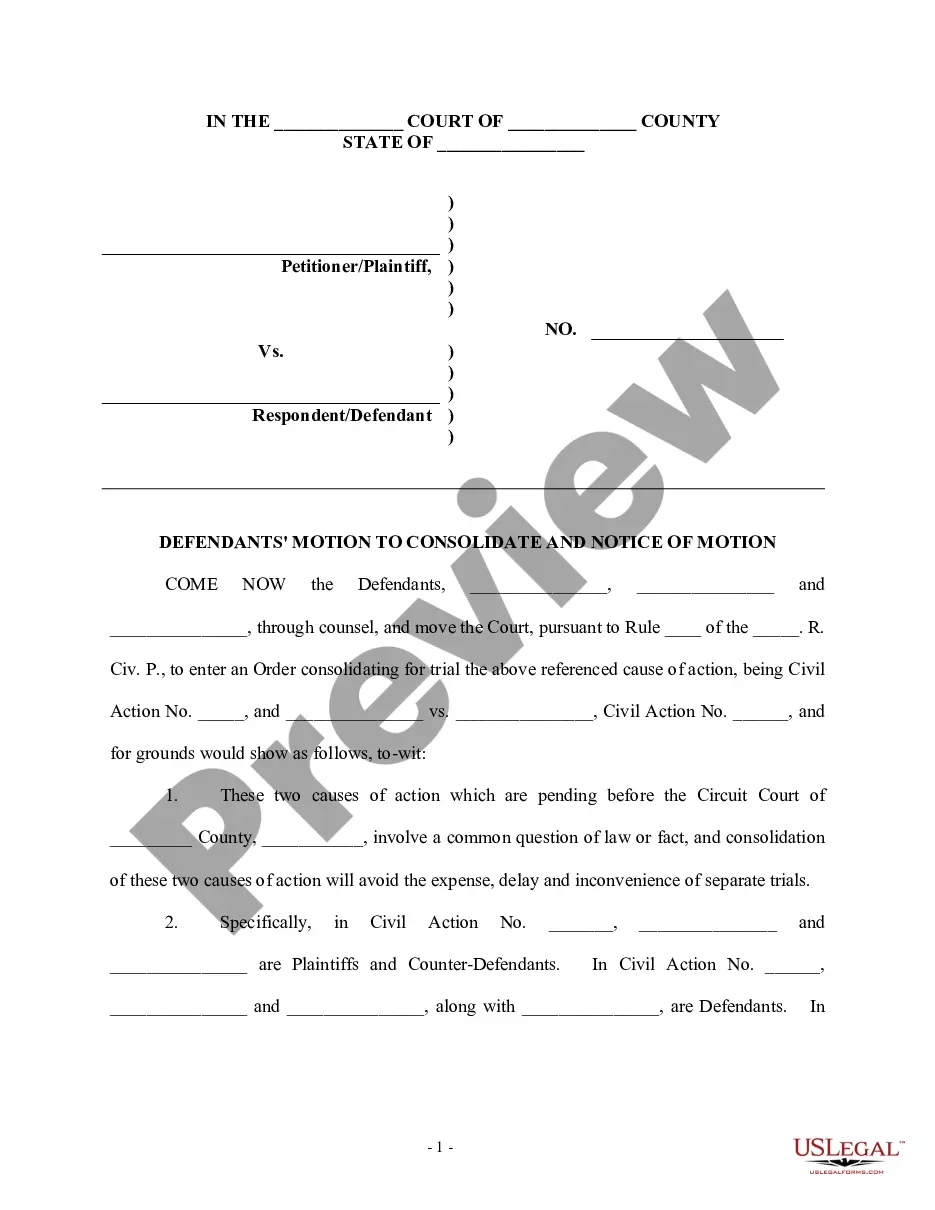
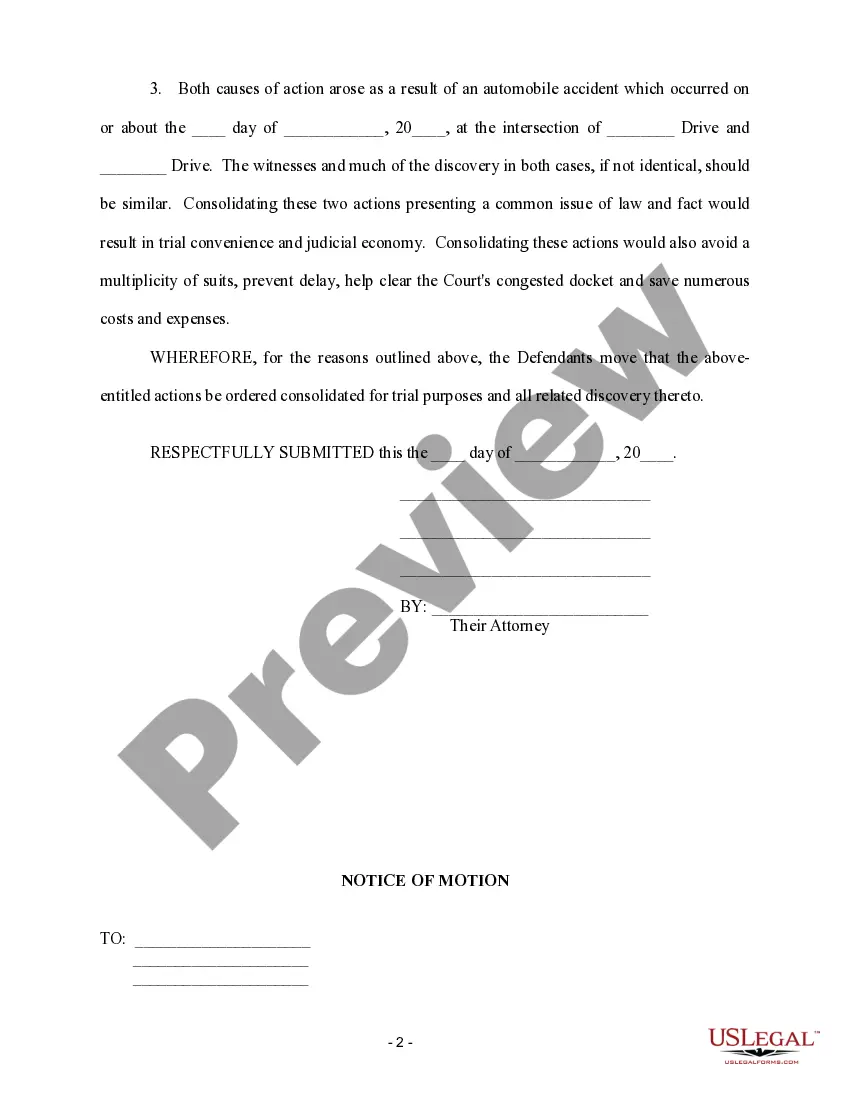
A motion for consolidation is a formal request to combine two or more cases that have similar issues. This motion aims to reduce the burden on the court and avoid inconsistent verdicts. By filing this motion, you streamline your legal strategy and promote judicial efficiency. If you need a clear example, a motion to consolidate sample for trial can help you visualize the format and necessary details.
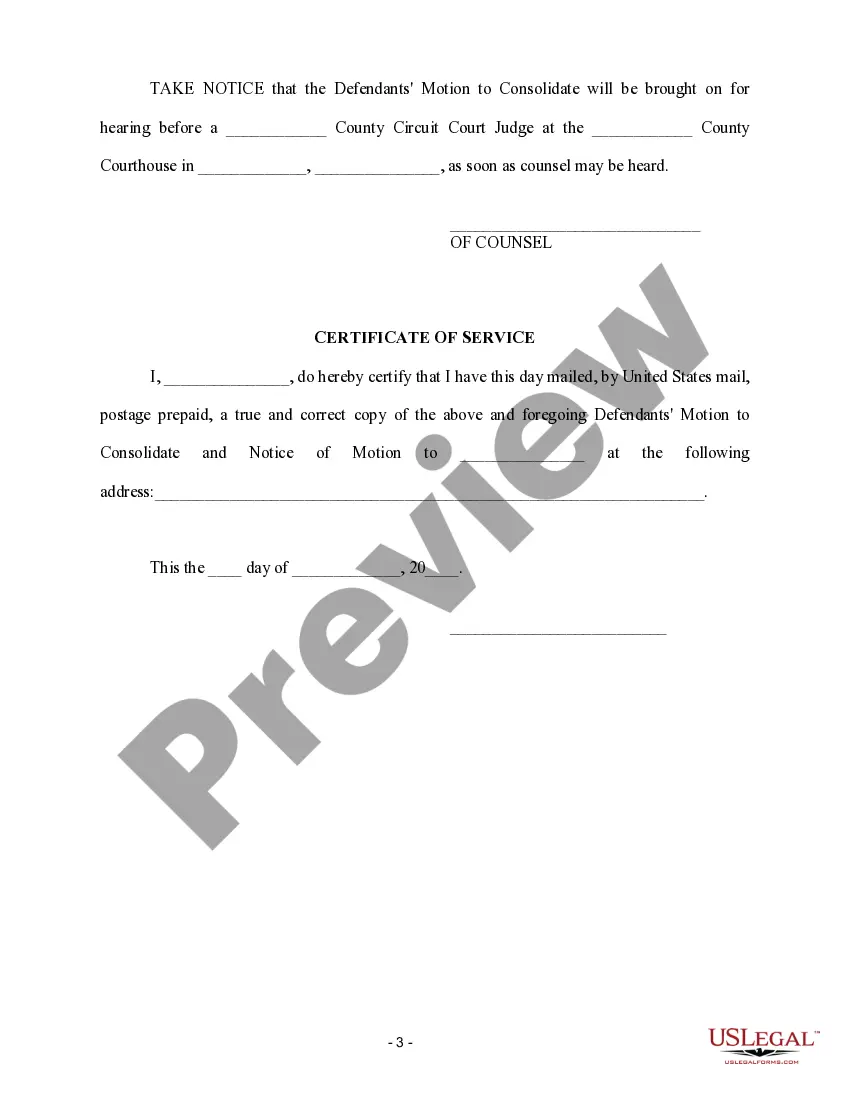
The process of consolidation starts with submitting a motion to the court, requesting that two or more cases be combined. You will need to provide reasons for the consolidation, demonstrating that it benefits all parties involved. The court will then review your motion, considering factors like judicial efficiency and fairness. A motion to consolidate sample for trial can guide you on what to include in your submission.
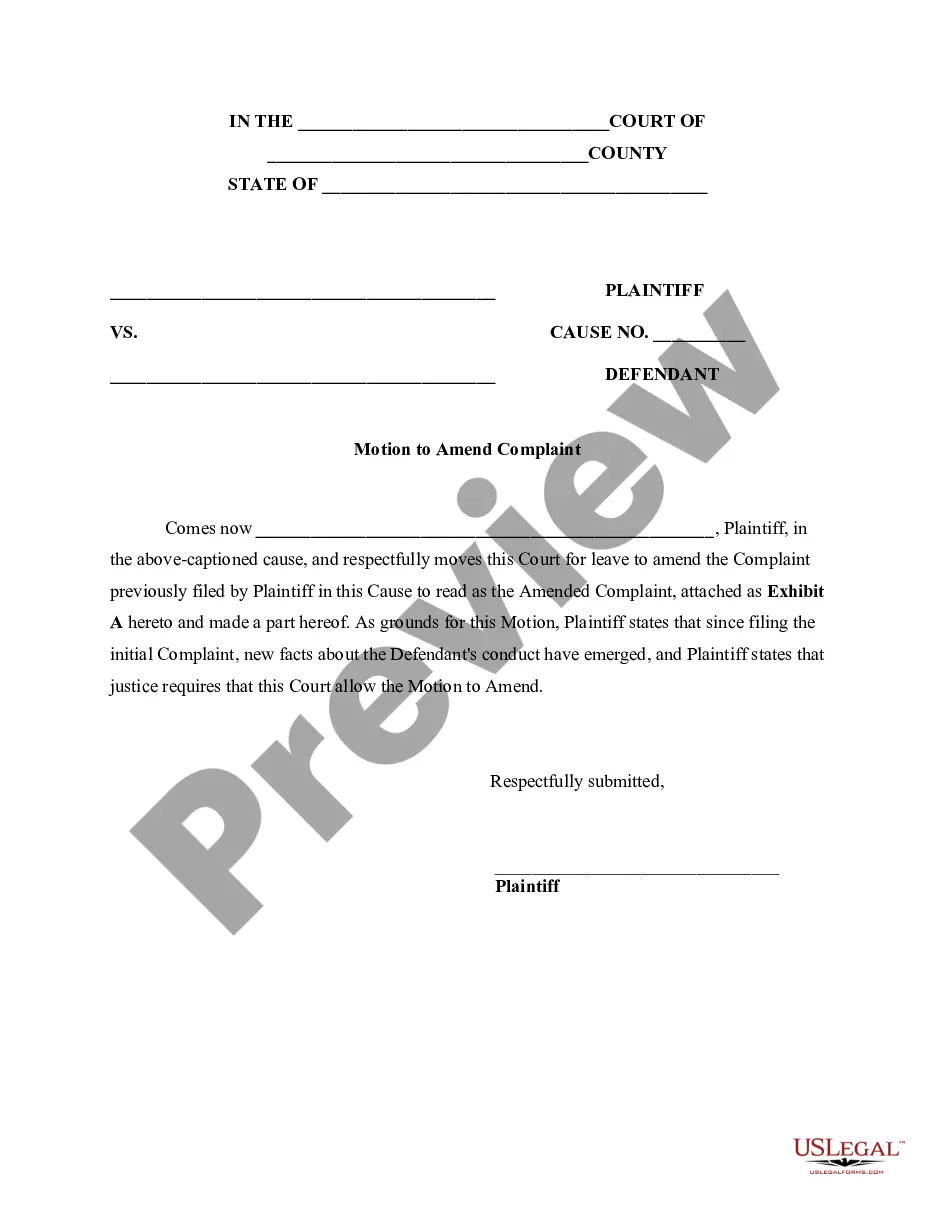
You should file a motion to consolidate when multiple cases share common questions of law or fact. This consolidation can streamline legal proceedings, saving time and resources. It's crucial to file this motion early, as waiting too long can complicate the process. Utilizing a motion to consolidate sample for trial can help you see how to structure your request effectively.
The federal rule for motion to consolidate is encapsulated in Rule 42 of the Federal Rules of Civil Procedure. This rule provides the parameters for merging lawsuits that have common facts or legal questions. For practical examples, examine a motion to consolidate sample for trial, as it can provide a clearer understanding of how to navigate this federal rule effectively.
A motion to consolidate means asking the court to merge separate lawsuits that share similar issues into a single case. This legal mechanism fosters consistency and efficiency, allowing related matters to be resolved together rather than individually. By referencing a motion to consolidate sample for trial, you can better grasp how this process can work in your favor during litigation.
The rule for consolidation of cases, as specified in Rule 42, outlines the procedure and criteria for combining cases. Courts typically consider factors such as judicial efficiency, convenience, and preventing inconsistent judgments. You can benefit from reviewing a motion to consolidate sample for trial to understand how to apply these criteria in your own legal strategy.
The rule 42 motion to consolidate is a formal request presented to the court, asking for multiple cases to be combined under Rule 42. This motion must establish that the cases have common questions of law or fact that warrant consolidation. Utilizing a motion to consolidate sample for trial can strengthen your position, helping you articulate compelling reasons for the court to grant consolidation.
Rule 42 within the court rules allows for the consolidation of cases to promote judicial efficiency. It permits parties to apply for consolidation when cases share critical issues, ensuring that resources are used effectively and that conflicting decisions are minimized. By reviewing a motion to consolidate sample for trial, you can gain insights into how Rule 42 can be applied to your own situation.
Rule 42 refers to the Federal Rules of Civil Procedure that govern the consolidation of cases. Specifically, it allows for joining two or more actions that involve a common question of law or fact. Understanding Rule 42 is crucial when preparing a motion to consolidate sample for trial, as it provides the legal framework for merging cases and can enhance your chances of success.
A motion to consolidate is a request made to the court to combine two or more related cases into a single proceeding. This is often done to streamline the judicial process, reduce duplication of effort, and achieve consistent outcomes. By using a motion to consolidate sample for trial, you can effectively present your case and demonstrate the benefits of consolidation, ensuring a more efficient resolution.