Motion To Consolidate Form For Court
Description

Get your form ready online
Our built-in tools help you complete, sign, share, and store your documents in one place.
Make edits, fill in missing information, and update formatting in US Legal Forms—just like you would in MS Word.
Download a copy, print it, send it by email, or mail it via USPS—whatever works best for your next step.
Sign and collect signatures with our SignNow integration. Send to multiple recipients, set reminders, and more. Go Premium to unlock E-Sign.
If this form requires notarization, complete it online through a secure video call—no need to meet a notary in person or wait for an appointment.
We protect your documents and personal data by following strict security and privacy standards.

Make edits, fill in missing information, and update formatting in US Legal Forms—just like you would in MS Word.

Download a copy, print it, send it by email, or mail it via USPS—whatever works best for your next step.

Sign and collect signatures with our SignNow integration. Send to multiple recipients, set reminders, and more. Go Premium to unlock E-Sign.

If this form requires notarization, complete it online through a secure video call—no need to meet a notary in person or wait for an appointment.

We protect your documents and personal data by following strict security and privacy standards.
Looking for another form?

How to fill out Motion To Consolidate - Personal Injury?
Whether for corporate reasons or for personal matters, everyone must confront legal circumstances at some stage in their lifetime.
Completing legal paperwork requires meticulous care, starting with selecting the correct form template.
With an extensive US Legal Forms catalog available, you do not have to waste time searching for the suitable template across the web. Take advantage of the library’s straightforward navigation to find the right template for any situation.
- Obtain the template you require by using the search bar or catalog browsing.
- Review the form’s description to ensure it aligns with your circumstances, state, and county.
- Click on the form’s preview to examine it.
- If it is not the right form, return to the search feature to find the Motion To Consolidate Form For Court sample that you need.
- Download the document if it satisfies your needs.
- If you already possess a US Legal Forms account, simply click Log in to access previously saved documents in My documents.
- In case you do not yet have an account, you may acquire the form by clicking Buy now.
- Choose the suitable pricing option.
- Complete the account registration form.
- Select your payment method: use a credit card or PayPal account.
- Choose the file format you prefer and download the Motion To Consolidate Form For Court.
- Once it is saved, you can complete the form using editing software or print it and finish it by hand.
Form popularity
FAQ
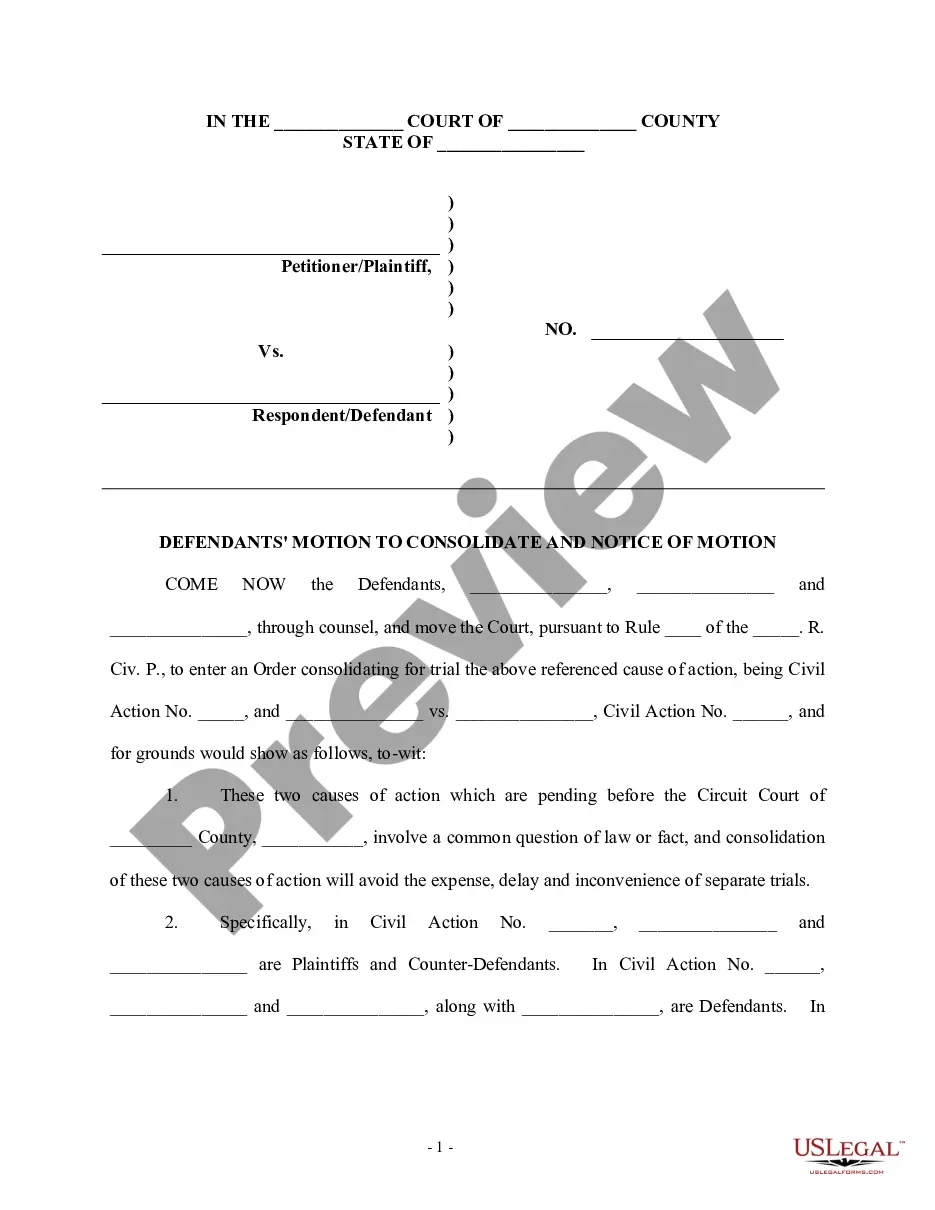
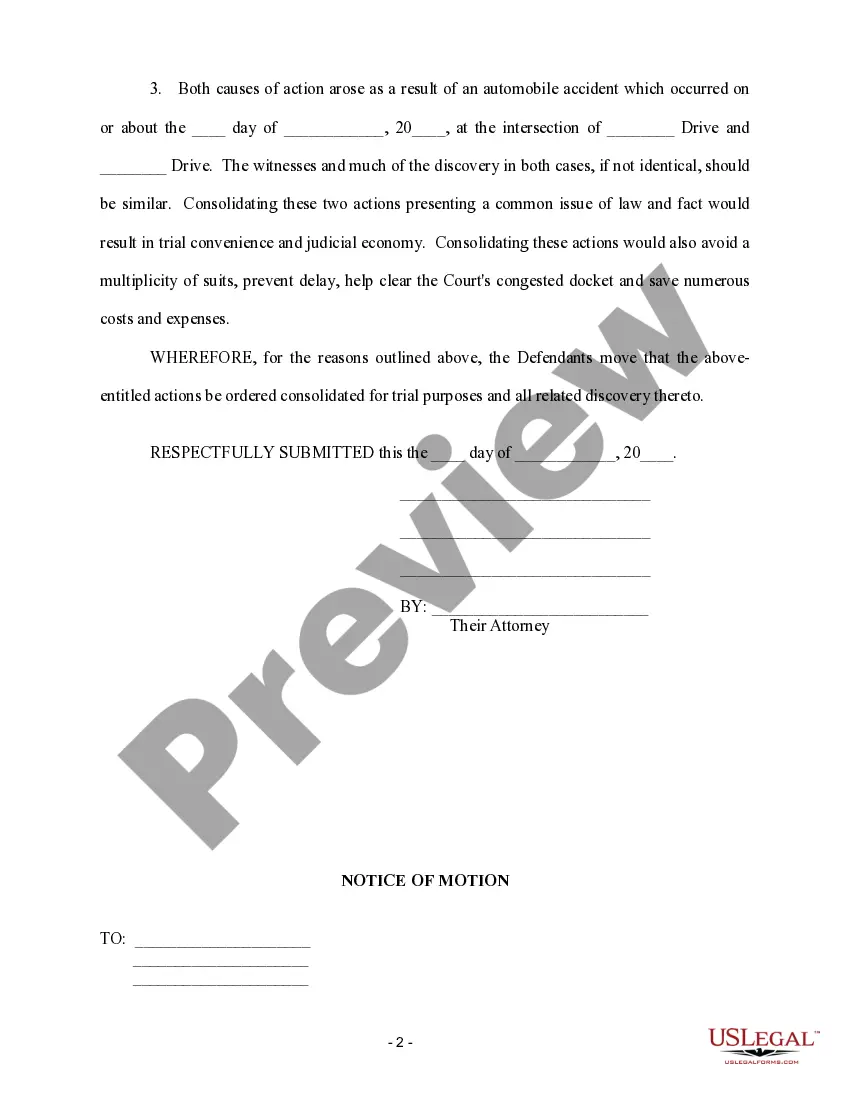
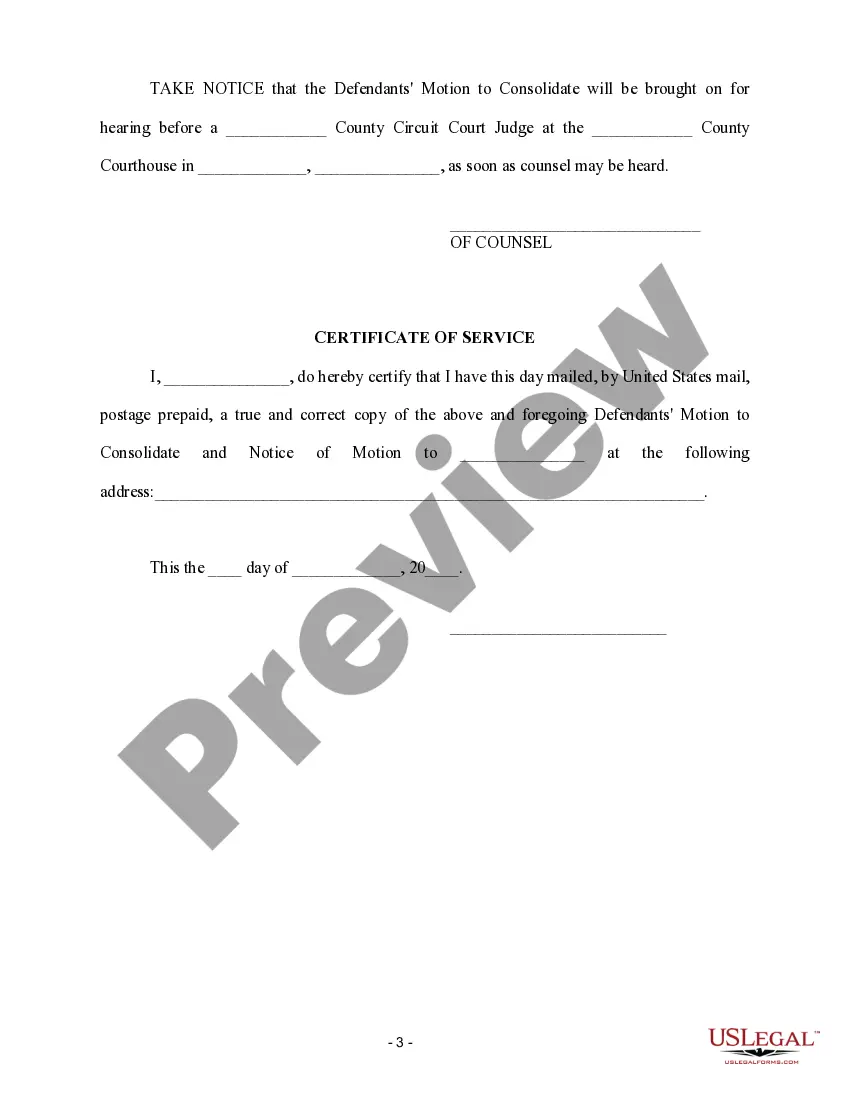
An order form consolidation refers to a document that a judge signs to officially combine multiple cases into one proceeding. This document outlines the decision to consolidate based on shared issues. To facilitate this, you may need to provide a motion to consolidate form for court, detailing your reasons for the request.
Rule 42a addresses the conditions under which cases may be consolidated in a court of law. It emphasizes ensuring judicial efficiency and consistent rulings across similar cases. If you're navigating this process, employing a motion to consolidate form for court can clarify your request and meet the specific requirements of Rule 42a.
Rule 42 of the Rules of Court pertains to the consolidation of actions with common questions of law or fact. It allows courts to merge proceedings for efficiency and judicial economy. If you need to file a motion for consolidation, utilizing a motion to consolidate form for court that aligns with Rule 42 can help strengthen your case.
Rule 4.03 (FRCP 42) Motions to Consolidate. A party desiring the consolidation of related cases shall file a motion in the case bearing the lowest cause number. The movant shall file in each related case a notice of the motion, to which a copy of the motion shall be attached.
Consolidation of cases is the administrative joining of separate cases into a single adjudication for all of the parties involved. Consolidation is generally limited to cases involving immediate family members.
A Motion to Consolidate is a request to combine the assets and liabilities of two or more debtors, which is in contrast to a Motion for Joint Administration which merely seeks to procedurally administer two or more cases together.
Code of Civil Procedure Section 1048(a) authorizes consolidation ?when actions involving a common question of law or fact are pending before the court, it may order a joint hearing or trial of any or all the matters in issue in the actions; it may order all the actions consolidated and it may make such orders ...
Courts usually consolidate cases to speed up the trial process and to eliminate duplicative trials involving the same parties, issues, and evidence.