Trade Secret Sample Former Employee
Description
Get your form ready online
Our built-in tools help you complete, sign, share, and store your documents in one place.
Make edits, fill in missing information, and update formatting in US Legal Forms—just like you would in MS Word.
Download a copy, print it, send it by email, or mail it via USPS—whatever works best for your next step.
Sign and collect signatures with our SignNow integration. Send to multiple recipients, set reminders, and more. Go Premium to unlock E-Sign.
If this form requires notarization, complete it online through a secure video call—no need to meet a notary in person or wait for an appointment.
We protect your documents and personal data by following strict security and privacy standards.

Make edits, fill in missing information, and update formatting in US Legal Forms—just like you would in MS Word.

Download a copy, print it, send it by email, or mail it via USPS—whatever works best for your next step.

Sign and collect signatures with our SignNow integration. Send to multiple recipients, set reminders, and more. Go Premium to unlock E-Sign.

If this form requires notarization, complete it online through a secure video call—no need to meet a notary in person or wait for an appointment.

We protect your documents and personal data by following strict security and privacy standards.
Looking for another form?




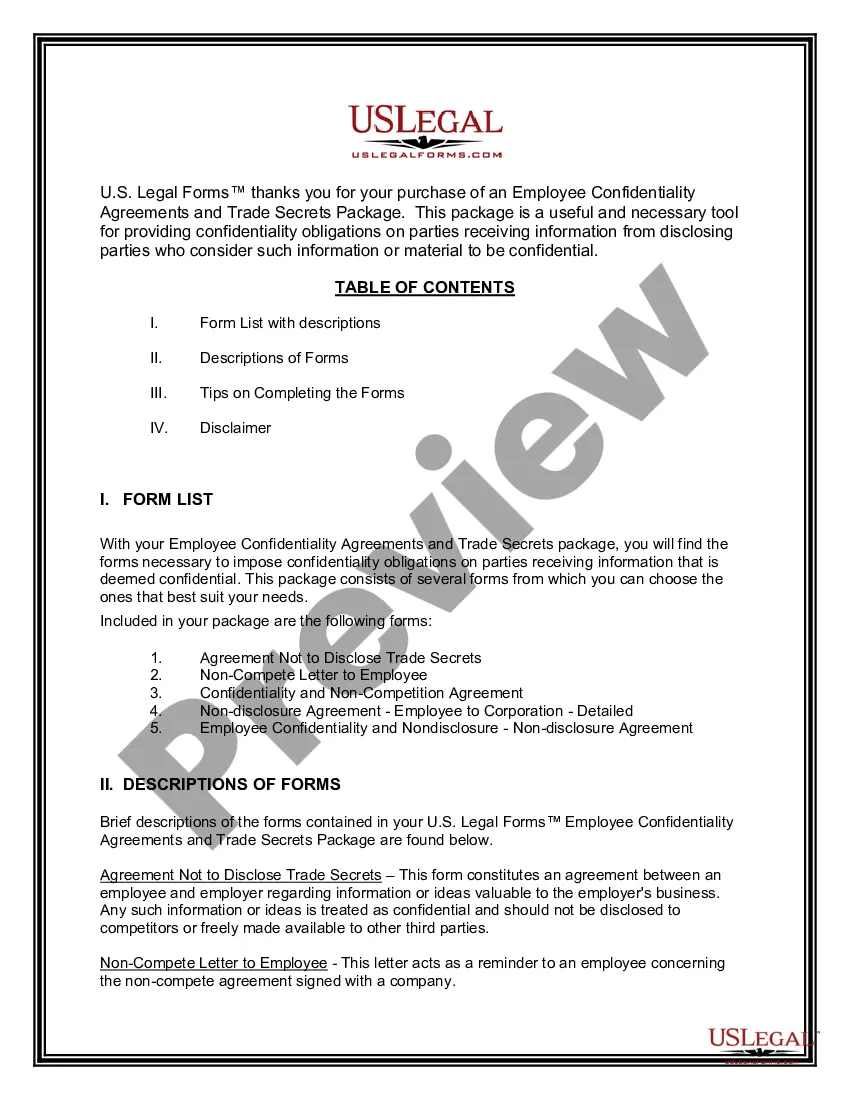
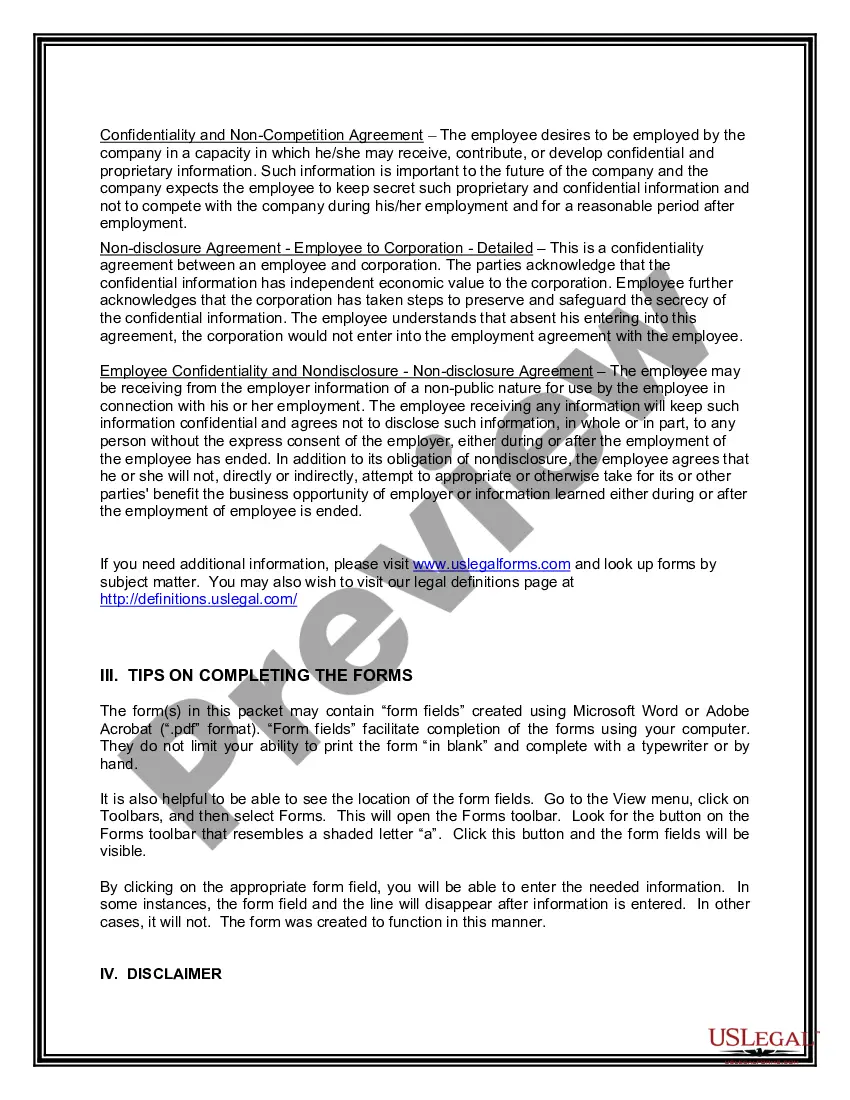
How to fill out Employee Confidentiality Agreements And Trade Secrets Package?
The Trade Secret Sample Previous Employee displayed on this page is a reusable official template created by expert attorneys in compliance with federal and local regulations.
For over 25 years, US Legal Forms has supplied individuals, enterprises, and lawyers with more than 85,000 confirmed, state-specific documents for any business and personal event. It’s the fastest, easiest, and most dependable method to acquire the paperwork you require, as the service ensures the utmost level of data protection and anti-virus security.
Subscribe to US Legal Forms to have verified legal templates for all of life's situations readily available.
- Search for the document you require and review it.
- Browse through the file you looked for and preview it or check the form description to verify it meets your requirements. If it does not, utilize the search feature to find the right one. Click Buy Now once you have identified the template you need.
- Register and Log In.
- Choose the pricing option that fits you and create an account. Use PayPal or a credit card to make a swift payment. If you already possess an account, Log In and verify your subscription to continue.
- Get the editable template.
- Pick the format you desire for your Trade Secret Sample Previous Employee (PDF, DOCX, RTF) and download the sample onto your device.
- Complete and sign the documents.
- Print the template to fill it out by hand. Alternatively, use an online versatile PDF editor to quickly and accurately fill and sign your form with an eSignature.
- Re-download your documents.
- Access the same document again whenever required. Open the My documents tab in your profile to redownload any previously purchased forms.
Form popularity
FAQ
To qualify as a trade secret, a business must ensure that the information derives independent economic value from not being publicly known. It is crucial that reasonable efforts are made to maintain its secrecy. Therefore, considering a trade secret sample former employee can highlight how such policies can protect valuable information.
Common examples of trade secrets include the Coca-Cola formula, Google’s search algorithm, and customer lists that provide competitive advantages. These types of information are crucial for business success and must be protected. A trade secret sample former employee can help you learn how to safeguard your proprietary information effectively.
In order for information to be protected as trade secret, it shall meet the following criteria. The information must be secret (i.e., it is not generally known among, or readily accessible, to circles that normally deal with the kind of information in question). Absolute secrecy is not required.
Having, following standard departure procedures Conducting an exit interview with the employee. Ensuring all company-provided materials are returned. Terminating access to confidential documents. Tracking and monitoring any unusual activity such as data requests and external communications.
Examples of trade secrets can include engineering information; methods, processes, and know-how; tolerances and formulas; business and financial information; computer programs (particularly source code) and related information; pending, unpublished patent applications; business plans; budgets; methods of calculating ...
Trade secrets encompass both technical information, such as information concerning manufacturing processes, pharmaceutical test data, designs and drawings of computer programs, and commercial information, such as distribution methods, list of suppliers and clients, and advertising strategies.
Breaches of non-disclosure agreements, industrial espionage, theft, fraud, and bribery are all improper means of acquiring a trade secret. For example, if you hack into a company's computer and copy the files, this act of acquiring the secrets improperly is misappropriation.