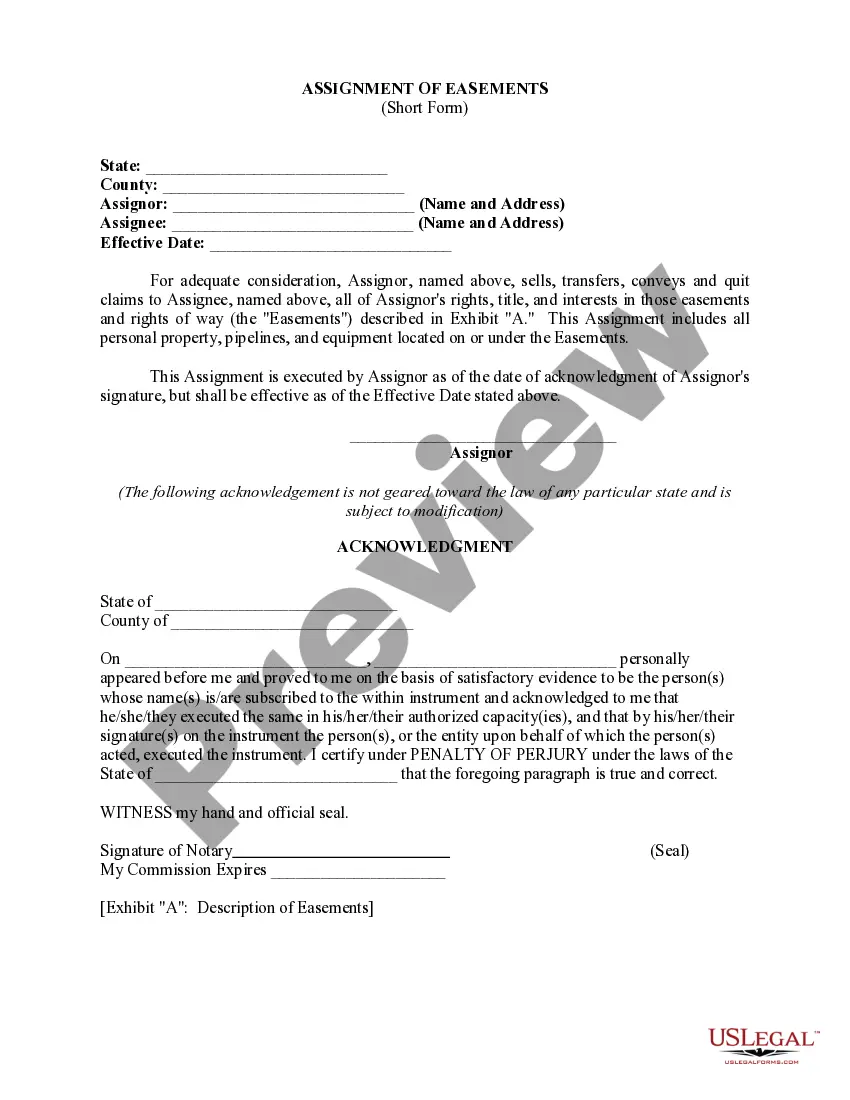
Assignment Of Easement Without A Contract
Description
Get your form ready online
Our built-in tools help you complete, sign, share, and store your documents in one place.
Make edits, fill in missing information, and update formatting in US Legal Forms—just like you would in MS Word.
Download a copy, print it, send it by email, or mail it via USPS—whatever works best for your next step.
Sign and collect signatures with our SignNow integration. Send to multiple recipients, set reminders, and more. Go Premium to unlock E-Sign.
If this form requires notarization, complete it online through a secure video call—no need to meet a notary in person or wait for an appointment.
We protect your documents and personal data by following strict security and privacy standards.

Make edits, fill in missing information, and update formatting in US Legal Forms—just like you would in MS Word.

Download a copy, print it, send it by email, or mail it via USPS—whatever works best for your next step.

Sign and collect signatures with our SignNow integration. Send to multiple recipients, set reminders, and more. Go Premium to unlock E-Sign.

If this form requires notarization, complete it online through a secure video call—no need to meet a notary in person or wait for an appointment.

We protect your documents and personal data by following strict security and privacy standards.
Looking for another form?










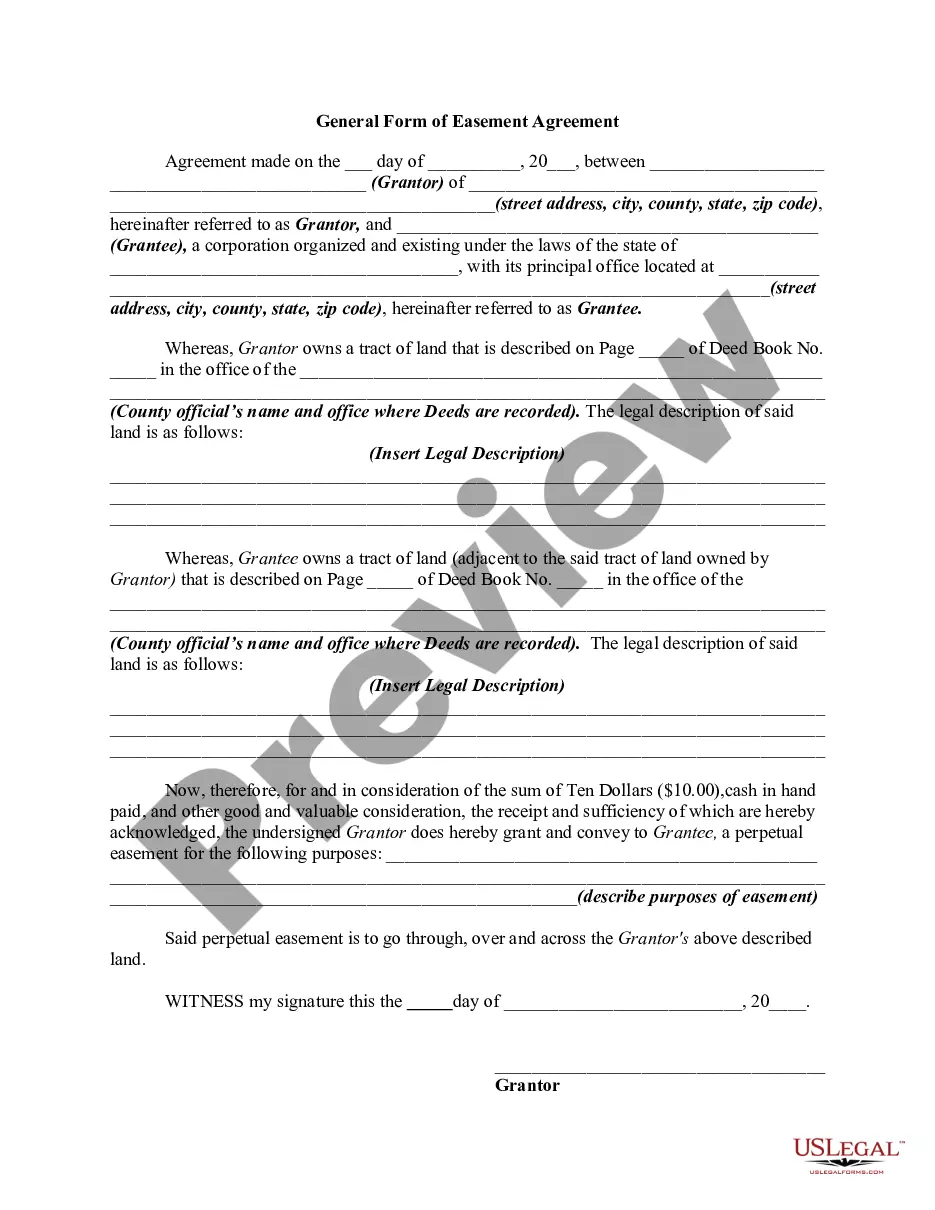
How to fill out Assignment Of Easements - Short Form?
Legal documentation management can be daunting, even for the most seasoned professionals.
If you need an Assignment Of Easement Without A Contract but lack the time to search for the appropriate and current version, the process can be stressful.
US Legal Forms meets all your needs, from personal to business documents, all in one convenient location.
Utilize advanced tools to fill out and manage your Assignment Of Easement Without A Contract.
Here are the steps to follow after obtaining the form you require: Verify that this is the correct form by previewing it and reviewing its description, confirm that the template is recognized in your state or county, click Buy Now when you are ready, choose a subscription plan, select your preferred format, then Download, complete, sign, print, and submit your documents. Take advantage of the US Legal Forms online catalog, supported by 25 years of expertise and reliability. Streamline your document management process today.
- Access a wealth of articles, guides, and resources related to your situation and requirements.
- Save time and effort searching for the documents you need, and take advantage of US Legal Forms’ sophisticated search and Review feature to locate and acquire your Assignment Of Easement Without A Contract.
- If you hold a subscription, Log In to your US Legal Forms account, find the form, and obtain it.
- Check your My documents tab to see the documents you've saved and organize your folders as desired.
- If it’s your first experience with US Legal Forms, create a free account for unlimited access to all the library's advantages.
- A comprehensive online form repository can significantly improve the experience for anyone looking to navigate these situations effectively.
- US Legal Forms is a leading provider in online legal documents, offering over 85,000 state-specific legal forms available to you at all times.
- With US Legal Forms, you can access legal and business forms tailored to your state or county requirements.
Form popularity
FAQ
There are eight ways to terminate an easement: abandonment, merger, end of necessity, demolition, recording act, condemnation, adverse possession, and release.
Elements of a Prescriptive Easement In California, a user of land may establish a prescriptive easement by proving that his or her use of another's land was: (1) continuous and uninterrupted for five years; (2) open and notorious; and (3) hostile. The first two requirements are relatively straightforward.
Sometimes homeowners want to understand if they can remove an easement from their property or can a property owner block an easement. If the intent is to prevent or obstruct the use of the easement, the answer is probably no. In Virginia, a specific statute addresses this last point.
In order to establish that there is an easement by prescription, the seeker of the easement must demonstrate(1) continuous use of the subservient estate, (2) for a statutory period, (3) that was open and notorious, and (4) hostile.
Some of the most common types of commercial easements in gross involve utility companies. Most commercial and residential properties have electric lines that run from the street to the property. Occasionally, the electric company may need to access those lines or other equipment on the property.