Right To Survivorship Meaning
Description
Get your form ready online
Our built-in tools help you complete, sign, share, and store your documents in one place.
Make edits, fill in missing information, and update formatting in US Legal Forms—just like you would in MS Word.
Download a copy, print it, send it by email, or mail it via USPS—whatever works best for your next step.
Sign and collect signatures with our SignNow integration. Send to multiple recipients, set reminders, and more. Go Premium to unlock E-Sign.
If this form requires notarization, complete it online through a secure video call—no need to meet a notary in person or wait for an appointment.
We protect your documents and personal data by following strict security and privacy standards.

Make edits, fill in missing information, and update formatting in US Legal Forms—just like you would in MS Word.

Download a copy, print it, send it by email, or mail it via USPS—whatever works best for your next step.

Sign and collect signatures with our SignNow integration. Send to multiple recipients, set reminders, and more. Go Premium to unlock E-Sign.

If this form requires notarization, complete it online through a secure video call—no need to meet a notary in person or wait for an appointment.

We protect your documents and personal data by following strict security and privacy standards.
Looking for another form?









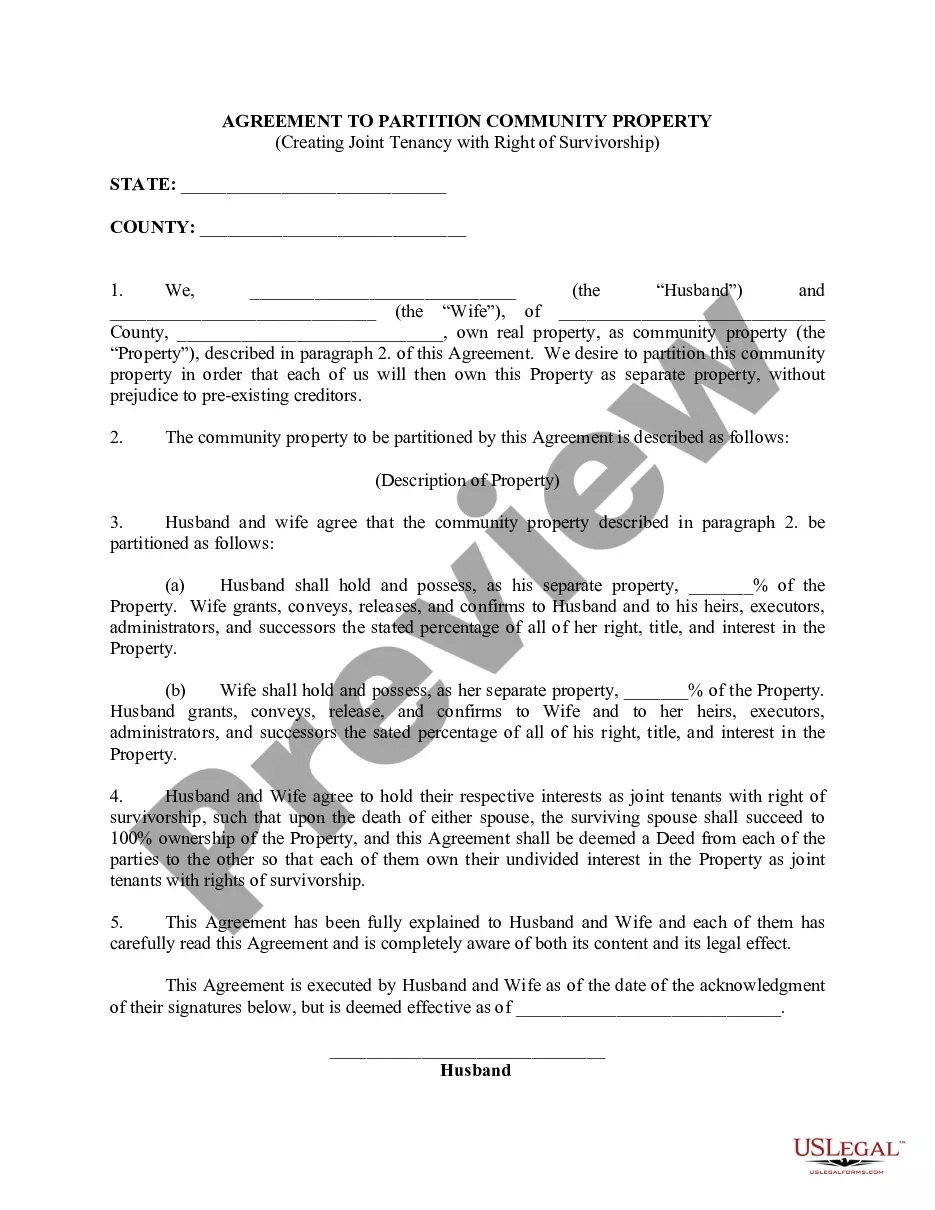
How to fill out Agreement To Partition Community Property Creating Joint Tenancy With Right Of Survivorship?
Regardless of whether it's for professional intents or personal matters, every individual encounters legal circumstances at some point in their life.
Completing legal documents requires meticulous attention, starting with selecting the correct form template.
With an extensive US Legal Forms library available, you will never have to waste time searching for the right template online. Utilize the library’s user-friendly navigation to locate the appropriate template for any situation.
- For instance, if you choose an incorrect version of a Right To Survivorship Definition, it will be rejected upon submission.
- Thus, it is crucial to obtain a reliable source for legal forms like US Legal Forms.
- Should you need to acquire a Right To Survivorship Definition template, adhere to these straightforward steps.
- Retrieve the template you require by employing the search bar or catalog navigation.
- Examine the form’s description to ensure it fits your scenario, state, and locality.
- Click on the form’s preview to review it.
- If it is the incorrect form, return to the search feature to find the Right To Survivorship Definition template you need.
- Download the template if it aligns with your specifications.
- If you presently possess a US Legal Forms account, just click Log in to access former documents in My documents.
- In case you do not yet have an account, you can download the form by clicking Buy now.
- Choose the suitable pricing option.
- Fill out the profile registration form.
- Choose your payment method: you can utilize a credit card or PayPal account.
- Pick the document format you prefer and download the Right To Survivorship Definition.
- Once it is downloaded, you can fill in the form using editing software or print it out and complete it by hand.
Form popularity
FAQ
When filling out a survivorship application, gather all necessary information about the property and the owners. Clearly state the intent to establish a right of survivorship in the application. Utilizing resources from US Legal Forms can help streamline this process, offering easy-to-follow instructions and ensuring you don’t miss any critical details.
Filling out a survivorship deed involves several key steps. Start by listing the names of all parties involved, and clearly state the right of survivorship in the document. Using platforms like US Legal Forms can simplify the process, providing templates and guidance to ensure your deed complies with local regulations.
To determine if you have the right of survivorship, check the property deed. If the deed specifies 'joint tenants with right of survivorship' or similar language, you likely possess this right. Understanding the right to survivorship meaning helps you recognize your legal standing and ensure your interests are protected.
An example of a right of survivorship occurs when two people own a property together as joint tenants. If one owner passes away, the surviving owner automatically receives full ownership of the property. This legal arrangement prevents the deceased owner's share from going through probate, illustrating the right to survivorship meaning in action.
To complete a survivorship application, first, gather all necessary documents that prove the relationship between the co-owners. Understanding the right to survivorship meaning is crucial, as it means that if one owner passes away, their share automatically transfers to the surviving owner. Next, fill out the appropriate forms, ensuring you provide accurate information regarding property ownership. If you need help, consider using US Legal Forms, which offers templates and guidance to simplify the process.
Yes, the right to survivorship meaning generally supersedes a will when it comes to jointly owned property. This means that if one owner passes away, their share automatically goes to the surviving owner, regardless of any instructions in a will. This automatic transfer can prevent disputes and delays in accessing the property. To learn more about how this works and to create your estate plan, consider using the US Legal Forms platform for reliable resources.
The right to survivorship meaning refers to a legal arrangement where co-owners of property automatically inherit each other's share upon death. In contrast, a beneficiary is designated in a will or trust to receive assets upon the owner's passing. With right of survivorship, property passes directly to the surviving owner without going through probate, which can simplify the transfer process. Understanding these distinctions can help you make informed decisions about your estate planning.
An example of the right of survivorship is when two siblings buy a house together, and the deed states they are joint tenants with this right. If one sibling passes away, the surviving sibling automatically becomes the sole owner of the house without going through probate. This practical illustration highlights the right to survivorship meaning in real-life scenarios.
To obtain a right of survivorship, ensure that all co-owners agree to hold the property as joint tenants. This agreement should be documented in the property deed using clear language that specifies the right of survivorship. Familiarizing yourself with the right to survivorship meaning can guide you through this process.
One disadvantage of the right of survivorship is that it can limit an owner's ability to transfer their share independently. This means that when one owner passes away, their share cannot be willed to someone else, which could lead to unintended consequences. Recognizing the right to survivorship meaning can help you weigh this against the benefits.