Phantom Stock Explained
Description
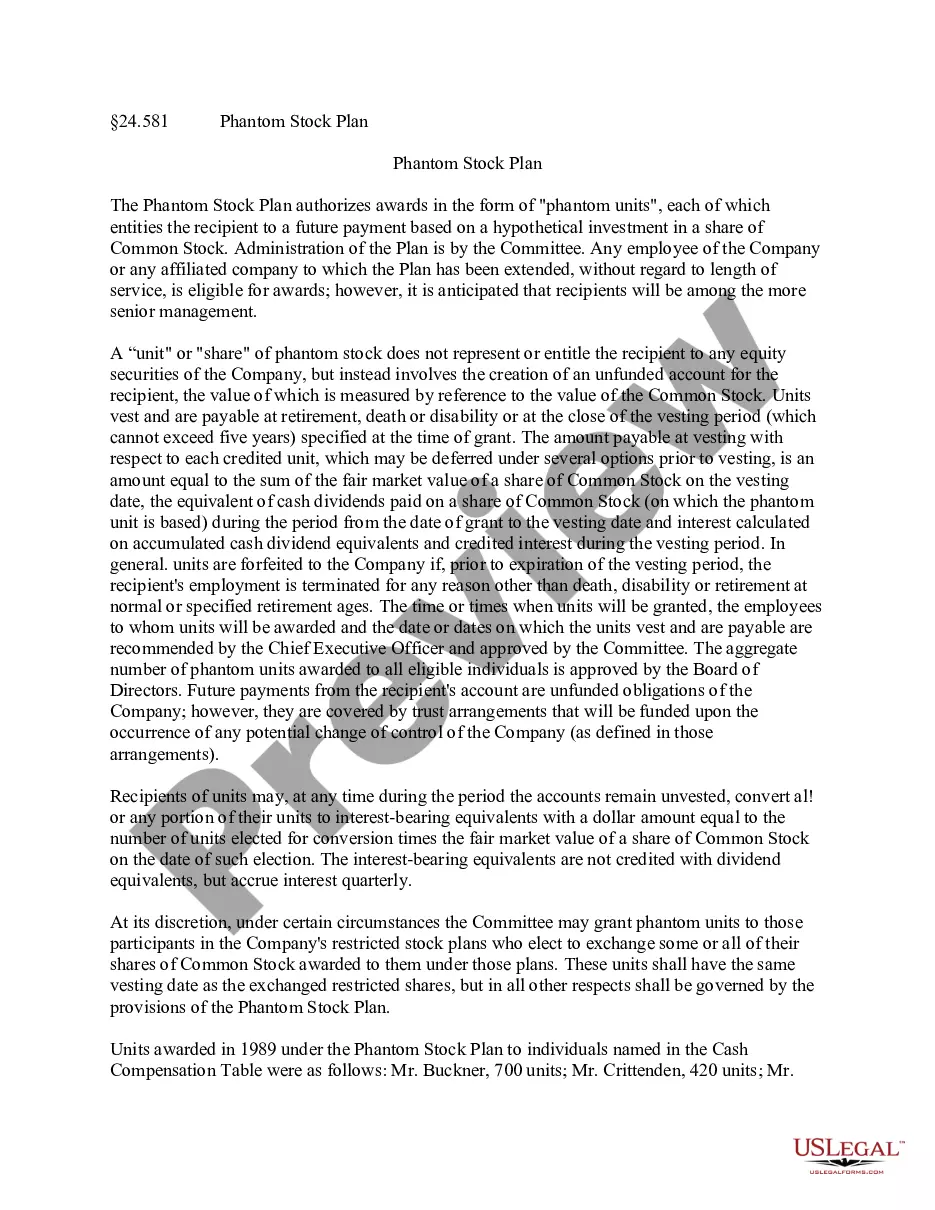





How to fill out Phantom Stock Plan Of Hercules, Inc.?
Whether for professional reasons or for private issues, everyone must confront legal circumstances at some stage in their life.
Completing legal documents necessitates meticulous focus, starting from choosing the appropriate template form.
Once it is saved, you can fill out the form using editing software or print it and complete it by hand. With a comprehensive US Legal Forms catalog available, you do not have to waste time searching for the suitable template online. Utilize the library's straightforward navigation to find the right template for any situation.
- Locate the template you require using the search box or catalog browsing.
- Review the form's details to ensure it suits your case, jurisdiction, and area.
- Click on the form's preview to examine it.
- If it is the incorrect document, return to the search option to find the Phantom Stock Explained example you seek.
- Download the file when it fulfills your needs.
- If you possess a US Legal Forms account, simply click Log in to access previously saved documents in My documents.
- If you do not have an account yet, you can acquire the form by clicking Buy now.
- Choose the appropriate pricing option.
- Complete the account registration form.
- Select your payment method: you can utilize a credit card or PayPal account.
- Choose the document format you prefer and download the Phantom Stock Explained.
Form popularity
FAQ
How do I write a Living Will in Vermont? Make the document - Provide a few simple details, and we will do the rest. Send and share it - Look over it with your healthcare agent or ask a lawyer. Sign and make it legal - Required or not, witnesses and notarization are a best practice.
Creating a Will in Vermont There are certain requirements which must be met for a will made in Vermont to be considered legal. The law requires that: The maker of the will (called the testator) be at least eighteen (18) years old and of sound mind. The will must be written.
The cost of creating a will in Vermont can range from roughly $250 to $1,000. A Vermont trust typically costs anywhere between $900 and $3,450. At Snug, any member can create a Power of Attorney and Health Care Directive for free. A Will costs $195 and a Trust costs $500.
Creating a Will in Vermont There are certain requirements which must be met for a will made in Vermont to be considered legal. The law requires that: The maker of the will (called the testator) be at least eighteen (18) years old and of sound mind. The will must be written.
No, in Vermont, you do not need to notarize your will to make it legal. However, Vermont allows you to make your will "self-proving" and you'll need to go to a notary if you want to do that. A self-proving will speeds up probate because the court can accept the will without contacting the witnesses who signed it.
Every individual 18 years of age or over or emancipated by court order who is of sound mind may make a will in writing. (Amended 2017, No. 195 (Adj. Sess.), § 1.)
You may file your will for safekeeping with the probate court in the county in which you reside. You may also file any amendments to the original will (codicils). There is a fee to file your will with the court. See the Probate section of the Fees web page for the amount.