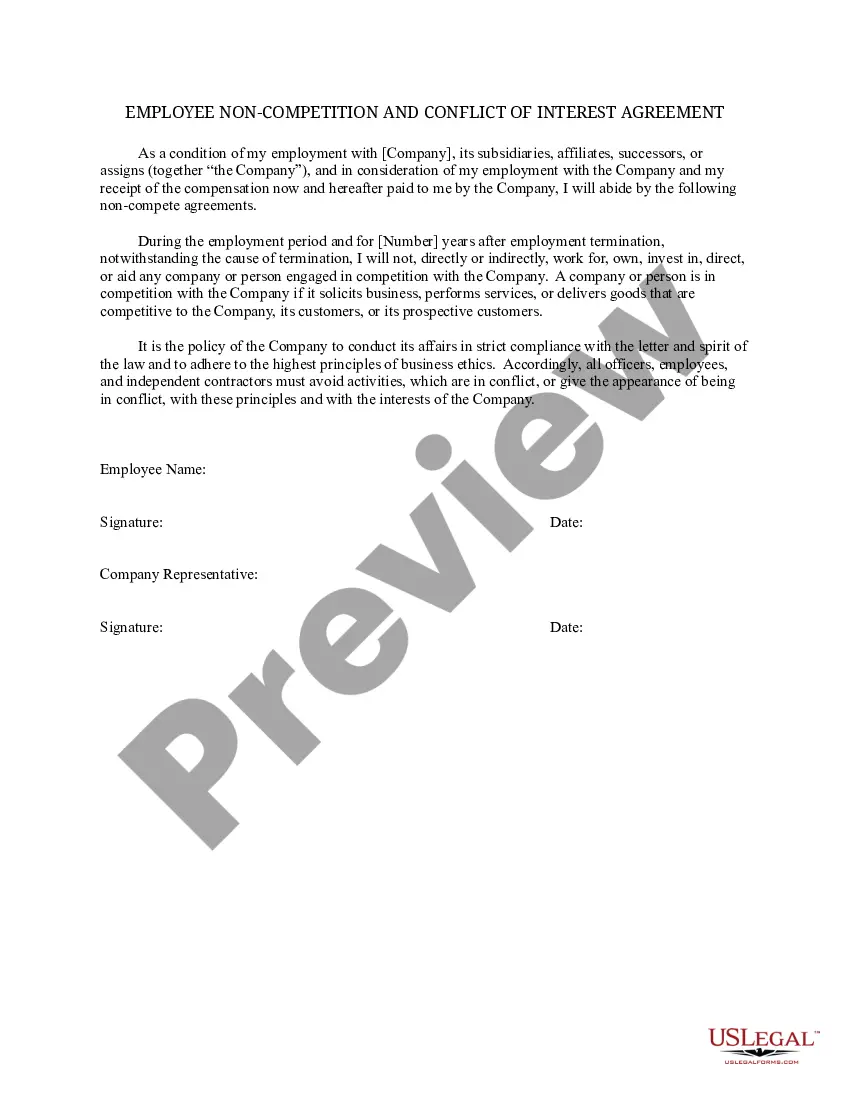
Conflict Interest Agreement Sample For Business
Description
Get your form ready online
Our built-in tools help you complete, sign, share, and store your documents in one place.
Make edits, fill in missing information, and update formatting in US Legal Forms—just like you would in MS Word.
Download a copy, print it, send it by email, or mail it via USPS—whatever works best for your next step.
Sign and collect signatures with our SignNow integration. Send to multiple recipients, set reminders, and more. Go Premium to unlock E-Sign.
If this form requires notarization, complete it online through a secure video call—no need to meet a notary in person or wait for an appointment.
We protect your documents and personal data by following strict security and privacy standards.

Make edits, fill in missing information, and update formatting in US Legal Forms—just like you would in MS Word.

Download a copy, print it, send it by email, or mail it via USPS—whatever works best for your next step.

Sign and collect signatures with our SignNow integration. Send to multiple recipients, set reminders, and more. Go Premium to unlock E-Sign.

If this form requires notarization, complete it online through a secure video call—no need to meet a notary in person or wait for an appointment.

We protect your documents and personal data by following strict security and privacy standards.
Looking for another form?









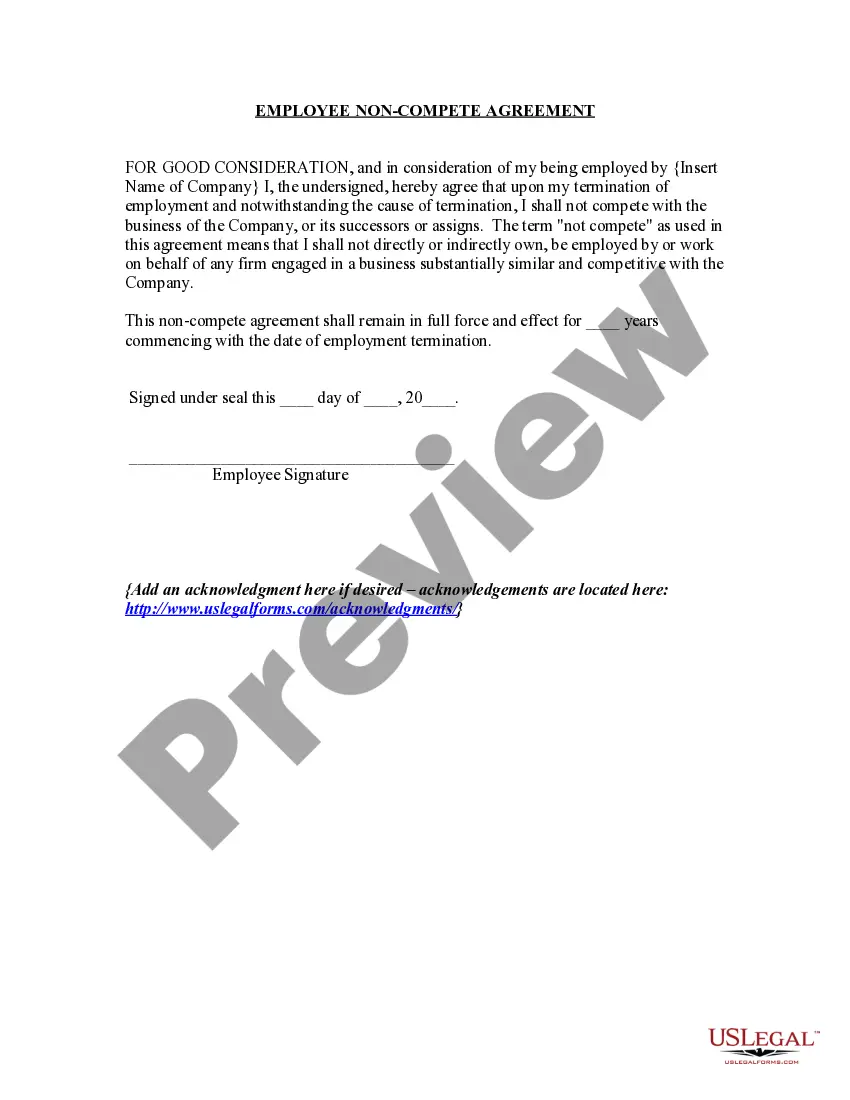
How to fill out Employee Noncompetition And Conflict Of Interest Agreement?
Regardless of whether it is for corporate reasons or personal affairs, everyone must confront legal matters at some point in their lives.
Completing legal forms requires meticulous consideration, starting from selecting the appropriate template example.
Once it is saved, you can either fill out the form using editing software or print it to complete it manually. With a vast catalog from US Legal Forms available, you never need to waste time searching for the ideal template online. Utilize the library’s straightforward navigation to find the correct document for any situation.
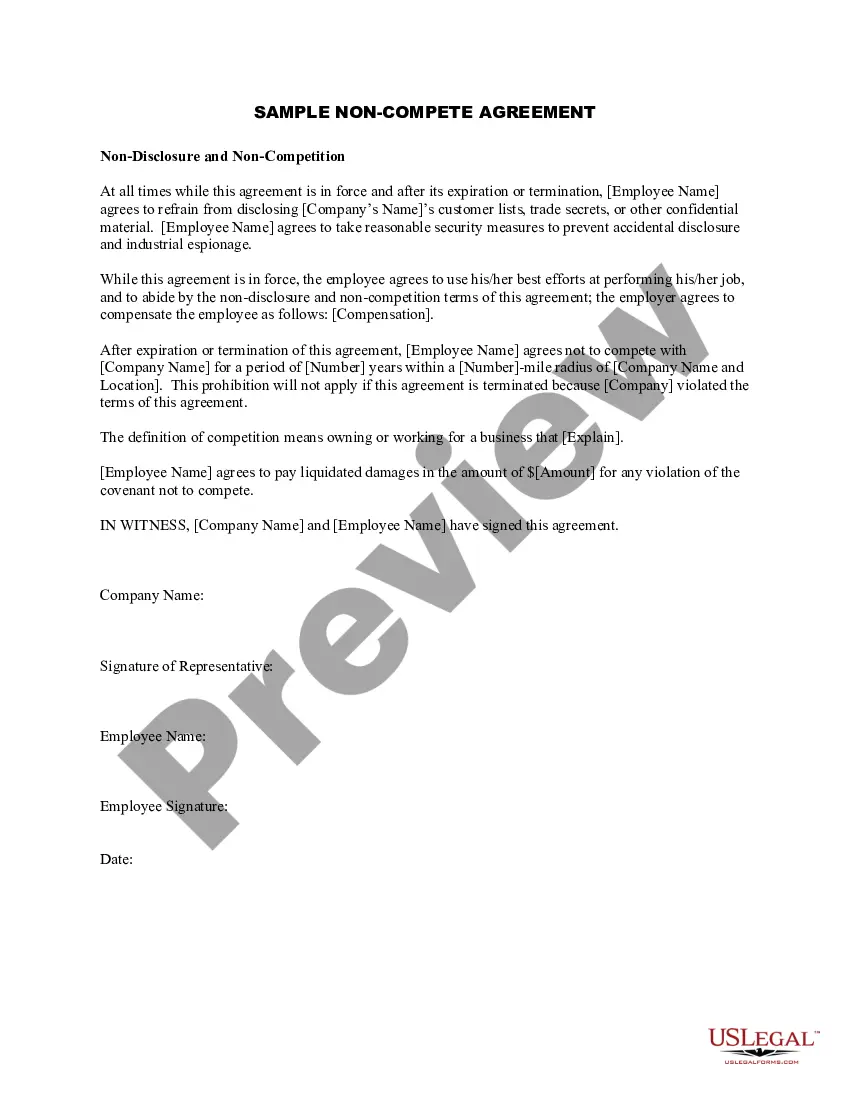
- For example, if you choose the incorrect variant of a Conflict Interest Agreement Example For Business, it will be rejected once submitted.
- Thus, it is crucial to find a trustworthy source for legal documents like US Legal Forms.
- If you need a Conflict Interest Agreement Example For Business document, adhere to these straightforward instructions.
- 1. Search for the required template using the search bar or catalog navigation.
- 2. Review the form’s description to ensure it aligns with your situation, state, and county.
- 3. Click on the form’s preview to inspect it.
- 4. If it is the wrong document, return to the search tool to find the Conflict Interest Agreement Example For Business document you need.
- 5. Obtain the file if it fulfills your requirements.
- 6. If you possess a US Legal Forms account, click Log in to access any previously saved files in My documents.
- 7. If you do not yet have an account, you can download the form by clicking Buy now.
- 8. Choose the appropriate pricing option.
- 9. Complete the account registration form.
- 10. Choose your payment method: a credit card or PayPal account.
- 11. Select the file format you prefer and download the Conflict Interest Agreement Example For Business.
Form popularity
FAQ
For example, if Jenna is a manager at Great Bird Feeders but she is also freelancing on the side for their competitor Best Bird Feeders, she has a conflict of interest because she's splitting her loyalties between two competing companies.
How to Manage Conflicts of Interest 1) Identify Conflicts of Interest. The first step in managing an employee's conflict of interest is to identify it. ... 2) Understand the Implications. ... 3) Inform the Employee. ... 4) Separate The Employee From The Conflict. ... 5) If All Else Fails, Terminate.
State the reasons why you think these interests could, or could be seen to, influence your decisions, actions or advice. Finally, set out the steps you intend to take, or which you may require others in the department to take, to mitigate any conflict arising. Attach supporting documentation if required.
Performing evaluative research for a company in which the investigator has a financial interest. Accepting a paid consultancy with a company having an interest in your research. Using students to perform services for a company in which you have a financial interest.
Some examples of a conflict of interest could be: Representing a family member in court. Starting a business that competes with your full-time employer. Advising a client to invest in a company owned by your spouse.