Health Civil Rights With Mental
Description

Get your form ready online
Our built-in tools help you complete, sign, share, and store your documents in one place.
Make edits, fill in missing information, and update formatting in US Legal Forms—just like you would in MS Word.
Download a copy, print it, send it by email, or mail it via USPS—whatever works best for your next step.
Sign and collect signatures with our SignNow integration. Send to multiple recipients, set reminders, and more. Go Premium to unlock E-Sign.
If this form requires notarization, complete it online through a secure video call—no need to meet a notary in person or wait for an appointment.
We protect your documents and personal data by following strict security and privacy standards.

Make edits, fill in missing information, and update formatting in US Legal Forms—just like you would in MS Word.

Download a copy, print it, send it by email, or mail it via USPS—whatever works best for your next step.

Sign and collect signatures with our SignNow integration. Send to multiple recipients, set reminders, and more. Go Premium to unlock E-Sign.

If this form requires notarization, complete it online through a secure video call—no need to meet a notary in person or wait for an appointment.

We protect your documents and personal data by following strict security and privacy standards.
Looking for another form?

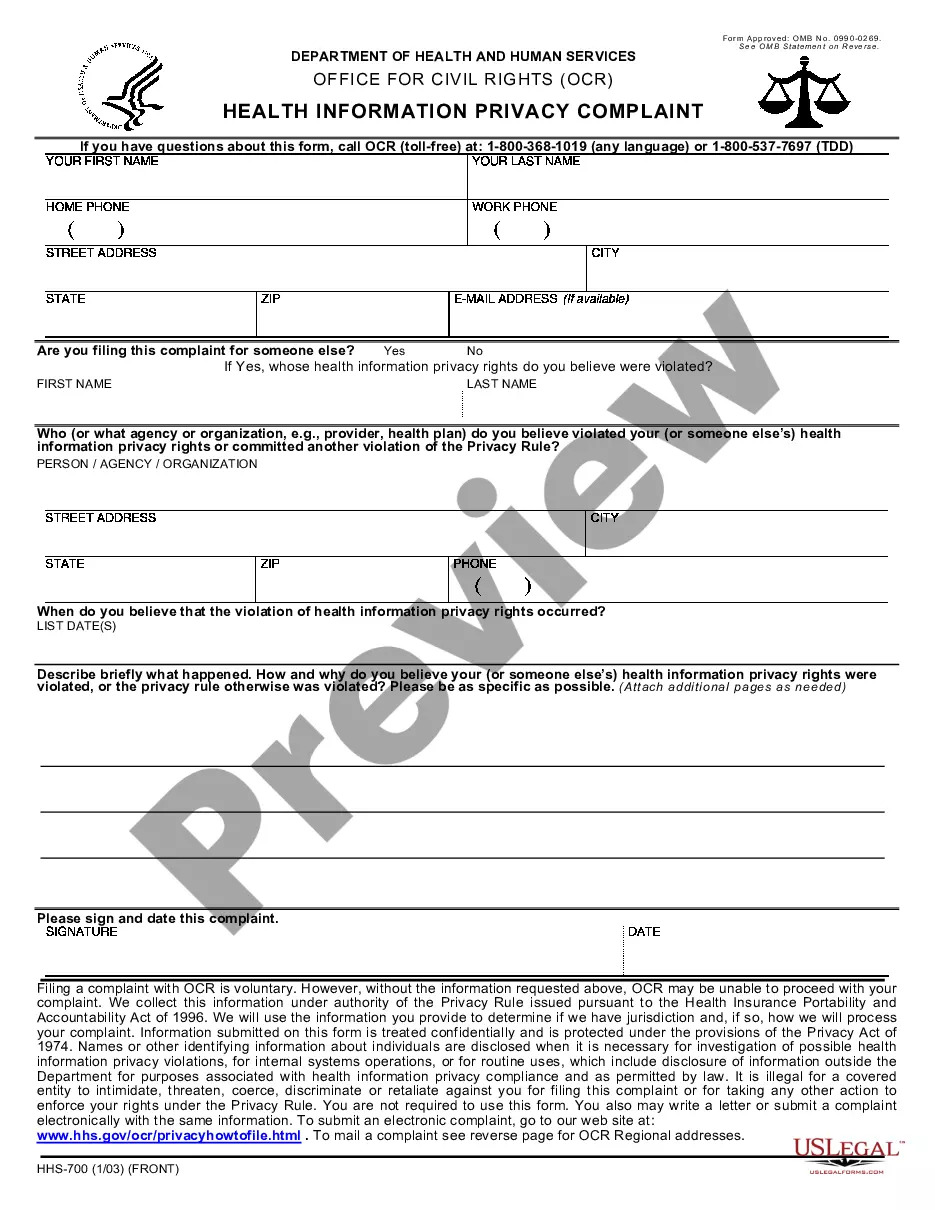
How to fill out Health Information Privacy Complaint For Filing With Dept. Of Health And Human Services Office Of Civil Rights?
Locating a reliable source to obtain the latest and suitable legal templates is a significant part of navigating bureaucracy.
Identifying the appropriate legal documents requires precision and careful consideration, which is why it is crucial to gather samples of Health Civil Rights With Mental exclusively from trustworthy sources, such as US Legal Forms.
Once the form is on your device, you can modify it using the editor or print it and fill it out manually. Eliminate the frustration associated with your legal paperwork. Explore the comprehensive US Legal Forms database where you can discover legal templates, assess their suitability for your situation, and download them immediately.
- Use the library navigation or search function to locate your template.
- Examine the form’s details to ensure it aligns with the requirements of your state and region.
- View the form preview, if available, to confirm that the form is indeed the one you need.
- Return to the search and locate the correct template if the Health Civil Rights With Mental does not fulfill your needs.
- If you are confident in the form’s suitability, download it.
- If you are a registered user, click Log in to verify and access your selected templates in My documents.
- If you do not have an account yet, click Buy now to acquire the template.
- Choose the pricing option that best fits your requirements.
- Complete the registration to finalize your purchase.
- Finish your purchase by selecting a payment method (credit card or PayPal).
- Select the document format for downloading Health Civil Rights With Mental.
Form popularity
FAQ
The Right to Humane Care You have the right to dignity, privacy, and humane care. You also have the right to treatment services that pro- mote your potential to function independently. Treatment must be provided in ways that are least restrictive to you.
If you disagree with your doctor about your diagnosis or treatment, you can tell them why. You can give your doctor more information to see if they will change their mind. You can ask for a second opinion, but you have no legal right to one.
Ask your doctor why they think you don't need a second opinion. If you still feel that you need one, try to clear up any misunderstandings and ask again. Be clear and specific with your reasons as to why you don't agree with the original opinion.
To diagnose a mental health problem, doctors will look at: your experiences (groupings of certain feelings, behaviours and physical symptoms may suggest different diagnoses) how long you've been experiencing these things. the impact it's having on your life.
People living with mental health conditions have the right to make decisions about their lives, including their treatment. Just as all Americans, they should be assumed competent to make their own decisions, and a refusal of any type of treatment should not be considered evidence that a person is incompetent.