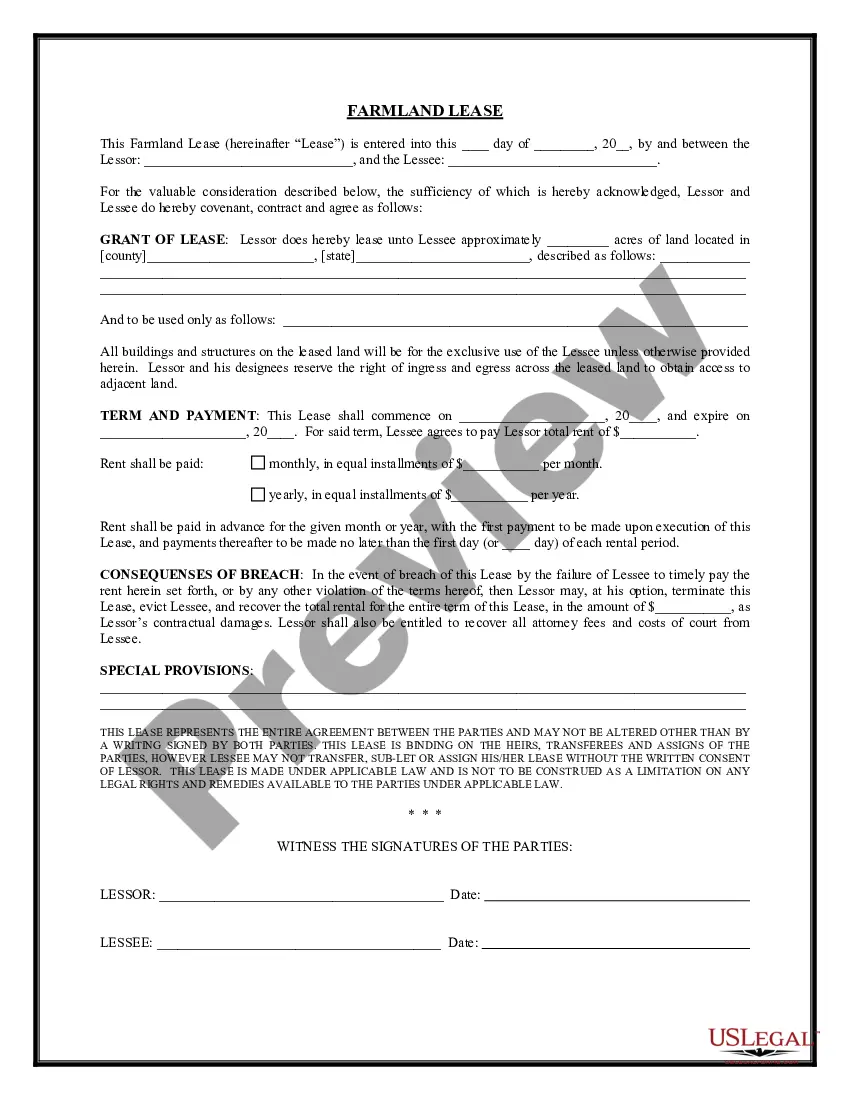
Farm Lease Dates
Description
Get your form ready online
Our built-in tools help you complete, sign, share, and store your documents in one place.
Make edits, fill in missing information, and update formatting in US Legal Forms—just like you would in MS Word.
Download a copy, print it, send it by email, or mail it via USPS—whatever works best for your next step.
Sign and collect signatures with our SignNow integration. Send to multiple recipients, set reminders, and more. Go Premium to unlock E-Sign.
If this form requires notarization, complete it online through a secure video call—no need to meet a notary in person or wait for an appointment.
We protect your documents and personal data by following strict security and privacy standards.

Make edits, fill in missing information, and update formatting in US Legal Forms—just like you would in MS Word.

Download a copy, print it, send it by email, or mail it via USPS—whatever works best for your next step.

Sign and collect signatures with our SignNow integration. Send to multiple recipients, set reminders, and more. Go Premium to unlock E-Sign.

If this form requires notarization, complete it online through a secure video call—no need to meet a notary in person or wait for an appointment.

We protect your documents and personal data by following strict security and privacy standards.
Looking for another form?









How to fill out Simple Farm Lease Or Rental?
Finding a reliable location to obtain the most up-to-date and pertinent legal samples is part of the challenge of navigating bureaucracy.
Selecting the appropriate legal documents necessitates precision and careful attention, which is why it is essential to source Farm Lease Dates exclusively from trustworthy providers, such as US Legal Forms. An incorrect template could squander your time and prolong your situation.
After you have the form on your device, you can edit it using the editor or print and fill it out manually. Eliminate the stress that comes with your legal documentation. Browse the extensive US Legal Forms catalog where you can discover legal samples, evaluate their applicability to your situation, and download them instantly.
- Use the library navigation or search bar to locate your sample.
- Examine the form’s details to ensure it meets the criteria for your state and county.
- Preview the form, if a preview is available, to confirm it is indeed the one you need.
- Return to the search for the right template if the Farm Lease Dates do not fulfill your requirements.
- Once you are confident about the form’s relevance, proceed to download it.
- If you are a registered user, click Log in to verify and access your selected templates in My documents.
- If you have not created an account, click Buy now to acquire the form.
- Choose the pricing option that suits your preferences.
- Proceed to register to complete your transaction.
- Finalize your acquisition by selecting a payment method (credit card or PayPal).
- Choose the file format to download the Farm Lease Dates.
Form popularity
FAQ
Farmland leasing works by allowing a farmer to use land owned by another party in exchange for rent. The lease agreement outlines key terms, such as the duration, payment schedule, and responsibilities for land maintenance. This arrangement allows farmers to access land without the costs of purchasing it. Knowing the farm lease dates is essential for managing these obligations effectively.
Common mistakes in farm lease agreements include failing to clarify payment terms, neglecting maintenance responsibilities, and not specifying lease duration. These oversights can lead to disputes or financial losses. Always ensure that both parties thoroughly review and understand the agreement before signing. Keeping track of farm lease dates can also help in maintaining clarity throughout the lease term.
One downside of a land lease is the potential for limited control over the property. Tenants may have to adhere to restrictions set forth by the landowner, which can affect farming practices. Additionally, lease agreements can be terminated or changed, creating uncertainty for the tenant. Understanding farm lease dates can help you anticipate these challenges and plan accordingly.
To determine the lease duration on a property, you can start by reviewing the lease agreement, which should clearly state the length of the lease. If you don't have access to the document, contacting the property owner or real estate agent can provide the necessary information. Additionally, local land records might offer insights into the lease history. Being aware of farm lease dates helps you stay informed about your agreements.
Leasing farmland typically involves a contractual agreement between a landowner and a farmer. The agreement outlines the terms, including lease duration, payment structure, and responsibilities for upkeep. Both parties benefit from this arrangement, as landowners receive rental income while farmers gain access to land. Keeping track of farm lease dates is crucial for ensuring compliance with the lease terms.
The 7 year rule for agricultural land refers to the tax implications of leasing land for that duration. If you lease farmland for seven years, it may impact your eligibility for certain tax benefits or deductions. This rule often encourages long-term planning for both landlords and tenants. Understanding the importance of farm lease dates can help you navigate this aspect effectively.
Filling in a lease agreement requires careful attention to detail, especially regarding the farm lease dates. Start by clearly entering the names of all parties involved, ensuring you include contact information. Next, specify the lease term by clearly stating the beginning and ending farm lease dates. Lastly, review the entire agreement for any special clauses or conditions that may apply to your specific situation.
To report farmland rental income, you will need to complete Schedule E and include it with your individual tax return. Make sure to itemize your income and any related expenses accurately, which may include depreciation or maintenance costs. Tracking your farm lease dates will make this process smoother. If you require further help, US Legal Forms is available to provide the necessary forms and instructions tailored to your needs.
Farm rental income is not considered earned income; it is classified as passive income. This distinction is important for tax purposes, as it may affect how you report your income. Keeping track of your farm lease dates can help clarify your income sources. If you're unsure about your classification, consult US Legal Forms for assistance.
Yes, farmland rent is taxable income. When you receive payment for leasing your farmland, you must report this income on your tax return. It is crucial to maintain accurate records of your farm lease dates and rental agreements. If you need help understanding tax implications, US Legal Forms offers resources to simplify the process.