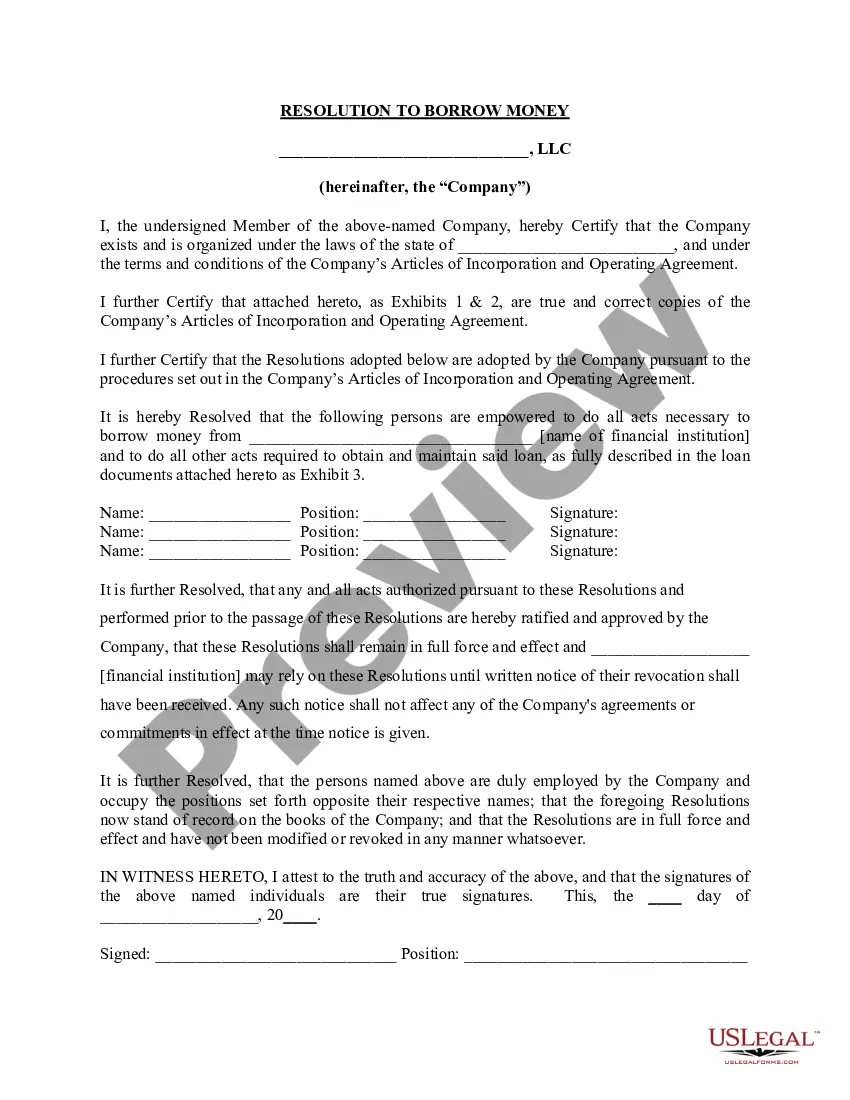
Llc Form Companies File For Tax
Description
Get your form ready online
Our built-in tools help you complete, sign, share, and store your documents in one place.
Make edits, fill in missing information, and update formatting in US Legal Forms—just like you would in MS Word.
Download a copy, print it, send it by email, or mail it via USPS—whatever works best for your next step.
Sign and collect signatures with our SignNow integration. Send to multiple recipients, set reminders, and more. Go Premium to unlock E-Sign.
If this form requires notarization, complete it online through a secure video call—no need to meet a notary in person or wait for an appointment.
We protect your documents and personal data by following strict security and privacy standards.

Make edits, fill in missing information, and update formatting in US Legal Forms—just like you would in MS Word.

Download a copy, print it, send it by email, or mail it via USPS—whatever works best for your next step.

Sign and collect signatures with our SignNow integration. Send to multiple recipients, set reminders, and more. Go Premium to unlock E-Sign.

If this form requires notarization, complete it online through a secure video call—no need to meet a notary in person or wait for an appointment.

We protect your documents and personal data by following strict security and privacy standards.
Looking for another form?








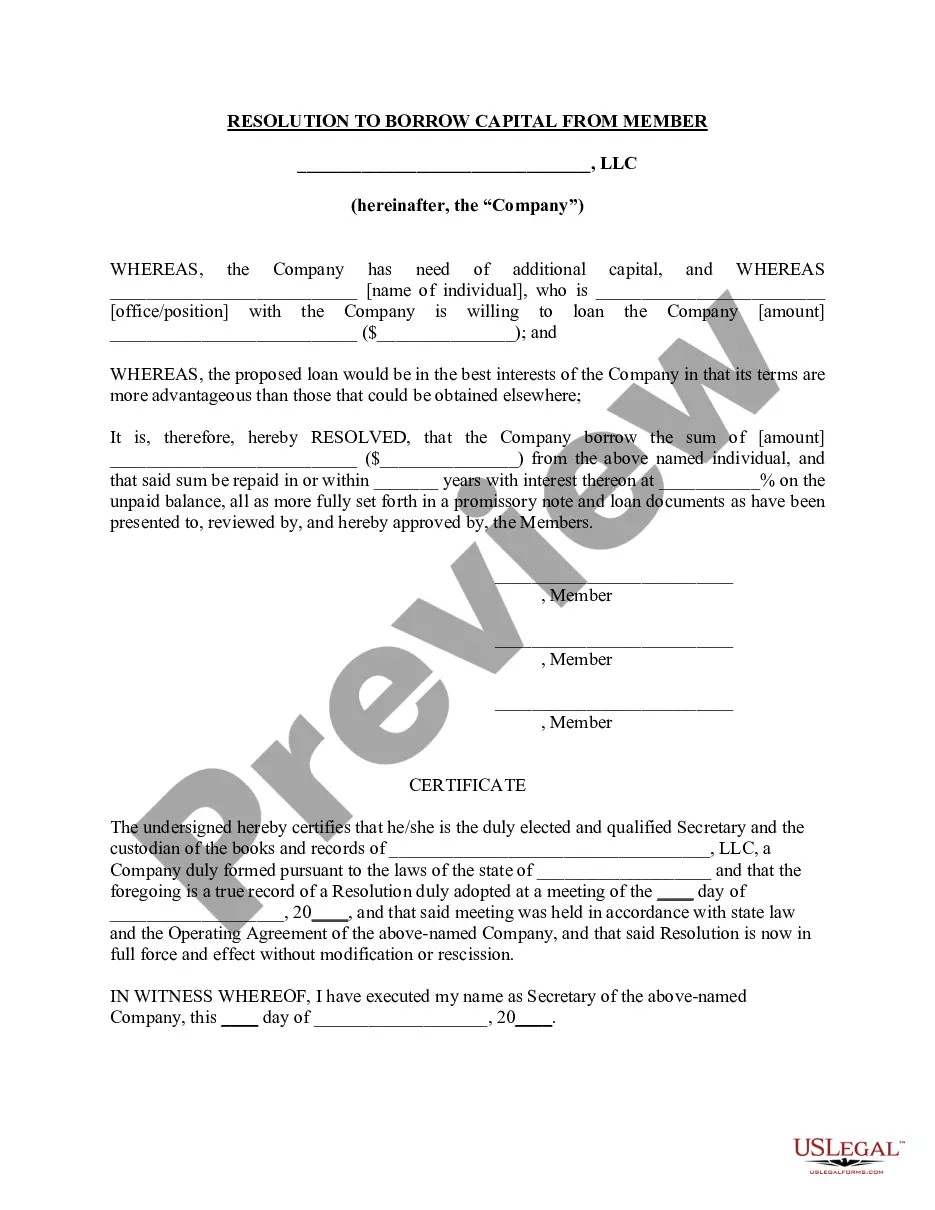
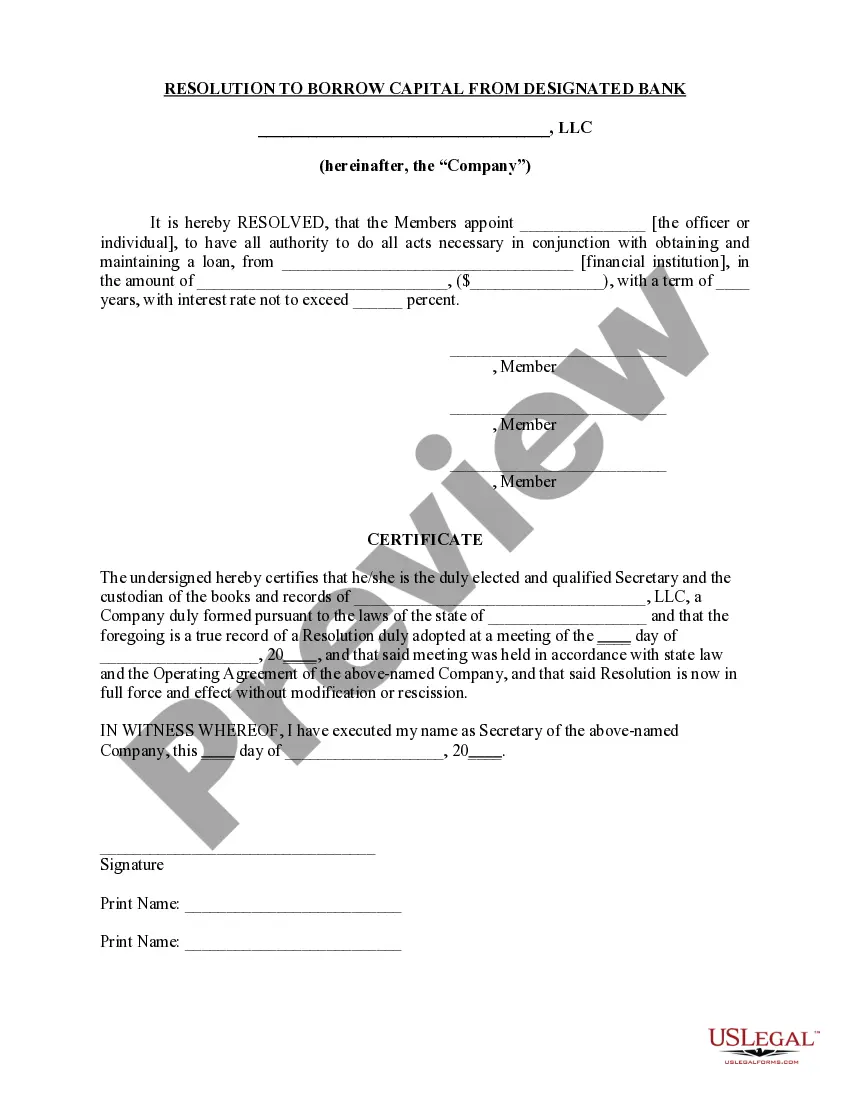
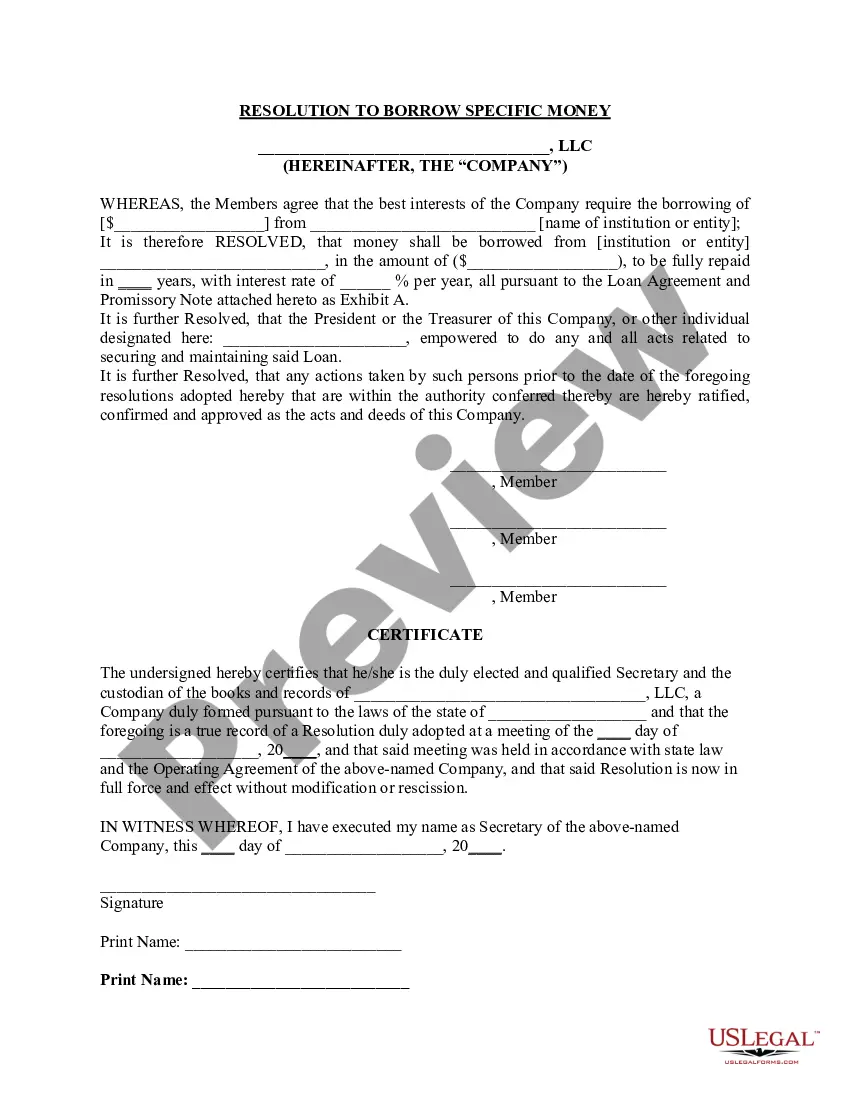
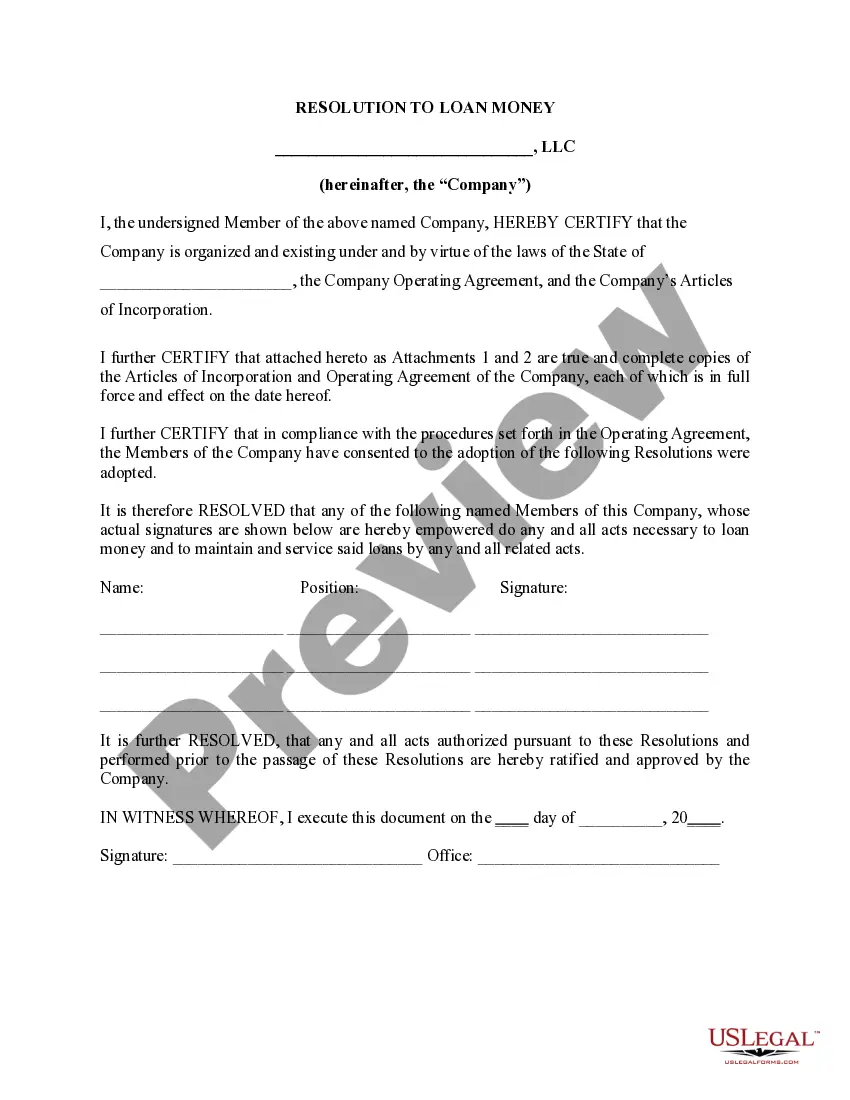
How to fill out Resolution Of Meeting Of LLC Members To Borrow Money?
- If you're a returning user, log in to your account to download the necessary form template. Check your subscription status and renew if necessary.
- For new users, begin by previewing the form descriptions to find the one that best meets your requirements and complies with local laws.
- If you find the current form doesn't fit your needs, utilize the Search feature to locate another suitable template.
- Once you've found the correct document, proceed to purchase by clicking the Buy Now button and selecting your desired subscription plan. An account registration will be required.
- Complete your transaction by entering your credit card information or using your PayPal account to secure your subscription.
- Finally, download the form to your device so you can fill it out as needed. You can always access it again in the My Forms section of your profile.
In conclusion, US Legal Forms offers a robust collection of legal documents that facilitates quick and efficient filing for LLC taxes. With their extensive resources and expert assistance, users can ensure that they submit precise and legally valid forms.
Start your journey today by visiting US Legal Forms and simplify your legal document filing!
Form popularity
FAQ
An LLC typically files Form 1065 to report its income, deductions, and other important financial information if it is treated as a partnership. This filing helps the IRS track the income and expenses of the LLC and ensures each member reports their share of income on their personal tax returns. Filing Form 1065 allows LLC form companies to file for tax properly while maintaining transparency and compliance with tax requirements.
Determining whether your LLC is an S Corp or C Corp hinges on your tax election. By default, a single-member LLC is treated as a sole proprietorship, and multi-member LLCs are seen as partnerships. However, LLCs can elect to be taxed as either an S Corp or C Corp by filing the appropriate forms. Therefore, LLC form companies file for tax with clarity on their chosen status, which can affect taxation and benefits.
Maximizing your LLC tax return involves careful planning and strategy. Keeping organized records, tracking all business expenses, and taking advantage of tax deductions can significantly boost your return. LLC form companies file for tax with the aim of minimizing their taxable income while remaining compliant. Online platforms like US Legal Forms can simplify the filing process and provide resources to help you optimize your returns.
Yes, LLCs can receive tax refunds under certain circumstances. If your LLC overpaid its estimated taxes or qualifies for tax credits, you may be in line for a refund. To ensure you correctly handle your tax filing, LLC form companies should file for tax with meticulous attention to the documentation. Consulting a tax professional can give you tailored advice for maximizing your chances of a refund.
The best filing status for an LLC often depends on your specific business needs. Most LLCs opt for pass-through taxation, where profits pass through to the owners’ personal tax returns. This allows LLC form companies to file for tax at the individual level, avoiding double taxation. However, some might choose to be taxed as an S-Corp or C-Corp, which could offer certain benefits depending on the situation.
Whether your LLC should elect S or C corporation status depends on your business goals and income. S corporations allow profits and losses to pass through to your personal tax return, potentially reducing your overall tax burden. However, C corporations face double taxation but may offer more flexibility in attracting investment. Using US Legal Forms can help you evaluate the pros and cons of each option, ensuring you make an informed decision about your LLC's tax structure.
Choosing a tax classification for your LLC should depend on how you want to manage taxes and profits. Generally, single-member LLCs are considered disregarded entities for tax purposes, unless you elect to be taxed as an S or C corporation. Each classification affects your tax liabilities and filing requirements differently. US Legal Forms can provide insights and guidance to help you choose the most beneficial tax classification for your LLC.
Your LLC can choose how it wants to be taxed. Typically, it can be classified as a sole proprietorship, partnership, S corporation, or C corporation depending on your election with the IRS. It’s essential to understand that an LLC does not automatically default to any corporate structure. For tailored advice, consider using US Legal Forms, which can guide you through the process and help you determine the best tax classification for your LLC.
A single member LLC typically files taxes using Form 1040 and Schedule C, which allows you to report income and expenses from your business. Unlike corporations, the IRS views single member LLCs as disregarded entities, meaning profits and losses are reported on your personal tax return. This simplifies the process, as you do not need to file a separate tax return for your LLC. For more guidance on how LLC form companies file for tax, our US Legal Forms platform offers helpful resources and templates to ensure you meet all filing requirements.
You should treat your LLC as a distinct entity for tax purposes, which means keeping separate records for business and personal expenses. Depending on the election made, it can be taxed as a sole proprietorship, partnership, or corporation. Consultation with a tax advisor can help clarify your obligations, and using US Legal Forms can ensure you have all the necessary documentation in place.