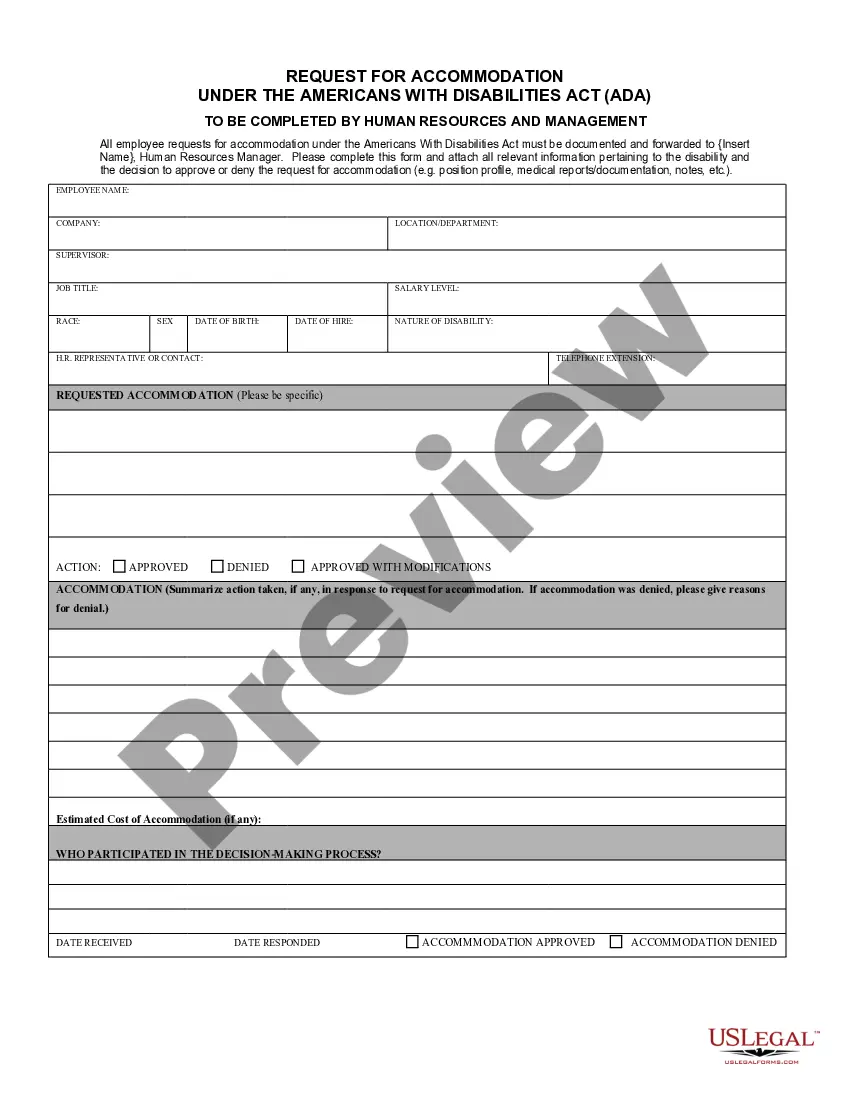
Reasonable Accommodation For Federal Employees
Description
Get your form ready online
Our built-in tools help you complete, sign, share, and store your documents in one place.
Make edits, fill in missing information, and update formatting in US Legal Forms—just like you would in MS Word.
Download a copy, print it, send it by email, or mail it via USPS—whatever works best for your next step.
Sign and collect signatures with our SignNow integration. Send to multiple recipients, set reminders, and more. Go Premium to unlock E-Sign.
If this form requires notarization, complete it online through a secure video call—no need to meet a notary in person or wait for an appointment.
We protect your documents and personal data by following strict security and privacy standards.

Make edits, fill in missing information, and update formatting in US Legal Forms—just like you would in MS Word.

Download a copy, print it, send it by email, or mail it via USPS—whatever works best for your next step.

Sign and collect signatures with our SignNow integration. Send to multiple recipients, set reminders, and more. Go Premium to unlock E-Sign.

If this form requires notarization, complete it online through a secure video call—no need to meet a notary in person or wait for an appointment.

We protect your documents and personal data by following strict security and privacy standards.
Looking for another form?








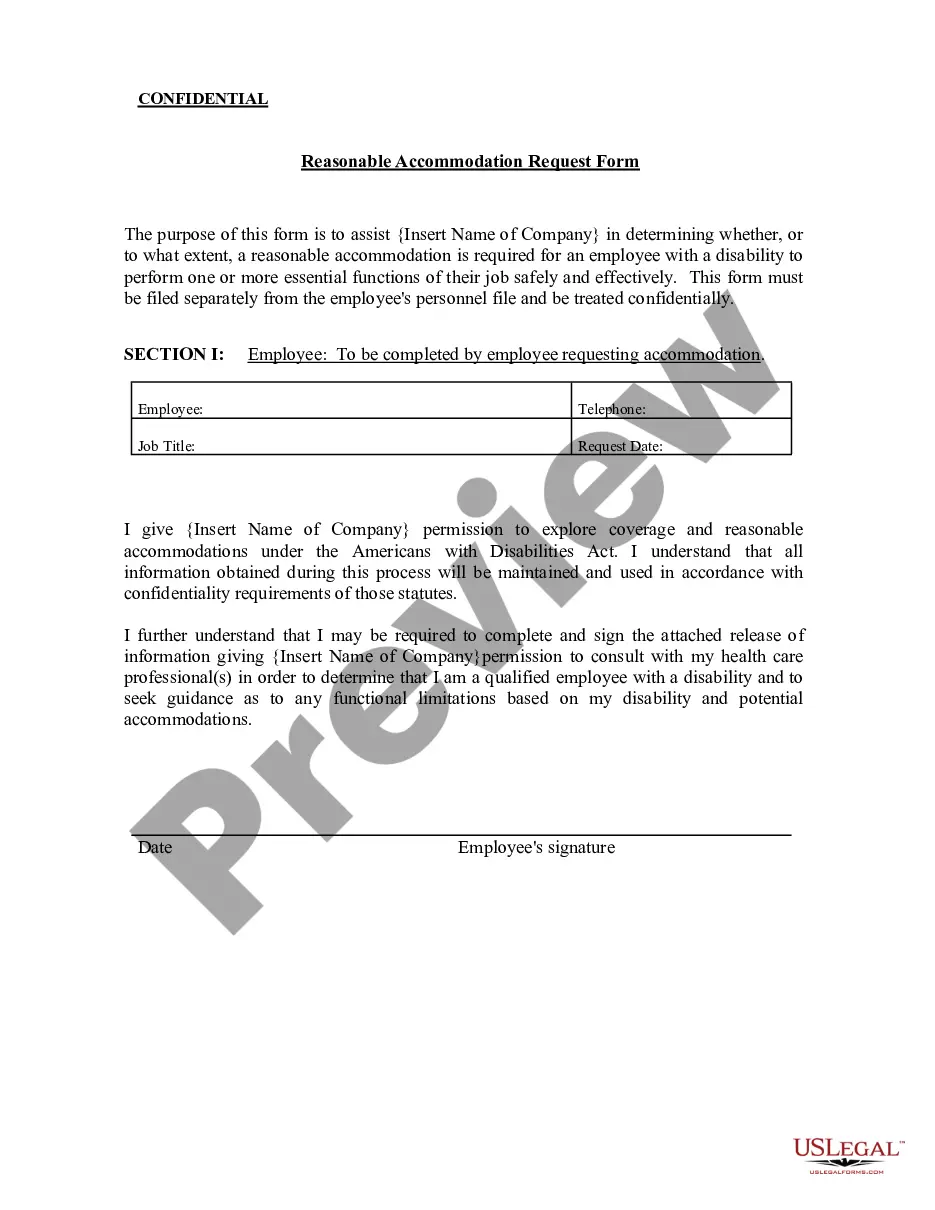
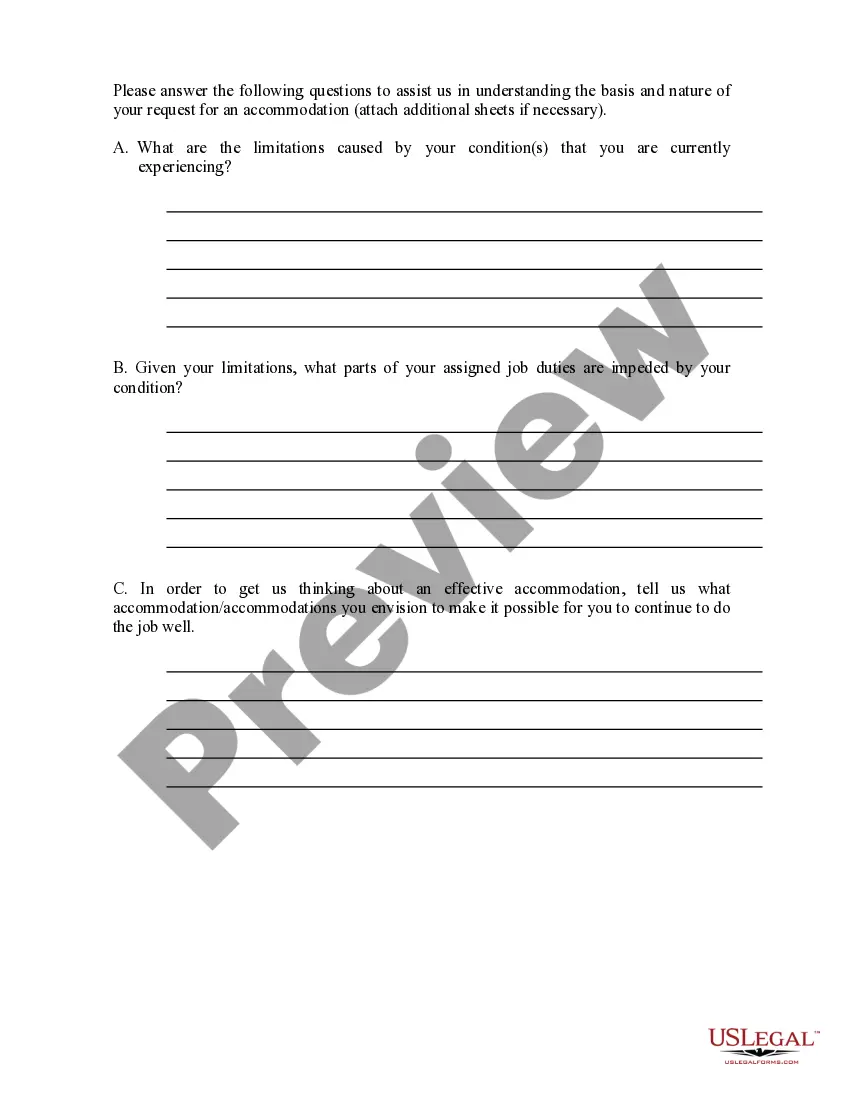
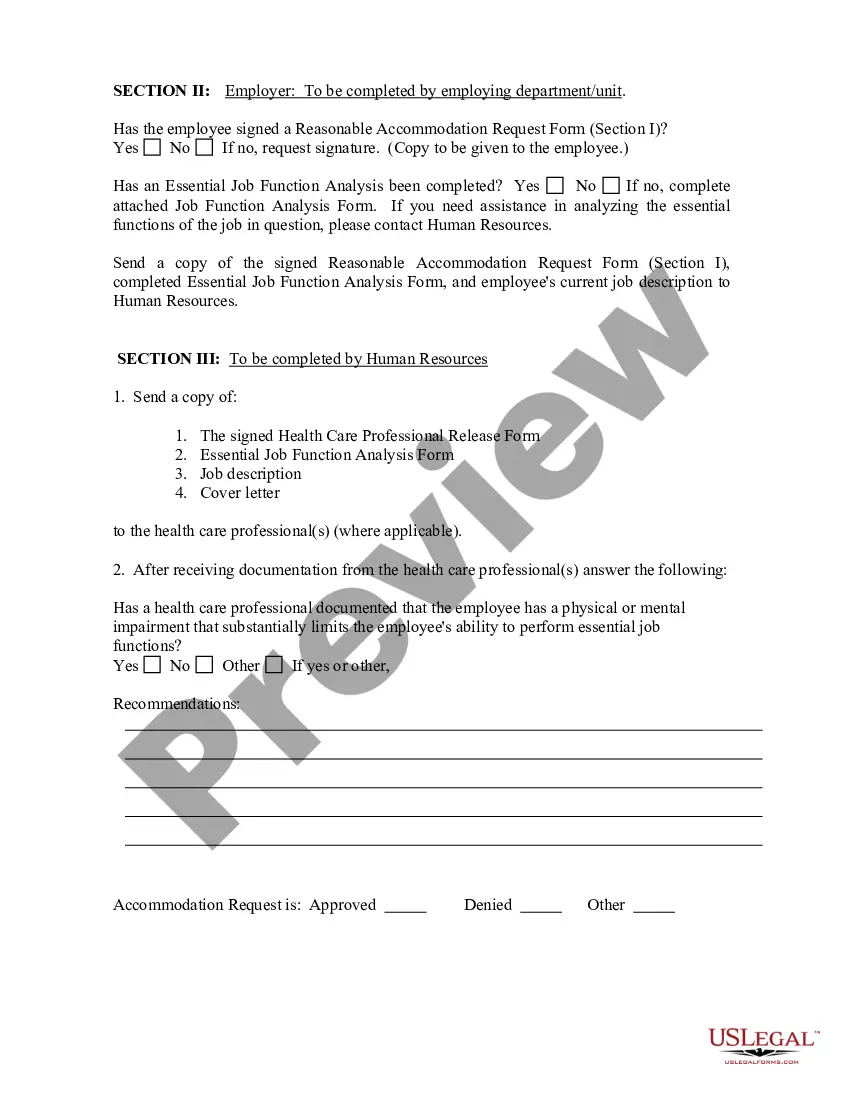
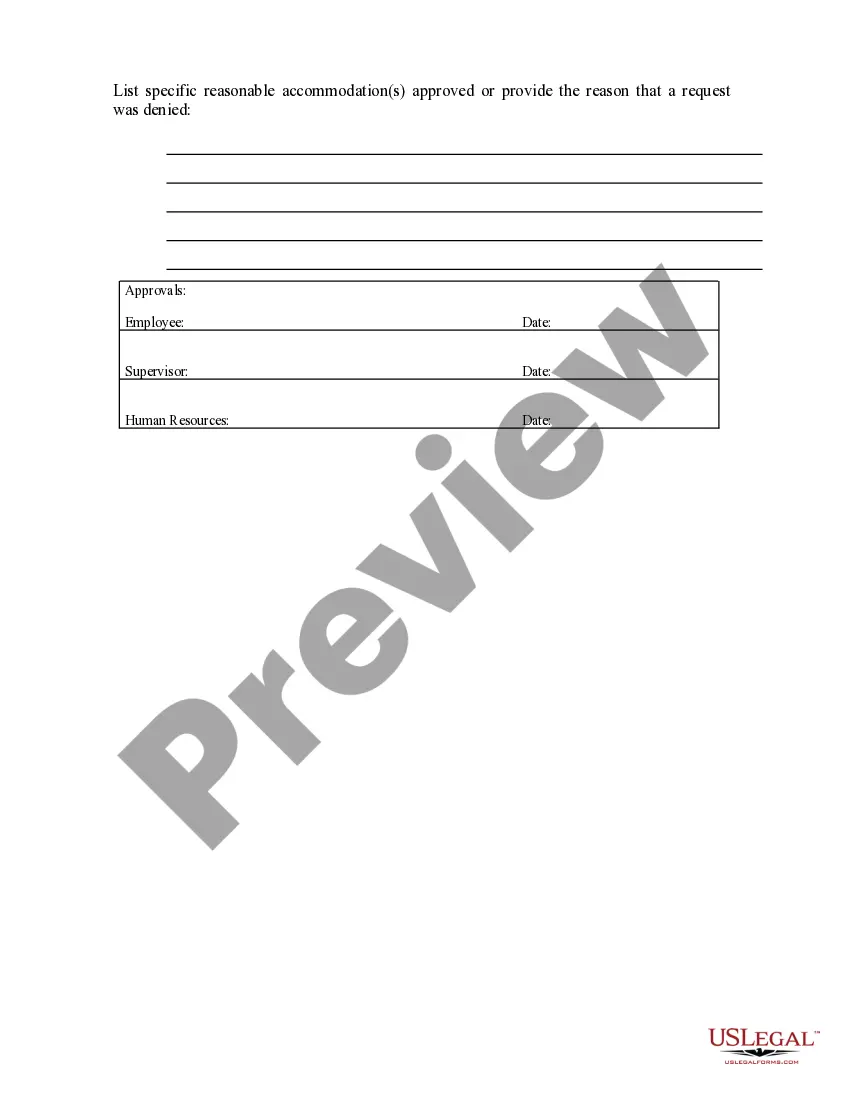
How to fill out Reasonable Accommodation Request Form?
Creating legal documents from the ground up can frequently be overwhelming.
Certain cases may require extensive research and substantial financial investment.
If you're looking for a simpler and more economical method of preparing Reasonable Accommodation For Federal Employees or any other forms without excessive hassle, US Legal Forms is readily accessible.
Our online library of over 85,000 current legal documents addresses nearly every aspect of your financial, legal, and personal matters.
However, before diving directly into downloading Reasonable Accommodation For Federal Employees, consider these suggestions: Review the document preview and descriptions to ensure you have located the correct form. Verify that the form you select adheres to the rules and regulations of your state and county. Choose the appropriate subscription option to obtain the Reasonable Accommodation For Federal Employees. Download the file, then fill it out, certify it, and print it. US Legal Forms boasts an impeccable reputation and over 25 years of experience. Join us today and make form completion an easy and efficient process!
- With just a few clicks, you can instantly access state- and county-specific templates meticulously prepared for you by our legal experts.
- Utilize our platform whenever you need dependable services that allow you to swiftly locate and download the Reasonable Accommodation For Federal Employees.
- If you are already familiar with our services and have set up an account with us previously, simply Log In, select the template, and download it immediately or retrieve it at any time from the My documents section.
- Not yet signed up? No worries. It requires minimal time to create your account and navigate through the library.
Form popularity
FAQ
When saying no to a reasonable accommodation request, it is vital to communicate clearly and compassionately. Be transparent about the reasons for the denial, referencing the specific criteria outlined in relevant laws and policies. Providing suggestions for alternative solutions may help maintain a positive relationship and show that the agency values the employee’s needs.
Reasons for denying a reasonable accommodation for federal employees can include undue hardship, lack of documentation, or inability to establish a disability as defined by the law. If the accommodation does not effectively address the employee’s needs or fails to align with the job requirements, it may also lead to a denial. It is crucial for both the employer and employee to engage in an open dialogue to explore possible alternatives.
An employer may deny a request for reasonable accommodation when it determines that the employee cannot perform the essential functions of their job, even with adjustments. Additionally, if the proposed accommodation would impose substantial difficulty or expense on the employer, this can serve as a basis for denial. Always document the decision thoroughly to maintain transparency and fairness in the process.
Exceptions to reasonable accommodations for federal employees often arise when specific circumstances make it impractical to provide the requested adjustments. For instance, if an employee’s request poses a direct threat to health or safety, or if it would require significant alterations to the workplace that are not feasible, these could be valid exceptions. Each case should be individually assessed to ensure compliance with federal laws.
A valid reason to deny a reasonable accommodation request for federal employees typically involves undue hardship on the agency. This can include situations where the accommodation would be excessively costly, create significant disruption, or fundamentally alter the nature of the work environment. It is essential to thoroughly evaluate each request while balancing the needs of the employee and the agency.
To write a proof of accommodation letter, you should begin by stating your name, position, and the nature of your request. Include details of the accommodation you received and explain how it benefits your work performance. Utilizing resources from uslegalforms can help you craft a clear and professional letter that meets all necessary legal standards.
Reasonable accommodations examples include accessibility improvements like ramps or automatic doors, as well as work environment modifications, such as noise-canceling headphones. Additionally, providing training or support services can also qualify as reasonable accommodations. These adjustments aim not only to support the employee but also to enhance overall productivity.
A reasonable accommodation statement could read, 'I am requesting a height-adjustable desk to better accommodate my mobility issues.' Such statements should clearly communicate your needs for reasonable accommodation for federal employees within the context of your role.
An accommodation statement might include a description of the employee’s need for adjustments due to a disability. For example, it could state, 'I require a modified work schedule to manage my medical appointments effectively.' Using clear and specific language helps convey your request succinctly.
Examples of reasonable accommodations for federal employees include flexible work schedules, modified job duties, and assistive technologies. Employers may also provide accessible workspaces or allow telecommuting as needed. Each accommodation should be tailored to fit the individual’s needs while maintaining job requirements.