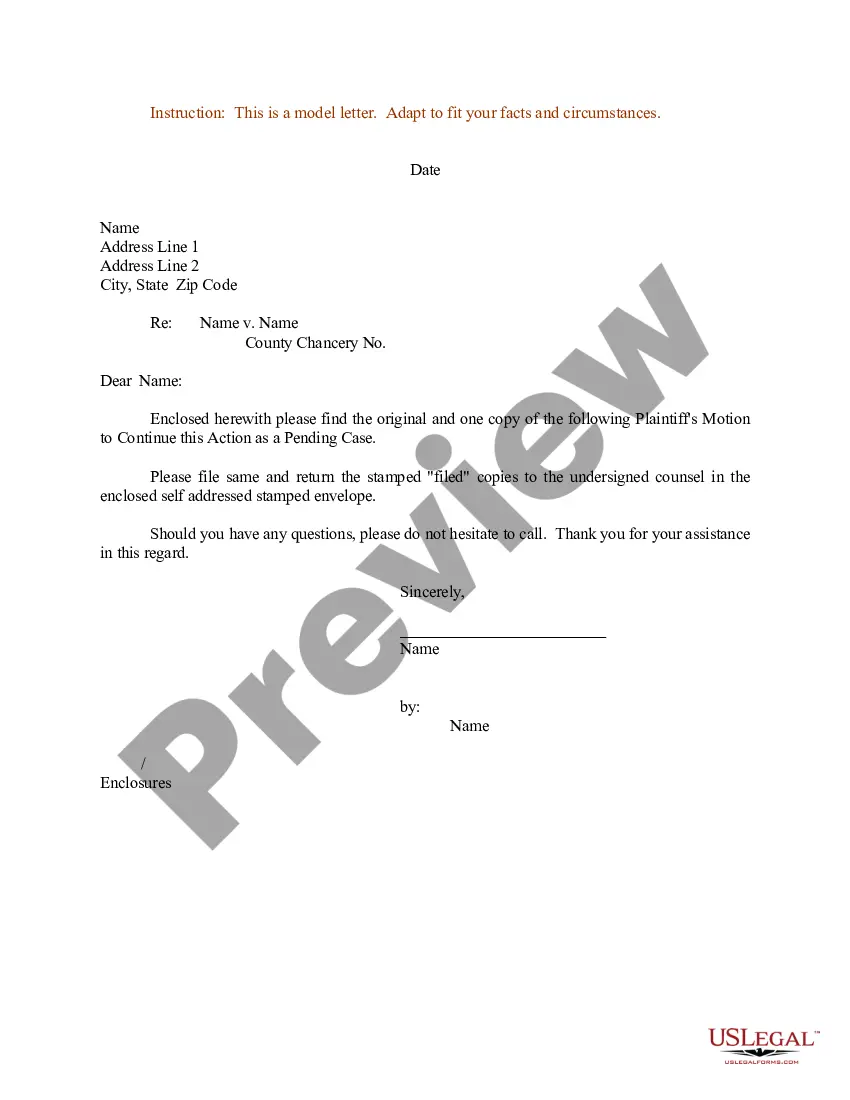
For Continue
Description




Get your form ready online
Our built-in tools help you complete, sign, share, and store your documents in one place.
Make edits, fill in missing information, and update formatting in US Legal Forms—just like you would in MS Word.
Download a copy, print it, send it by email, or mail it via USPS—whatever works best for your next step.
Sign and collect signatures with our SignNow integration. Send to multiple recipients, set reminders, and more. Go Premium to unlock E-Sign.
If this form requires notarization, complete it online through a secure video call—no need to meet a notary in person or wait for an appointment.
We protect your documents and personal data by following strict security and privacy standards.

Make edits, fill in missing information, and update formatting in US Legal Forms—just like you would in MS Word.

Download a copy, print it, send it by email, or mail it via USPS—whatever works best for your next step.

Sign and collect signatures with our SignNow integration. Send to multiple recipients, set reminders, and more. Go Premium to unlock E-Sign.

If this form requires notarization, complete it online through a secure video call—no need to meet a notary in person or wait for an appointment.

We protect your documents and personal data by following strict security and privacy standards.
Looking for another form?
How to fill out Sample Letter For Motion To Continue?
- If you are a returning user, log into your account and verify your subscription status. If it's valid, simply click on the Download button for your required form template.
- For first-time users, start by previewing the form and reading its description to confirm it meets your needs.
- Search for any additional templates if necessary, using the Search tab at the top of the page to find the exact match.
- Once you've located the right document, click on the Buy Now button and select your preferred subscription plan to proceed.
- Make your payment by entering your credit card information or using your PayPal account to secure your subscription.
- After purchase, download your form and save it on your device. You can access it anytime through the My Forms section of your profile.
Using US Legal Forms not only saves you time but also guarantees access to legal documents that are well-prepared and easy to edit. The assurance of having premium experts available for assistance enhances the entire experience, providing peace of mind.
Get started with US Legal Forms today and streamline your legal document process effortlessly!
Form popularity
FAQ
Using the 'continue' statement effectively alters the flow of a loop, helping you focus on relevant iterations. The immediate effect is that control passes to the next loop iteration, bypassing any remaining code for that cycle. Consequently, it enhances your program's efficiency and readability while maintaining logical structure.
You should use 'continue' when certain conditions in a loop require you to skip the remaining code for that iteration without exiting the loop. This keeps your code more structured and understandable. Especially in scenarios where data filtering is needed, 'continue' helps you manage your loops efficiently, making your algorithms cleaner and easier to maintain.
Yes, the 'break' statement works perfectly in 'while' loops as well as other loop types. It provides a way to exit from the loop immediately, regardless of whether the loop condition is still true. By understanding both 'break' and 'continue', you can have precise control over when and how your loops terminate or iterate.
The 'continue' keyword is used to control the flow of loop execution in programming. Its primary function is to skip the remainder of the current iteration and proceed to the next one. By utilizing this keyword intelligently, you can enhance the performance and clarity of your loops, effectively managing how code executes.
The 'continue' statement can be used within any loop structure, including 'for', 'while', and 'do while' loops. It's particularly useful when you want to skip specific iterations based on condition checks you define. Incorporating 'continue' improves code readability and logic, making your intentions clearer.
'Continue' and 'goto' are not the same, although they can both alter the flow of control in programs. 'Continue' affects only the current iteration of loops, making it a safer and more structured choice for managing loop execution. In contrast, 'goto' can lead to unpredictable behavior by jumping to arbitrary locations in code, which is often discouraged in modern programming practices.
'Continue' is not directly related to functions; however, it plays a crucial role in loops that may exist within a function. When a loop contains the 'continue' statement, it halts the current loop iteration and moves to the next one. This allows functions to efficiently process collections or sequences by skipping unnecessary computations based on certain conditions.
When you use 'continue' within loops, it immediately skips the remainder of that loop's code for the current iteration, proceeding directly to the next iteration. This action helps streamline your code by allowing specific iterations to be bypassed without terminating the loop entirely. To effectively use 'continue', understand its placement within your loop structure.
To effectively use the continue statement, place it within the loop structure of your code. When specific criteria are met, the continue statement will prevent any further code execution in that iteration and jump to the next one. This enhances control over your loop flow, ensuring that only relevant iterations are processed. For continue, apply it where you need to efficiently manage repetitive tasks without unnecessary clutter.
A suitable synonym for 'continue to go' includes terms like keep moving or carry on. These phrases convey the essence of maintaining movement and progress without interruption. Using synonyms adds variety to your communication while retaining the original meaning. For continue to go, select a phrase that feels comfortable and clear to your audience.