Estate Name Would For A Private Instance Variable
Description

Get your form ready online
Our built-in tools help you complete, sign, share, and store your documents in one place.
Make edits, fill in missing information, and update formatting in US Legal Forms—just like you would in MS Word.
Download a copy, print it, send it by email, or mail it via USPS—whatever works best for your next step.
Sign and collect signatures with our SignNow integration. Send to multiple recipients, set reminders, and more. Go Premium to unlock E-Sign.
If this form requires notarization, complete it online through a secure video call—no need to meet a notary in person or wait for an appointment.
We protect your documents and personal data by following strict security and privacy standards.

Make edits, fill in missing information, and update formatting in US Legal Forms—just like you would in MS Word.

Download a copy, print it, send it by email, or mail it via USPS—whatever works best for your next step.

Sign and collect signatures with our SignNow integration. Send to multiple recipients, set reminders, and more. Go Premium to unlock E-Sign.

If this form requires notarization, complete it online through a secure video call—no need to meet a notary in person or wait for an appointment.

We protect your documents and personal data by following strict security and privacy standards.
Looking for another form?







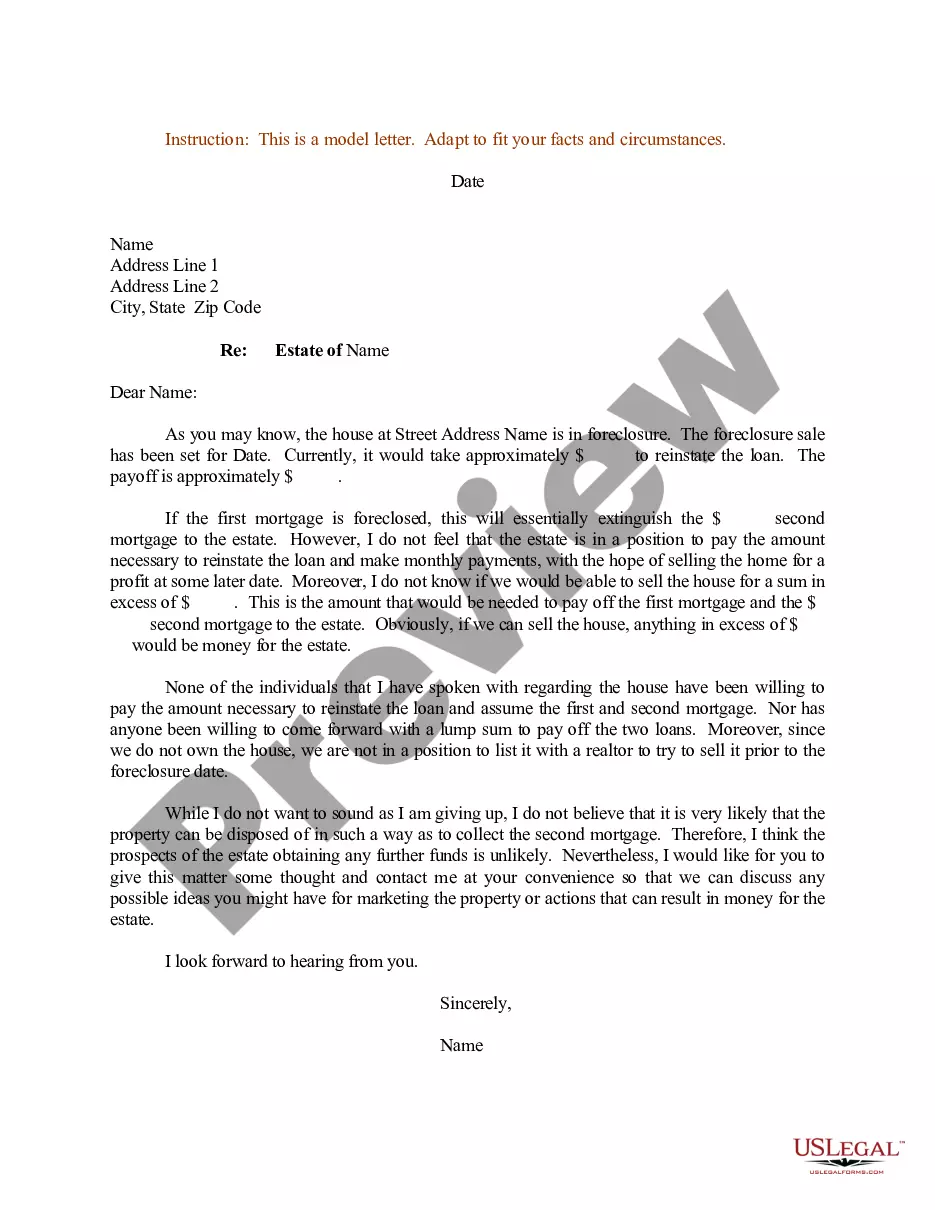
How to fill out Sample Letter For Foreclosed Home Of Estate?
Legal managing can be overwhelming, even for the most knowledgeable experts. When you are interested in a Estate Name Would For A Private Instance Variable and don’t get the a chance to commit searching for the right and up-to-date version, the processes can be demanding. A robust online form library might be a gamechanger for everyone who wants to take care of these situations effectively. US Legal Forms is a market leader in web legal forms, with more than 85,000 state-specific legal forms available anytime.
With US Legal Forms, you can:
- Access state- or county-specific legal and business forms. US Legal Forms handles any needs you may have, from personal to business documents, all-in-one place.
- Use advanced resources to complete and handle your Estate Name Would For A Private Instance Variable
- Access a resource base of articles, tutorials and handbooks and resources related to your situation and requirements
Save time and effort searching for the documents you will need, and employ US Legal Forms’ advanced search and Review feature to get Estate Name Would For A Private Instance Variable and download it. In case you have a membership, log in in your US Legal Forms account, look for the form, and download it. Review your My Forms tab to see the documents you previously downloaded as well as handle your folders as you see fit.
If it is the first time with US Legal Forms, register an account and get unlimited use of all benefits of the platform. Listed below are the steps to take after getting the form you need:
- Verify this is the correct form by previewing it and looking at its description.
- Be sure that the sample is recognized in your state or county.
- Pick Buy Now once you are ready.
- Select a monthly subscription plan.
- Find the format you need, and Download, complete, eSign, print and send out your document.
Benefit from the US Legal Forms online library, supported with 25 years of expertise and trustworthiness. Change your daily document managing into a easy and easy-to-use process right now.
Form popularity
FAQ
Instance variable names begin with an underscore ( _ ) followed by a camel case alphanumeric string. The first character following the underscore must be a lowercase letter; numerals are not permitted.
Instance variables are made private to force the users of those class to use methods to access them. In most cases there are plain getters and setters but other methods might be used as well.
Instance variables are declared right after the class declaration. They usually start with private then the type of the variable and then a name for the variable. Private means only the code in this class has access to it. The Person class declares 3 private instance variables: name , email , and phoneNumber .
Instance variables are declared with the keyword ?private? by default. However, it is possible to make an instance variable public or protected. The value of an instance variable can be changed only within the method in which it is declared.
Subclasses inherit public methods from the superclass that they extend, but they cannot access the private instance variables of the superclass directly. And subclasses do not inherit constructors from the superclass.