Sample Petition To Remove Executor Of An Estate New York
Description
Get your form ready online
Our built-in tools help you complete, sign, share, and store your documents in one place.
Make edits, fill in missing information, and update formatting in US Legal Forms—just like you would in MS Word.
Download a copy, print it, send it by email, or mail it via USPS—whatever works best for your next step.
Sign and collect signatures with our SignNow integration. Send to multiple recipients, set reminders, and more. Go Premium to unlock E-Sign.
If this form requires notarization, complete it online through a secure video call—no need to meet a notary in person or wait for an appointment.
We protect your documents and personal data by following strict security and privacy standards.

Make edits, fill in missing information, and update formatting in US Legal Forms—just like you would in MS Word.

Download a copy, print it, send it by email, or mail it via USPS—whatever works best for your next step.

Sign and collect signatures with our SignNow integration. Send to multiple recipients, set reminders, and more. Go Premium to unlock E-Sign.

If this form requires notarization, complete it online through a secure video call—no need to meet a notary in person or wait for an appointment.

We protect your documents and personal data by following strict security and privacy standards.
Looking for another form?
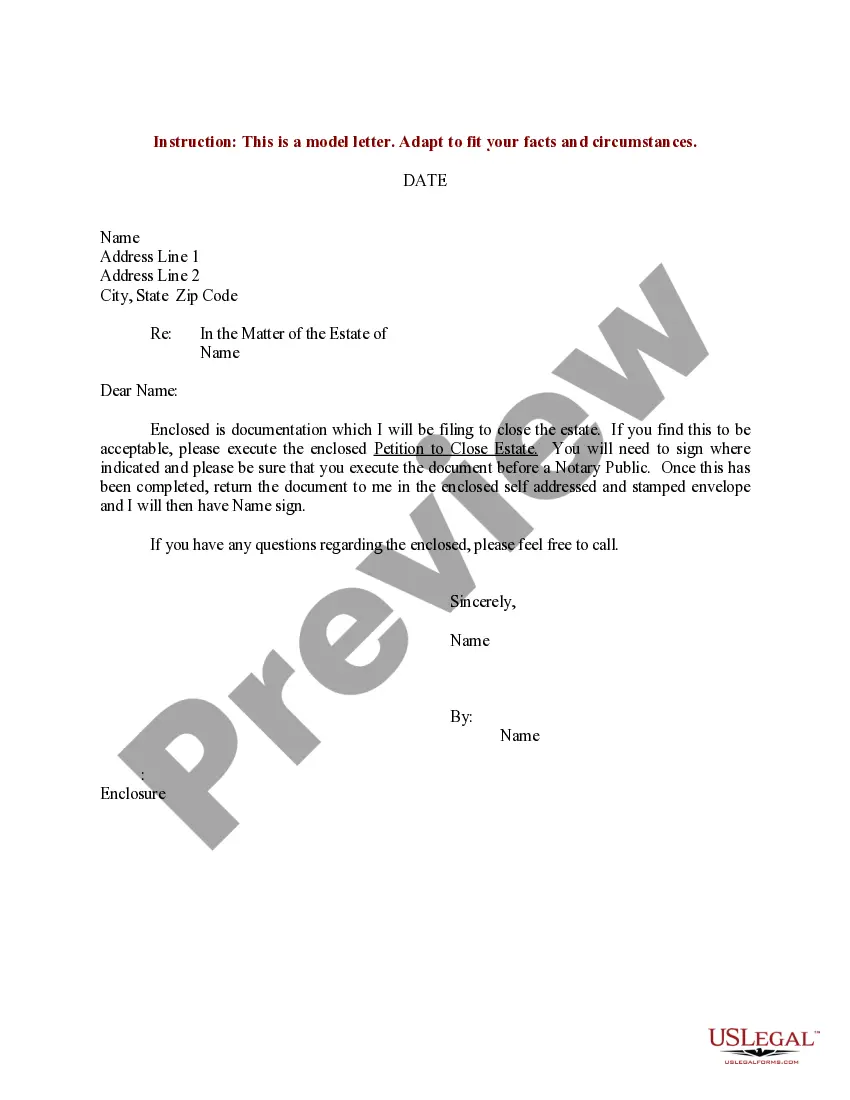
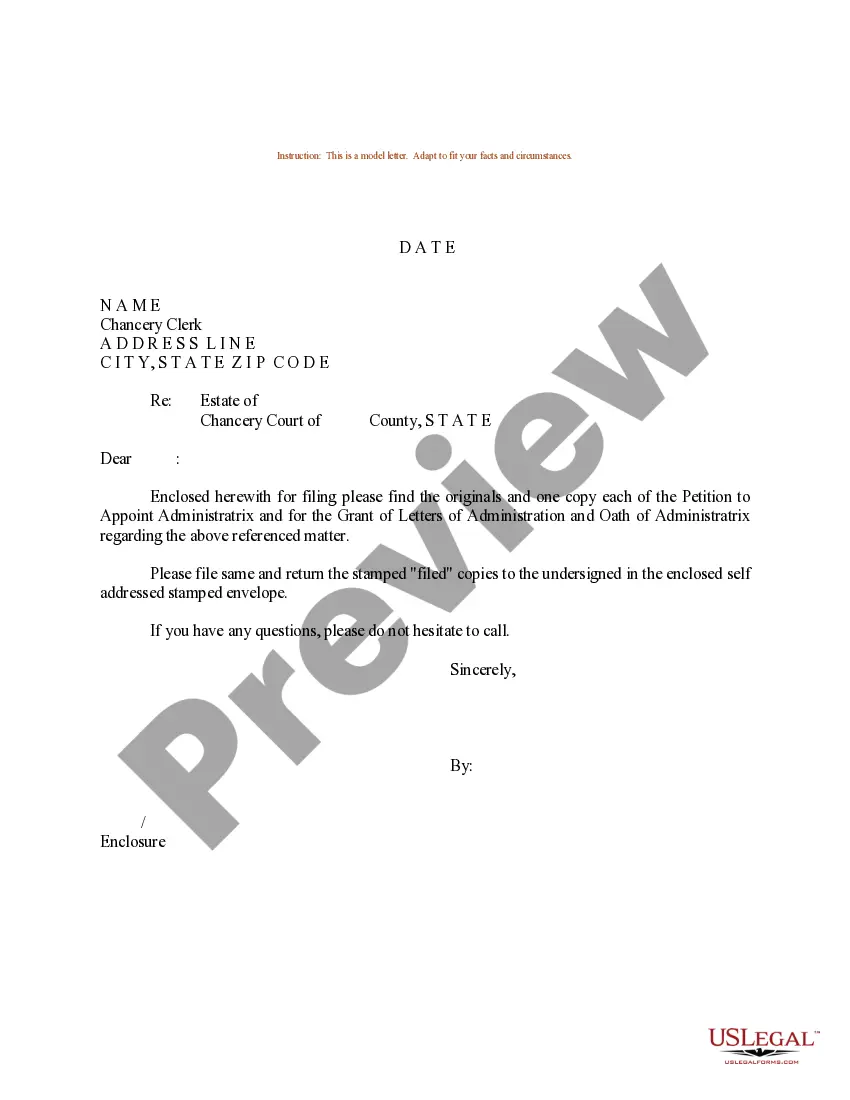
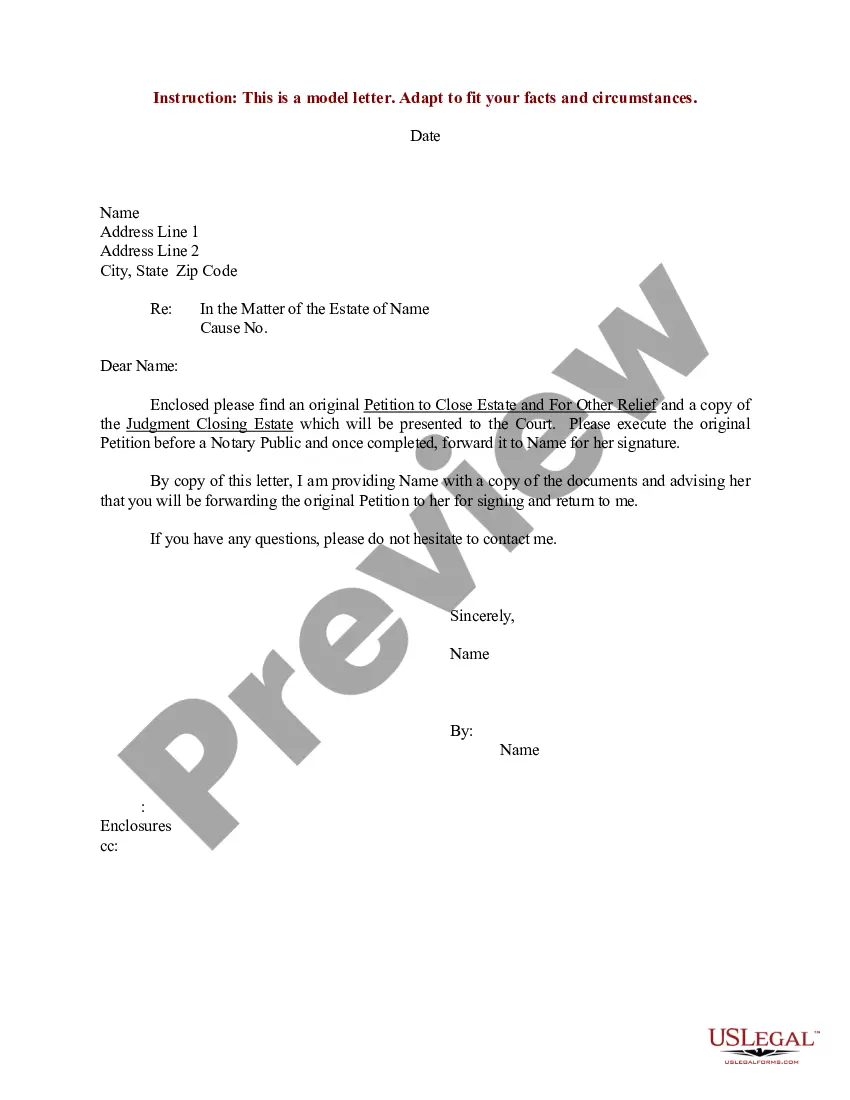
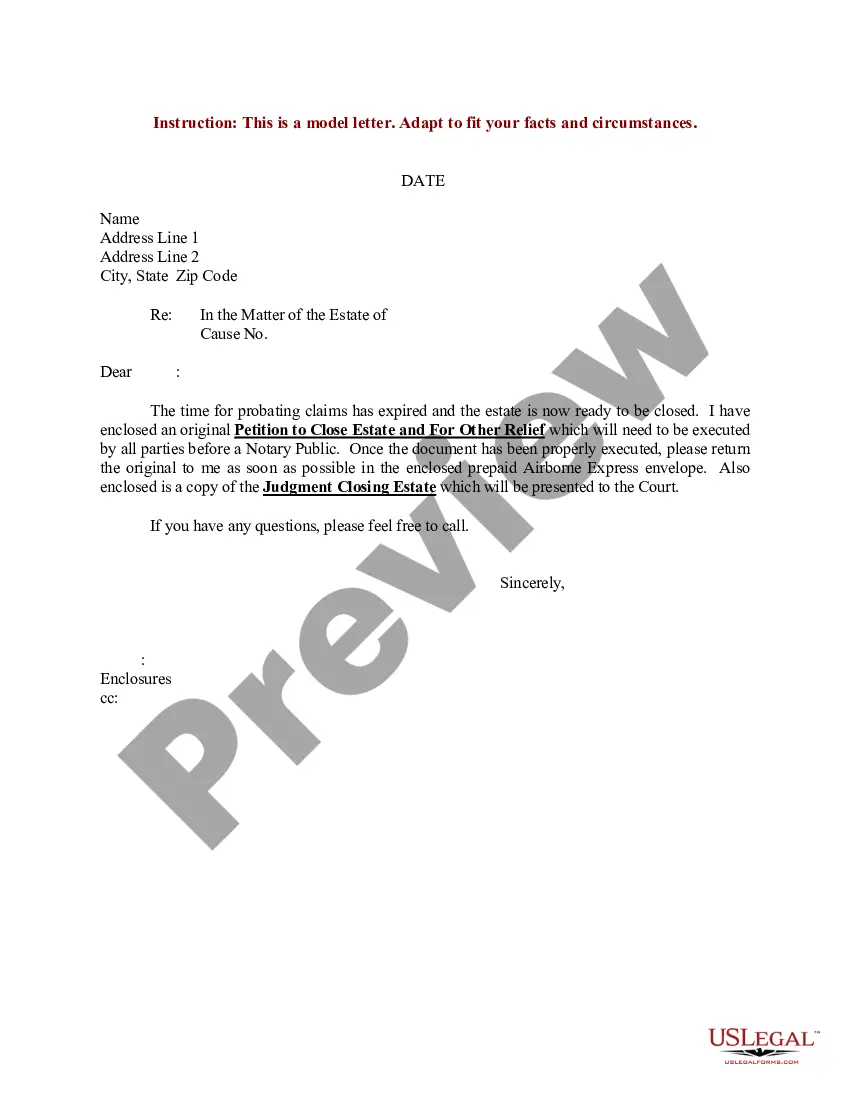
How to fill out Sample Letter For Petition To Close Estate?
Whether for professional objectives or for personal matters, everyone must manage legal circumstances at some point in their lifetime.
Completing legal paperwork requires meticulous attention, starting from selecting the correct form template.
With an extensive US Legal Forms catalog available, you will never need to waste time searching for the correct template across the web. Take advantage of the library's easy navigation to find the suitable template for any occasion.
- For example, if you select an incorrect version of a Sample Petition To Remove Executor Of An Estate New York, it will be rejected upon submission.
- Thus, it is essential to obtain a reliable source of legal documents such as US Legal Forms.
- If you need to acquire a Sample Petition To Remove Executor Of An Estate New York template, follow these straightforward steps.
- Utilize the search bar or catalog navigation to find the form you require.
- Review the form's details to ensure it aligns with your situation, state, and county.
- Click on the form's preview to inspect it.
- If it is the wrong document, go back to the search feature to find the Sample Petition To Remove Executor Of An Estate New York template you need.
- Download the file once it corresponds to your specifications.
- If you possess a US Legal Forms account, click Log in to access previously saved templates in My documents.
- If you don't have an account yet, you can download the form by clicking Buy now.
- Choose the appropriate pricing option.
- Complete the account registration form.
- Select your payment method: use a credit card or PayPal account.
- Choose the document format you prefer and download the Sample Petition To Remove Executor Of An Estate New York.
- After it is saved, you can fill out the document using editing software or print it and complete it by hand.
Form popularity
FAQ
Here are some things to consider when drafting a letter to your executor or trustee. Your thoughts about wealth. Share your story about how you came to the assets that you are leaving in your will. How was your wealth created, what do you value and what are your long-term goals for your wealth?
To remove an executor of an estate, an interested party can file a petition in probate court. This legal action alleges that the executor is unfit due to reasons such as negligence, misconduct, or incapacity. Such a petition ensures the proper administration of the estate.
Procedure for Removal A party seeking to have an executor, administrator or a trustee removed, must file a petition requesting revocation of the fiduciary's letters pursuant to NY Surrogate's Court Procedure Act (SCPA) 711, 712 or 719. The petition must state in clear terms the grounds to revoke the letters.
Answer: Just because you are nominated as executor of a Will does not mean that you must serve. You can renounce your rights as executor and decline to act by simply signing and having notarized a Renunciation of Nominated Executor form and filing it with the Surrogate's Court in the county in which your aunt resided.
In New York, the process of removing an executor starts with filing a petition with the court. The petition must explain the grounds for removal and provide supporting evidence. Typically the Petition is filed with a Citation.