Sample No Loss Letter For Insurance
Description
Get your form ready online
Our built-in tools help you complete, sign, share, and store your documents in one place.
Make edits, fill in missing information, and update formatting in US Legal Forms—just like you would in MS Word.
Download a copy, print it, send it by email, or mail it via USPS—whatever works best for your next step.
Sign and collect signatures with our SignNow integration. Send to multiple recipients, set reminders, and more. Go Premium to unlock E-Sign.
If this form requires notarization, complete it online through a secure video call—no need to meet a notary in person or wait for an appointment.
We protect your documents and personal data by following strict security and privacy standards.

Make edits, fill in missing information, and update formatting in US Legal Forms—just like you would in MS Word.

Download a copy, print it, send it by email, or mail it via USPS—whatever works best for your next step.

Sign and collect signatures with our SignNow integration. Send to multiple recipients, set reminders, and more. Go Premium to unlock E-Sign.

If this form requires notarization, complete it online through a secure video call—no need to meet a notary in person or wait for an appointment.

We protect your documents and personal data by following strict security and privacy standards.
Looking for another form?


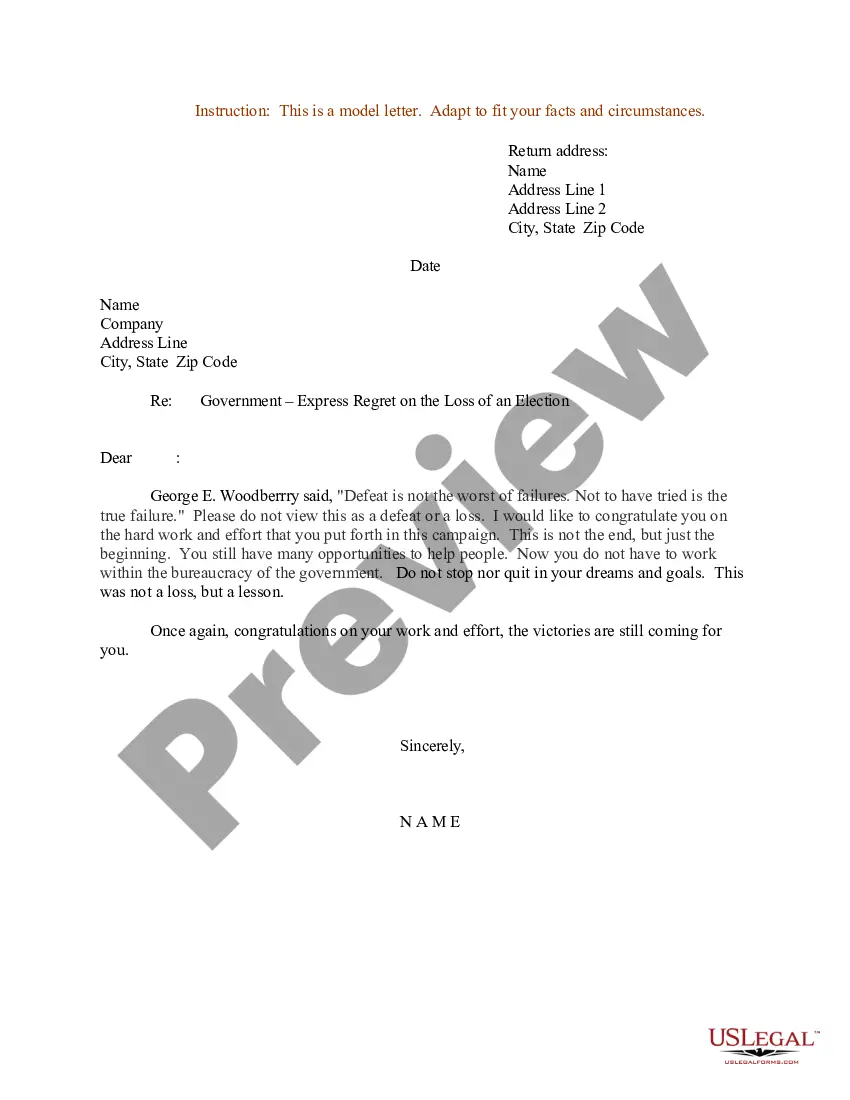
How to fill out Sample Letter For Express Regret On The Loss Of An Election?
Bureaucracy demands precision and exactness.
If you do not handle documents like Sample No Loss Letter For Insurance on a regular basis, it could lead to some misunderstanding.
Selecting the correct template from the beginning will ensure that your document submission goes smoothly and avoids any troubles of resubmitting a file or repeating the work entirely from the beginning.
Obtaining the correct and updated templates for your documents can take just a few minutes with an account at US Legal Forms. Minimize the bureaucratic issues and simplify your form management.
- Find the template using the search feature.
- Verify that the Sample No Loss Letter For Insurance you found is suitable for your state or region.
- Review the preview or examine the description that includes the details on the template's usage.
- If the result corresponds with your inquiry, click the Buy Now button.
- Choose the suitable option from the proposed pricing options.
- Log In to your account or create a new account.
- Complete the transaction using a credit card or PayPal payment method.
- Download the document in the format you prefer.
Form popularity
FAQ
A no loss claim is a request filed with an insurance company when a policyholder has not experienced any financial loss but seeks a record or acknowledgment of this status. This claim often serves as documentation that may be needed in the future, especially for liability or compliance reasons. Using a Sample no loss letter for insurance can help you communicate your situation clearly and effectively to your insurer. You can find such templates on platforms like USLegalForms, which can simplify the process for you.
A warranty letter and a guarantee letter are similar but serve different purposes. A warranty letter typically refers to specific assurances about a product or service, while a guarantee letter ensures compensation in the event of a loss. Both can benefit from a sample no loss letter for insurance to communicate coverage expectations effectively.
When writing a letter for an insurance claim, start with your policy details and a clear statement of the claim. Describe the event that led to the claim, including dates and damage incurred. Including a reference to a sample no loss letter for insurance can enhance the professionalism and clarity of your letter.
An insurance warranty letter is a document that guarantees certain conditions or actions regarding an insurance policy. It can outline specific obligations for both the insurer and the insured. When drafting such a letter, refer to a sample no loss letter for insurance to ensure your message is precise and comprehensive.
known loss letter is a declaration from an insured party stating that they have no knowledge of any losses that need to be reported. This letter provides clarity and can help prevent misunderstandings with an insurance provider. By including a sample no loss letter for insurance, your communication will be clear and effective.
To fill out a proof of loss form, start by gathering all relevant details about the loss. Clearly describe the incident, the items lost, and any supporting documentation. Then, complete the form with accurate information, ensuring to sign and date it. Using a sample no loss letter for insurance can also help guide your writing.
An example of a no loss letter typically includes a statement indicating that the insured has not experienced any claims or losses during a specified period. It should also contain essential details like the policyholder's name, policy number, and the date the letter is written. For a concrete sample no loss letter for insurance, exploring templates available on platforms like US Legal Forms can offer helpful insights.
To write a declaration letter for insurance, start by stating the purpose of the letter, including your name, policy number, and relevant dates. Clearly express the details about what you are declaring, whether it's a loss, a request, or updates to your policy. US Legal Forms provides templates that may help you frame a comprehensive declaration letter for insurance.
In insurance, 'no loss' refers to a situation where a policyholder has not sustained any losses that would require filing a claim. This terminology is important because it affects the policy's standing and can influence renewal terms. For those looking to draft a sample no loss letter for insurance, clarifying this term can help simplify communication with your insurance provider.
To write a no loss letter for insurance, begin by clearly stating your name, policy number, and the date. Include a statement confirming that you have not experienced any losses that would affect the insurance policy. It is beneficial to use a structured format, and for guidance, check resources like US Legal Forms for a sample no loss letter for insurance.