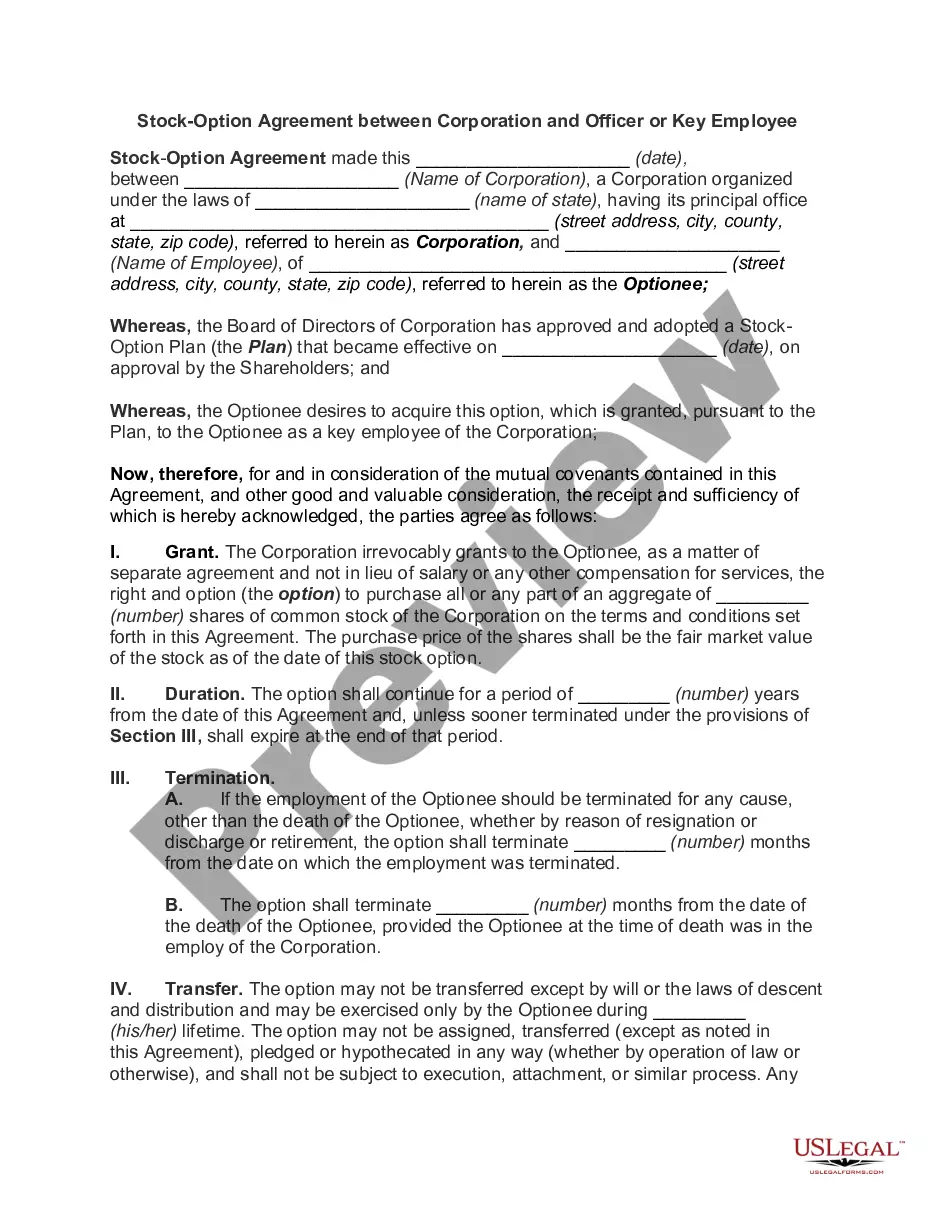
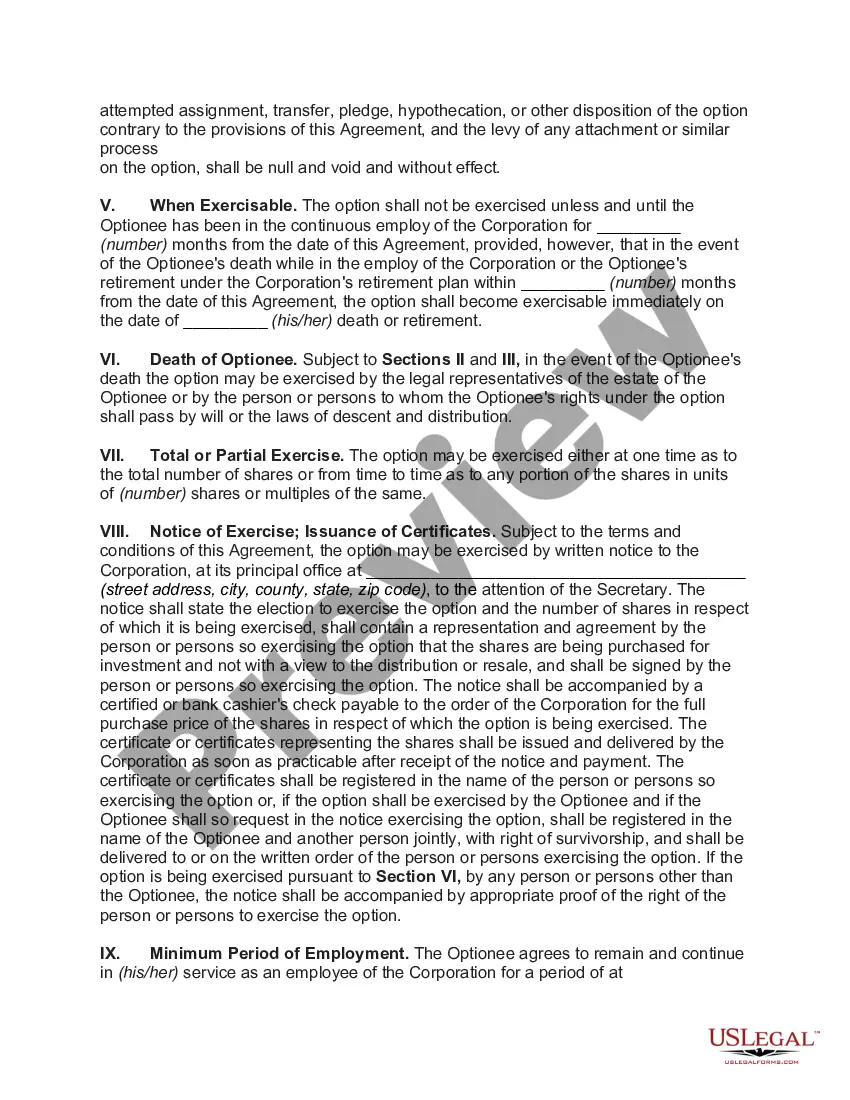
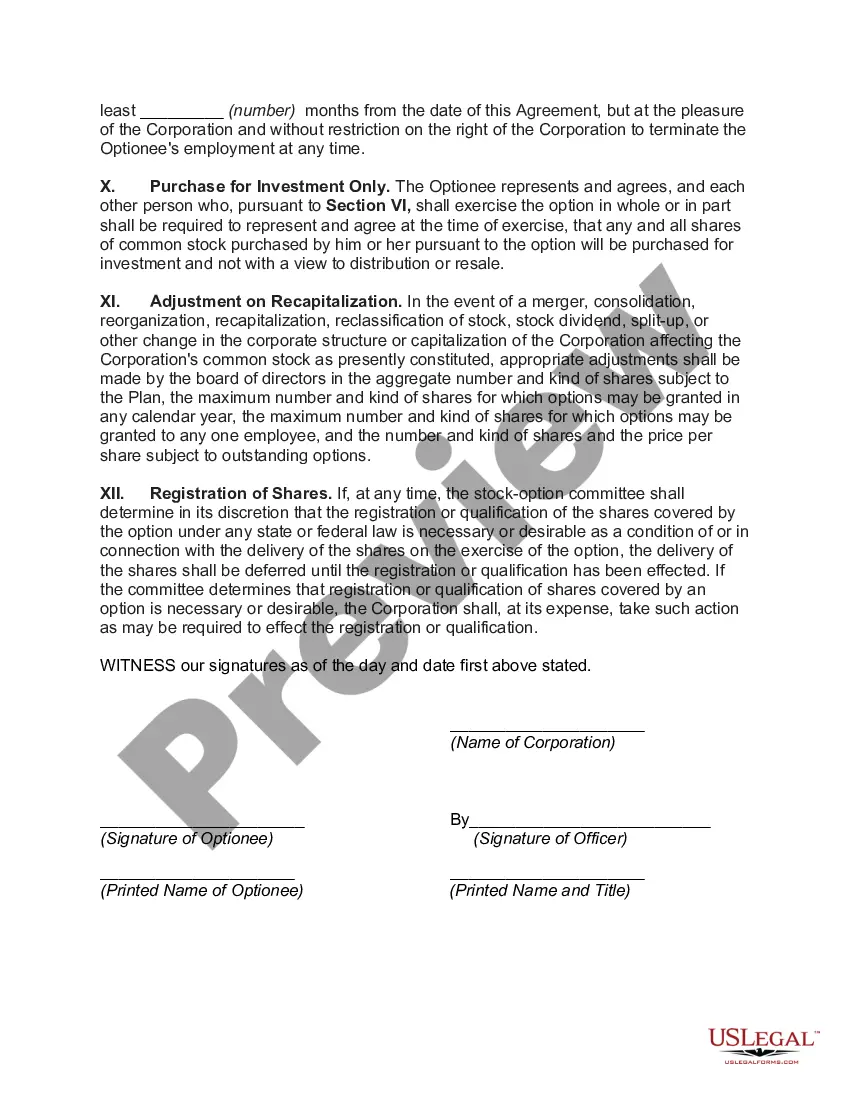
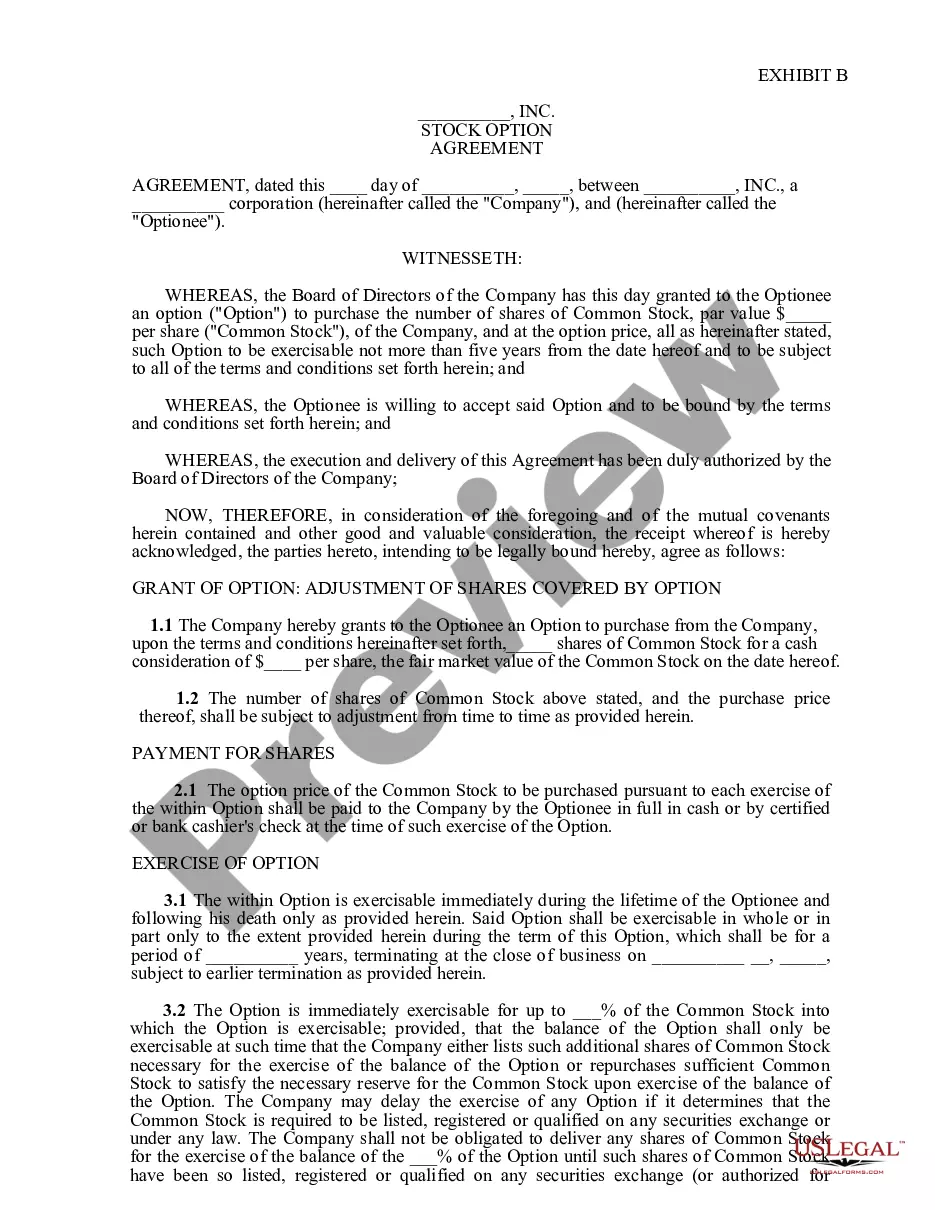
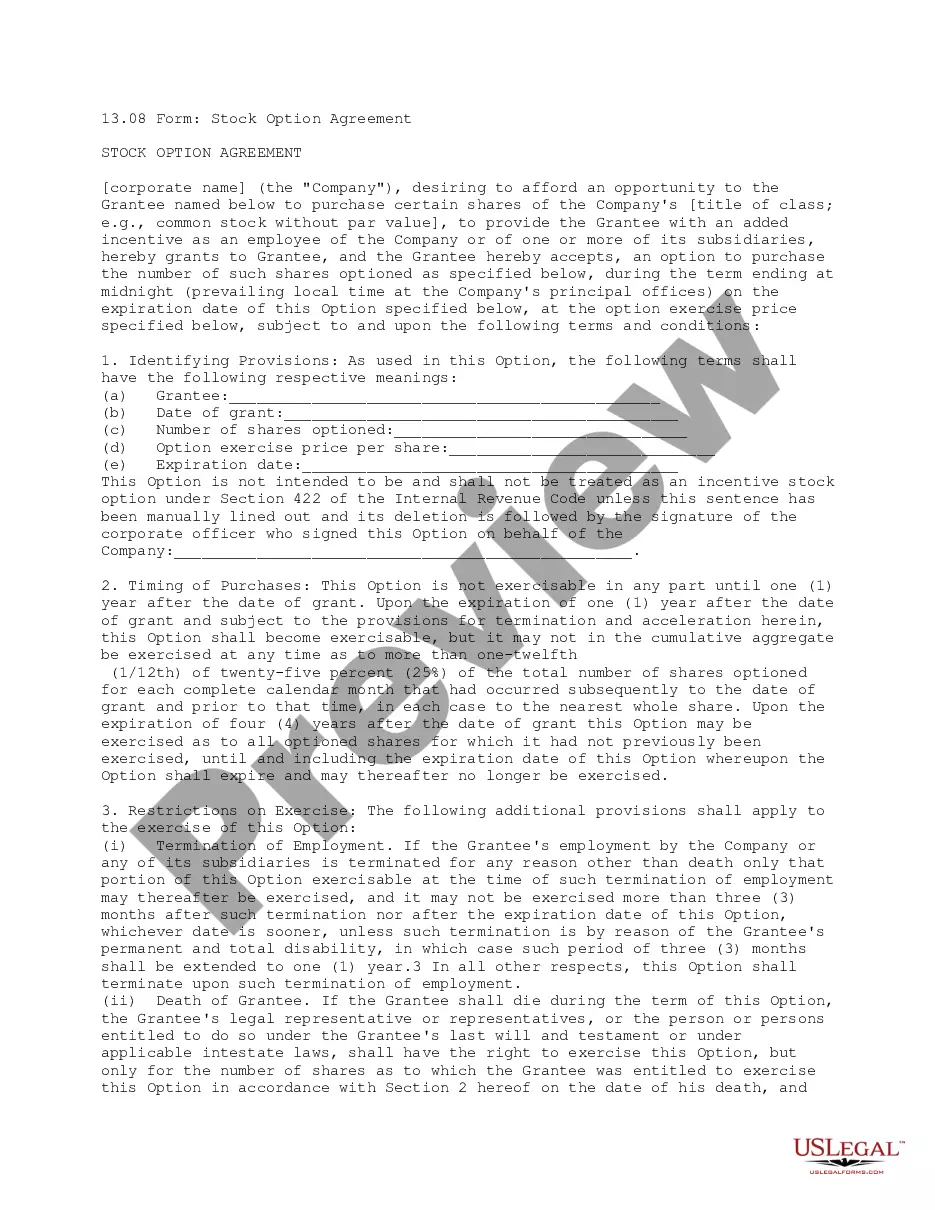
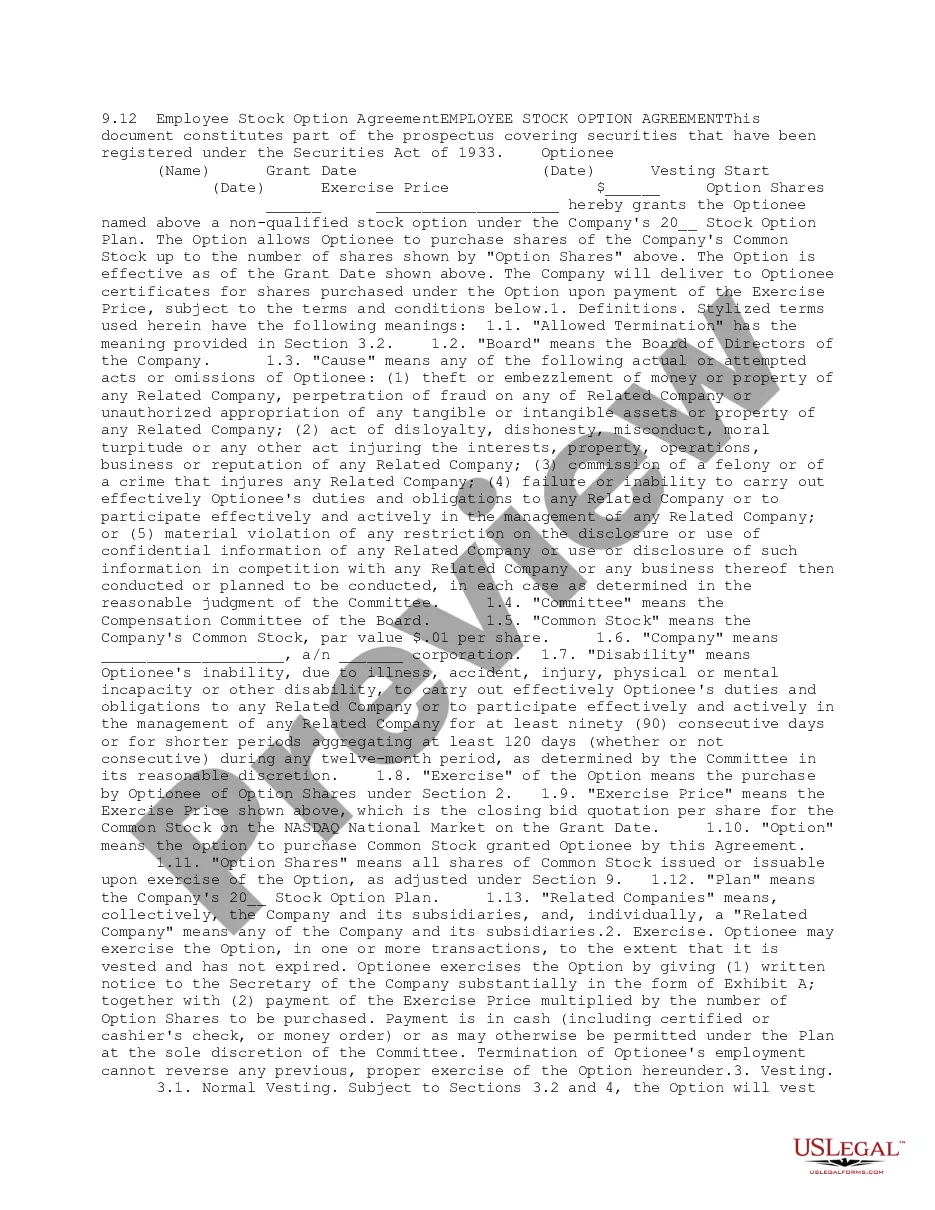
Stock Option Agreement With Vesting
Description
Get your form ready online
Our built-in tools help you complete, sign, share, and store your documents in one place.
Make edits, fill in missing information, and update formatting in US Legal Forms—just like you would in MS Word.
Download a copy, print it, send it by email, or mail it via USPS—whatever works best for your next step.
Sign and collect signatures with our SignNow integration. Send to multiple recipients, set reminders, and more. Go Premium to unlock E-Sign.
If this form requires notarization, complete it online through a secure video call—no need to meet a notary in person or wait for an appointment.
We protect your documents and personal data by following strict security and privacy standards.

Make edits, fill in missing information, and update formatting in US Legal Forms—just like you would in MS Word.

Download a copy, print it, send it by email, or mail it via USPS—whatever works best for your next step.

Sign and collect signatures with our SignNow integration. Send to multiple recipients, set reminders, and more. Go Premium to unlock E-Sign.

If this form requires notarization, complete it online through a secure video call—no need to meet a notary in person or wait for an appointment.

We protect your documents and personal data by following strict security and privacy standards.
Looking for another form?





How to fill out Stock Option Agreement Between Corporation And Officer Or Key Employee?
There’s no longer a requirement to spend countless hours searching for legal documents to meet your local state obligations.
US Legal Forms has compiled all of them in a single location and made their availability easier.
Our platform offers over 85k templates for various business and personal legal matters organized by state and purpose.
Utilize the Search field above to find another template if the previous one wasn’t suitable. Click Buy Now beside the template title when you identify the correct one. Choose the most appropriate pricing plan and register for an account or Log In. Make payment for your subscription using a credit card or through PayPal to proceed. Select the file format for your Stock Option Agreement With Vesting and download it to your device. Print your form to complete it manually or upload the sample if you prefer to use an online editor. Creating formal paperwork under federal and state regulations is quick and simple with our library. Experience US Legal Forms today to maintain your documentation organized!
- All forms are professionally prepared and verified for accuracy, so you can trust in receiving an up-to-date Stock Option Agreement With Vesting.
- If you are already familiar with our service and possess an account, ensure your subscription is active before acquiring any templates.
- Log In to your account, select the document, and click Download.
- You can also access all saved documents anytime needed by navigating to the My documents tab in your profile.
- If this is your first time using our service, the process will require a few additional steps to complete.
- Here’s how new users can discover the Stock Option Agreement With Vesting in our collection.
- Review the page content carefully to confirm it has the sample you need.
- To do this, utilize the form description and preview options if available.
Form popularity
FAQ
When an employee is vested in employer-matching retirement funds or stock options, she has nonforfeitable rights to those assets. The amount in which an employee is vested often increases gradually over a period of years until the employee is 100% vested. A common vesting period is three to five years.
The vesting period is the length of time that an employee must wait in order to be able to exercise their ESOs. Why does the employee need to wait? Because it gives the employee an incentive to perform well and stay with the company.
Often, vested stock options expire if they are not exercised within the specified timeframe after service termination. Typically, stock options expire within 90 days of leaving the company, so you could lose them if you don't exercise your options.
When a stock option vests, it means that it is actually available for you to exercise or buy. Unfortunately, you will not receive all of your options right when you join a company; rather, the options vest gradually, over a period of time known as the vesting period.
