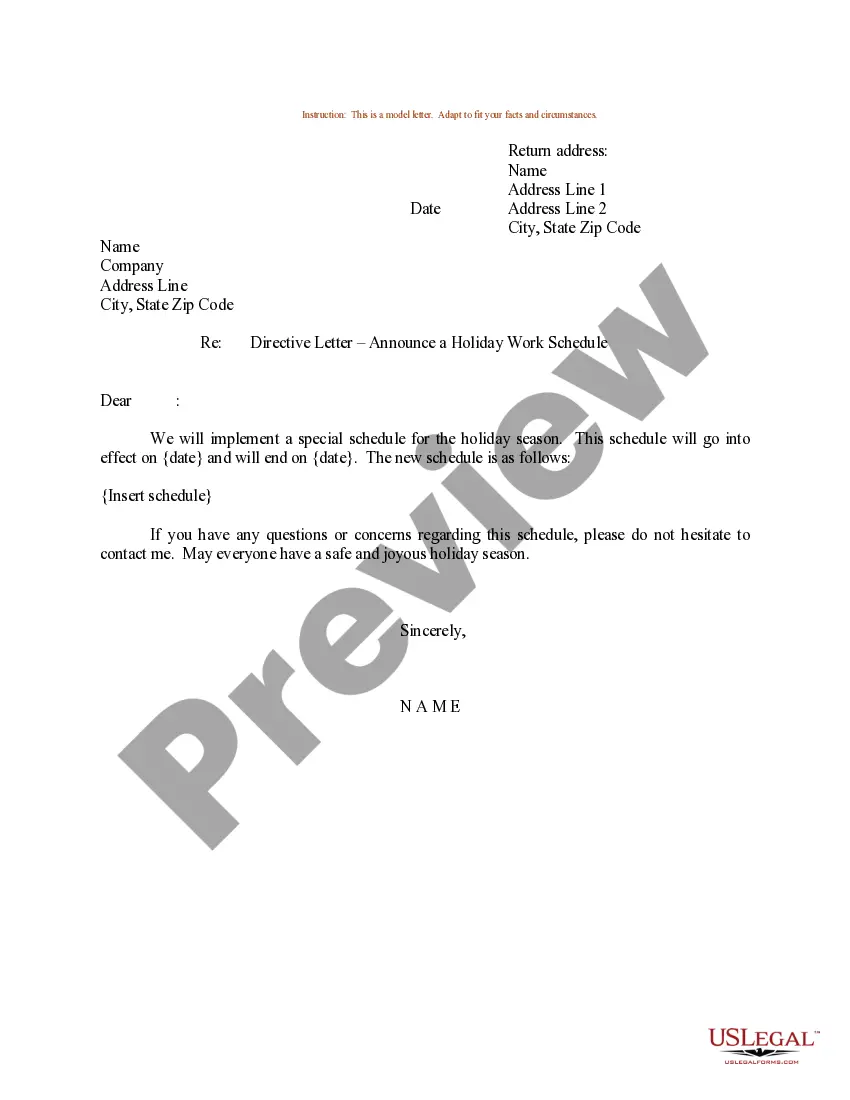
Sample Work Schedule Form With 2 Points
Description
Get your form ready online
Our built-in tools help you complete, sign, share, and store your documents in one place.
Make edits, fill in missing information, and update formatting in US Legal Forms—just like you would in MS Word.
Download a copy, print it, send it by email, or mail it via USPS—whatever works best for your next step.
Sign and collect signatures with our SignNow integration. Send to multiple recipients, set reminders, and more. Go Premium to unlock E-Sign.
If this form requires notarization, complete it online through a secure video call—no need to meet a notary in person or wait for an appointment.
We protect your documents and personal data by following strict security and privacy standards.

Make edits, fill in missing information, and update formatting in US Legal Forms—just like you would in MS Word.

Download a copy, print it, send it by email, or mail it via USPS—whatever works best for your next step.

Sign and collect signatures with our SignNow integration. Send to multiple recipients, set reminders, and more. Go Premium to unlock E-Sign.

If this form requires notarization, complete it online through a secure video call—no need to meet a notary in person or wait for an appointment.

We protect your documents and personal data by following strict security and privacy standards.
Looking for another form?

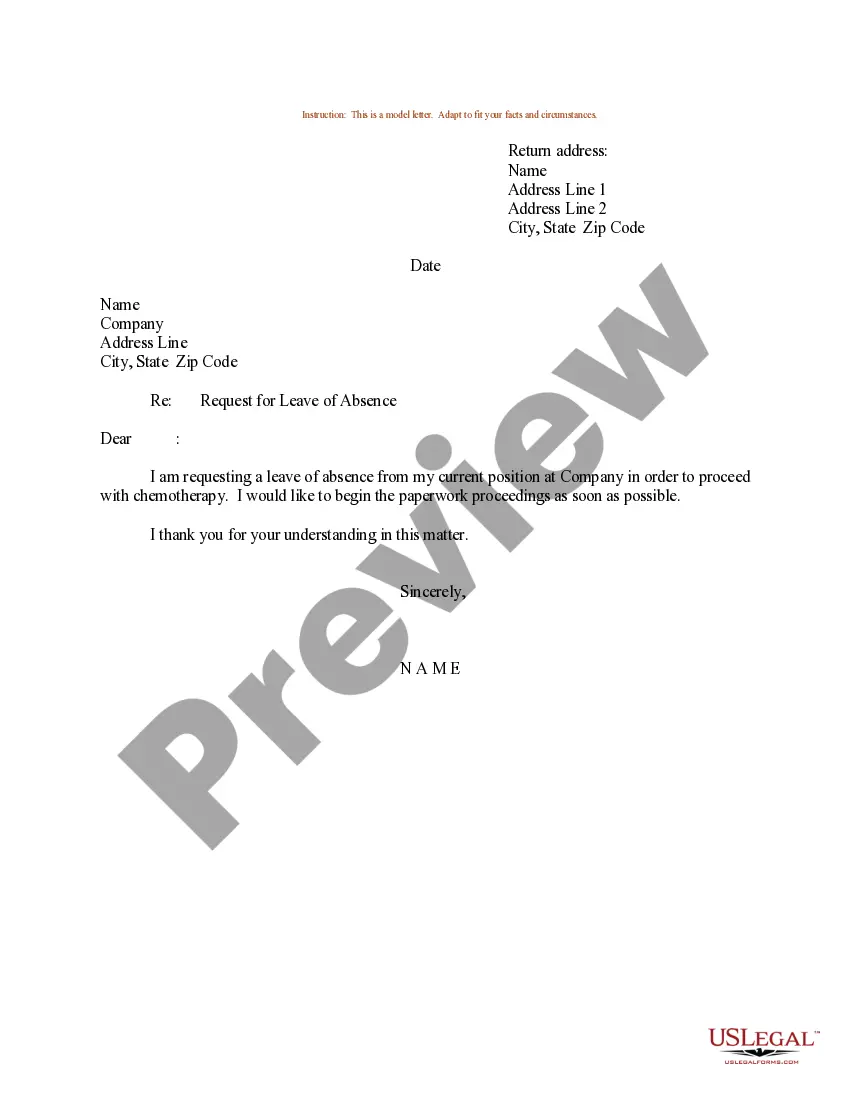
How to fill out Sample Letter For Holiday Work Schedule?
Whether for business purposes or for personal affairs, everyone has to deal with legal situations sooner or later in their life. Filling out legal documents demands careful attention, beginning from selecting the appropriate form sample. For instance, if you choose a wrong version of the Sample Work Schedule Form With 2 Points, it will be rejected once you send it. It is therefore important to get a reliable source of legal documents like US Legal Forms.
If you need to obtain a Sample Work Schedule Form With 2 Points sample, stick to these simple steps:
- Get the template you need by using the search field or catalog navigation.
- Look through the form’s description to ensure it matches your situation, state, and region.
- Click on the form’s preview to view it.
- If it is the wrong form, get back to the search function to find the Sample Work Schedule Form With 2 Points sample you require.
- Download the template when it matches your needs.
- If you already have a US Legal Forms profile, just click Log in to gain access to previously saved templates in My Forms.
- If you don’t have an account yet, you can obtain the form by clicking Buy now.
- Select the correct pricing option.
- Finish the profile registration form.
- Pick your payment method: you can use a credit card or PayPal account.
- Select the document format you want and download the Sample Work Schedule Form With 2 Points.
- After it is saved, you are able to complete the form with the help of editing software or print it and finish it manually.
With a vast US Legal Forms catalog at hand, you do not need to spend time searching for the right template across the internet. Use the library’s simple navigation to get the right form for any situation.
Form popularity
FAQ
A standard business schedule is one where employees work set days (usually Monday through Friday) and set hours (usually 9 a.m. to 5 p.m.). This is often referred to as a ?9-to-5 work schedule.? The standard work schedule is common enough that most employees will already be used to working those regular hours.
'2 Shift': Teams of participants usually rotate on a weekly basis. The 0600-1400 shift may be called earlies, mornings, AM, or 6-2, while the 1400-2200 shift may be called lates, afters, afternoons, back shift or 2-10. The default pattern may cover: two x 40 hours = 80 hours per week or two x 37.5 hours per week.
How best to create work schedules? Make the time to understand your team. Make the time to analyze the workload. Track employee clock-in and clock-out times. Follow a set of rules to schedule employees fairly. Establish an efficient team communication system. Post the work schedule at least 7 days in advance.
The ?2-3-2? The 2-3-2 was first introduced in the 1960's and became popular in the 1980's. The schedule is based on a 14-day period in which employees work 2 days on, 2 days off, 3 days on, 2 days off, 2 days on, and 3 days off.
A 2-2-3 work schedule requires employees to work 12-hour shifts in a 28-day rotating shift cycle. Four teams work 2 days in a row, get 2 days off, then work another 3 days. Typically, the teams will work opposite schedules throughout the 28-day cycle.