Accident Waiver Liability Without Insurance
Description
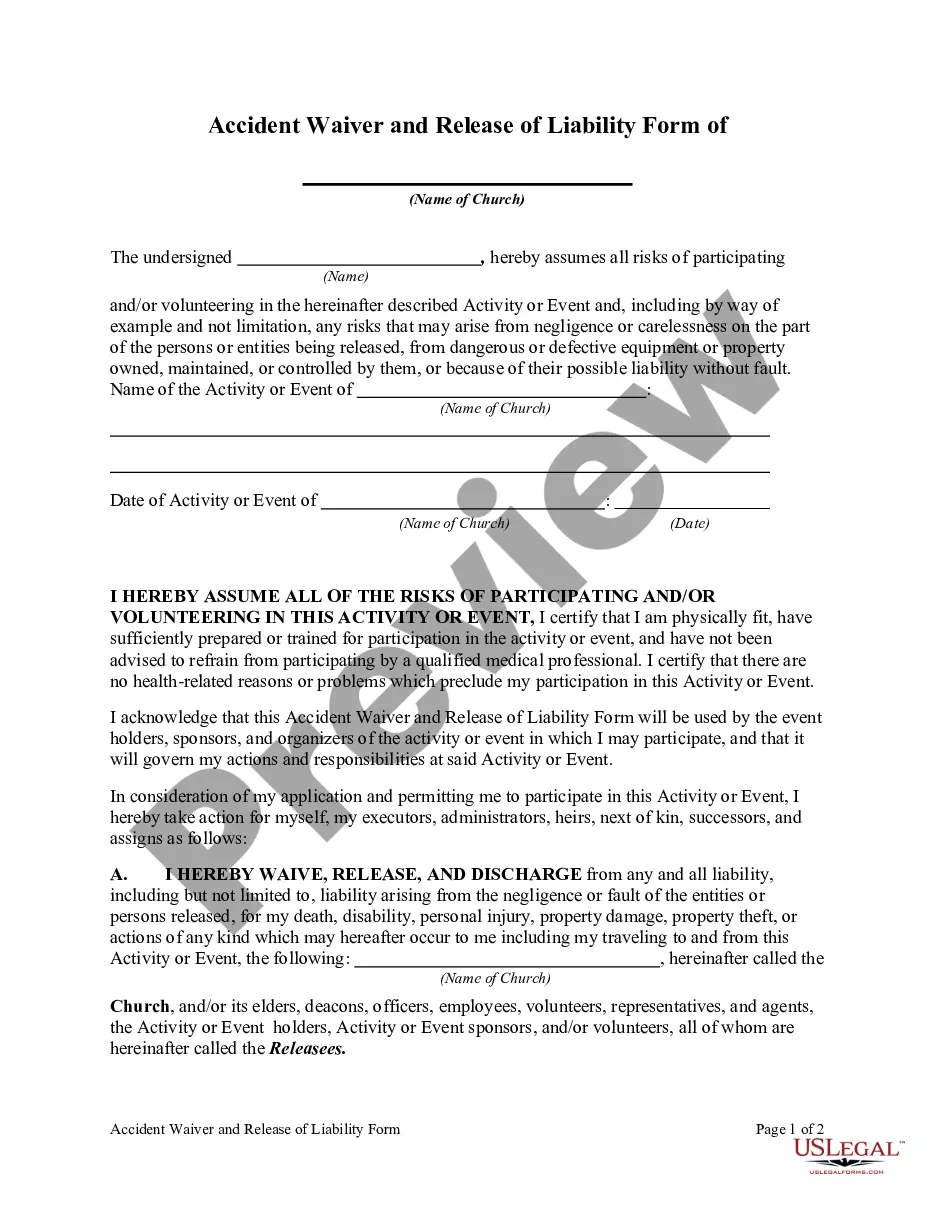
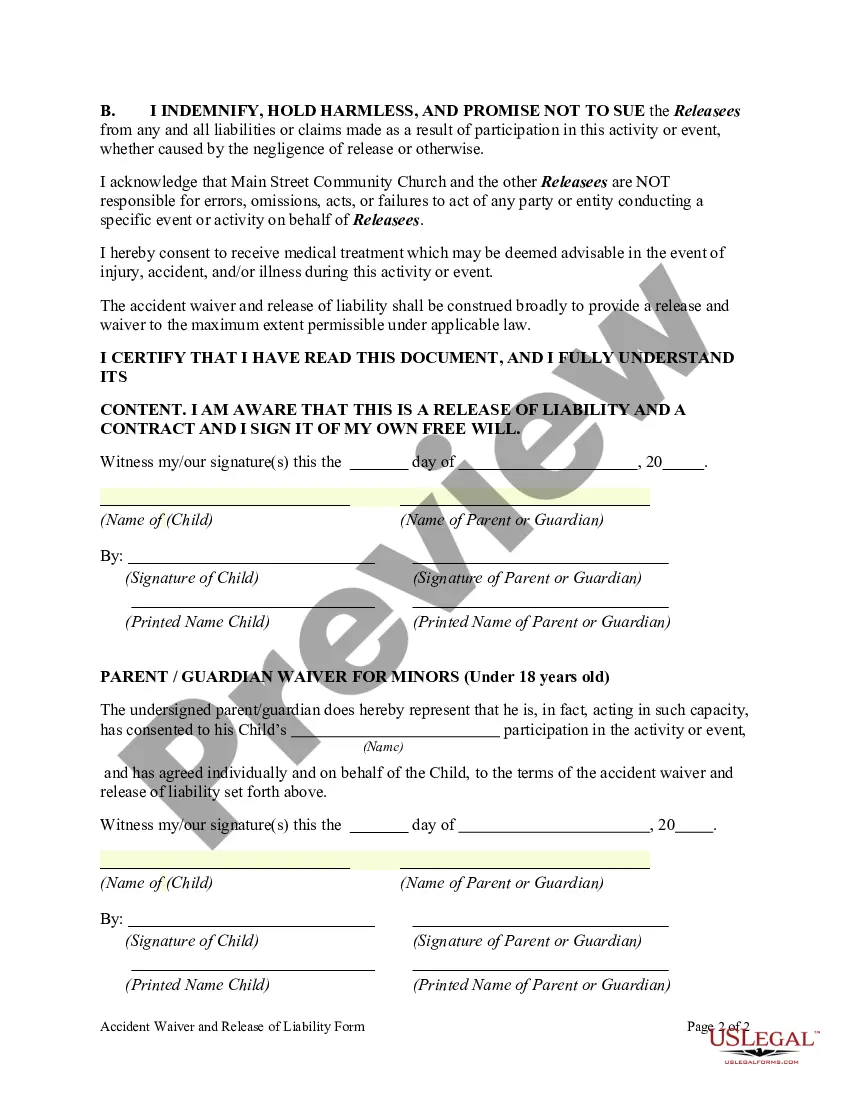

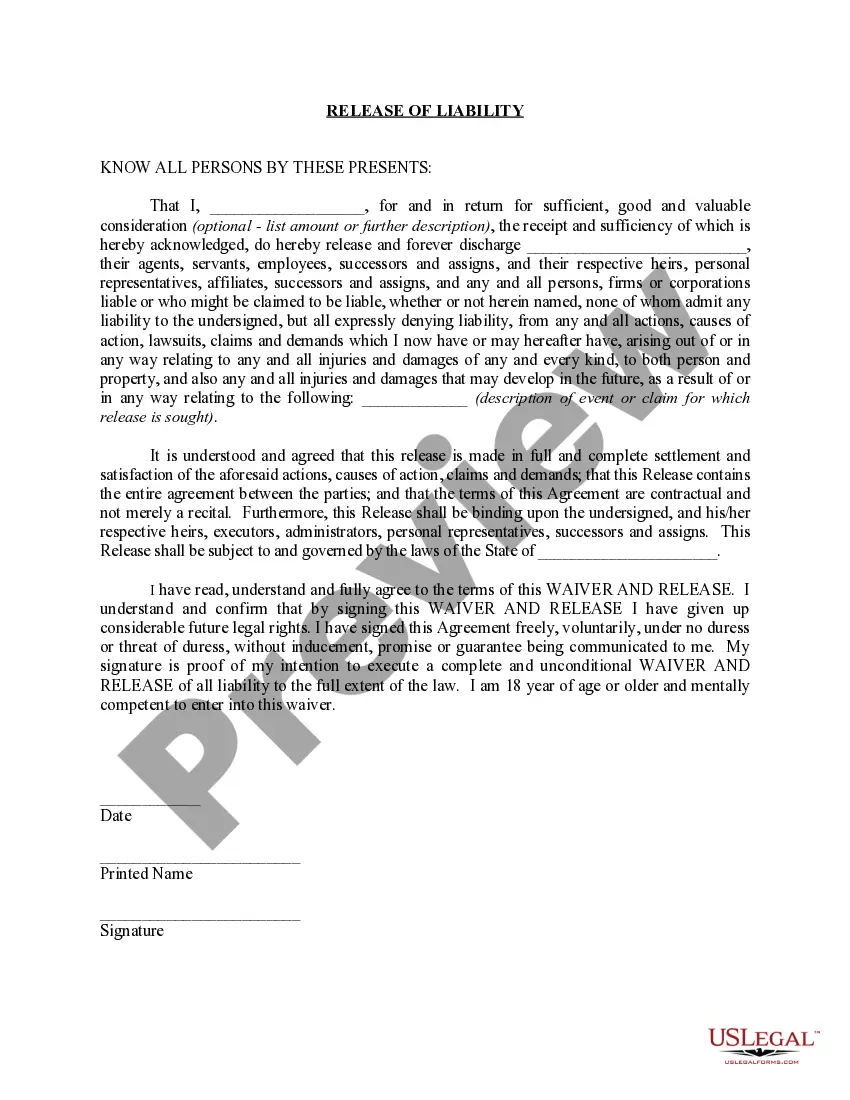
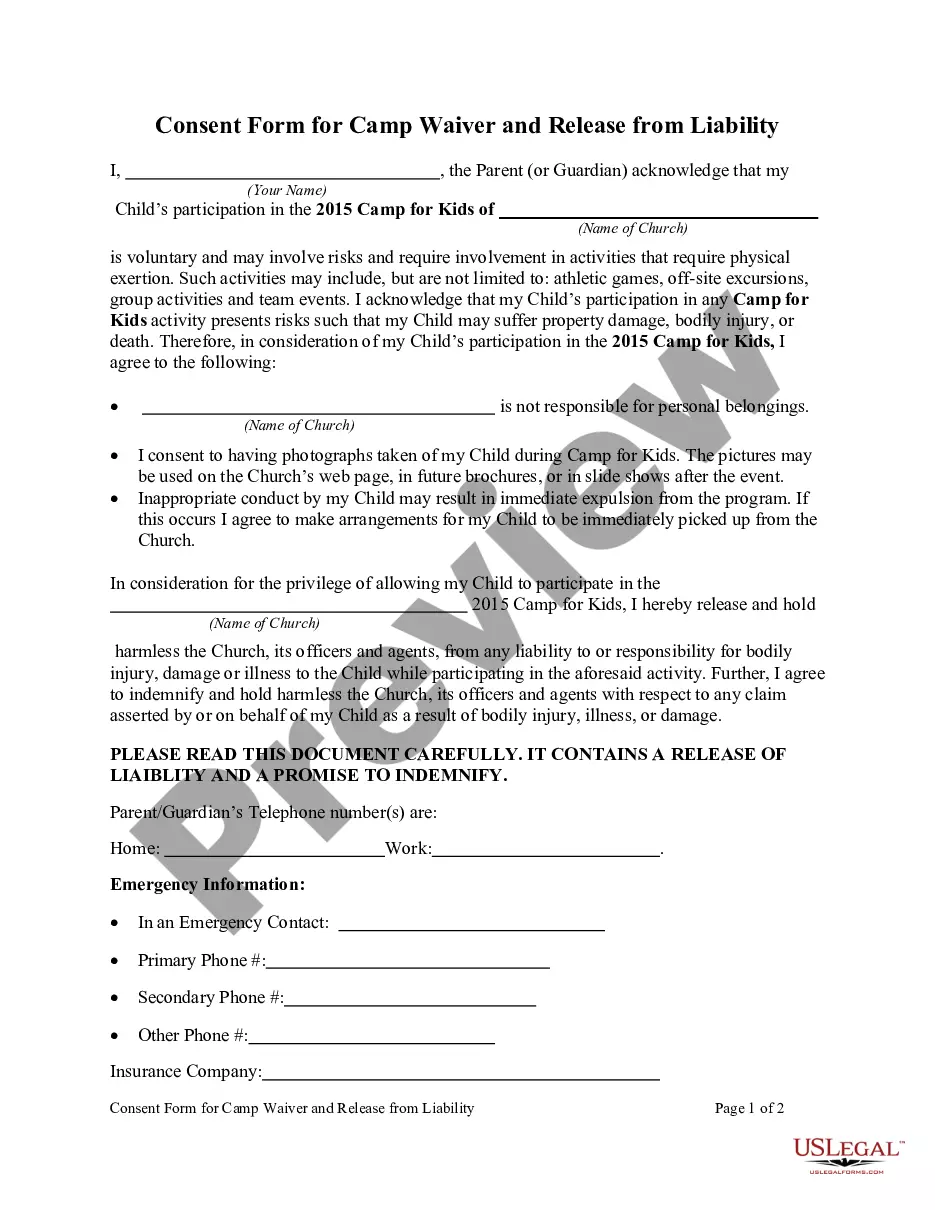
Get your form ready online
Our built-in tools help you complete, sign, share, and store your documents in one place.
Make edits, fill in missing information, and update formatting in US Legal Forms—just like you would in MS Word.
Download a copy, print it, send it by email, or mail it via USPS—whatever works best for your next step.
Sign and collect signatures with our SignNow integration. Send to multiple recipients, set reminders, and more. Go Premium to unlock E-Sign.
If this form requires notarization, complete it online through a secure video call—no need to meet a notary in person or wait for an appointment.
We protect your documents and personal data by following strict security and privacy standards.

Make edits, fill in missing information, and update formatting in US Legal Forms—just like you would in MS Word.

Download a copy, print it, send it by email, or mail it via USPS—whatever works best for your next step.

Sign and collect signatures with our SignNow integration. Send to multiple recipients, set reminders, and more. Go Premium to unlock E-Sign.

If this form requires notarization, complete it online through a secure video call—no need to meet a notary in person or wait for an appointment.

We protect your documents and personal data by following strict security and privacy standards.
Looking for another form?










How to fill out Accident Waiver And Release Of Liability Form?
Locating a reliable source for obtaining the latest and pertinent legal documents is a significant part of navigating bureaucracy.
Identifying the correct legal documentation necessitates precision and careful consideration, which underscores the importance of acquiring samples of Accident Waiver Liability Without Insurance exclusively from trustworthy sources, such as US Legal Forms. An incorrect template can squander your time and impede your circumstances.
Eliminate the hassles associated with your legal paperwork. Explore the comprehensive US Legal Forms collection where you can find legal templates, verify their suitability to your situation, and download them promptly.
- Utilize the library navigation or search option to locate your template.
- Examine the form’s description to determine if it aligns with the requirements of your state and locality.
- If available, preview the form to confirm it is indeed what you seek.
- If the Accident Waiver Liability Without Insurance does not meet your needs, return to the search for the appropriate template.
- Once you are confident about the form’s pertinence, proceed to download it.
- If you are a registered user, click Log in to verify your identity and access your selected forms in My documents.
- If you haven’t created an account, click Buy now to acquire the form.
- Select the pricing option that suits your needs.
- Continue to the registration process to finalize your purchase.
- Conclude your acquisition by selecting a payment method (credit card or PayPal).
- Choose the document format for downloading Accident Waiver Liability Without Insurance.
- Once the form is on your device, you can edit it using the editor or print it to fill it out by hand.
Form popularity
FAQ
Yes, it is legal to settle a car accident without insurance, but be cautious. Settlements between parties can lead to misunderstandings about financial liability. To ensure clarity, drafting an accident waiver liability without insurance can provide both parties with documented terms and help avoid future issues.
The Certificate of Parentage (COP) is a legal form parents complete to add the biological father's name to the child's birth certificate. By signing the form, parents are establishing paternity for their child ? meaning legally recognized fatherhood.
To establish paternity at the hospital, parents simply complete a Certificate of Parentage with the birth certificate coordinator. This adds the father's name to the child's birth certificate.
Under New Jersey law, fathers have rights with respect to their children, just as mothers do. Courts are to consider what is in the best interests of the child in determining matters involving child custody in divorce cases. A father also has rights if he is not married to the mother of his child.
Paternity will need to be established before the Court addresses any other matter of dispute such as child custody, parenting time or child support. Note that prior to birth, unmarried fathers do not have parental rights - or responsibilities.
Therefore, even if the father's name is not on the birth certificate, once paternity is established, the court could award him shared custody with the mother ? or even sole custody in appropriate circumstances. Having both parents involved is typically considered to be in the best interests of the child.
-38 et seq., provides the procedure by which paternity may be established. ing to the New Jersey Parentage Act, there is a 23-year statute of limitations, which means that a child must file a Complaint to Establish Paternity by their 23rd year, which is five years after the child is legally an adult.
If the father agrees that he is the father, he may sign a Certificate of Parentage (COP), which legally proves who the father of a child is. The first opportunity to sign the COP is at the hospital, right after a baby's birth. Hospital staff can help you complete it.
As long as paternity has been established, single mothers and single fathers have the same custody and visitation rights to their children as divorcing couples. Unmarried parents can petition the court for sole custody, joint custody and visitation with their children.