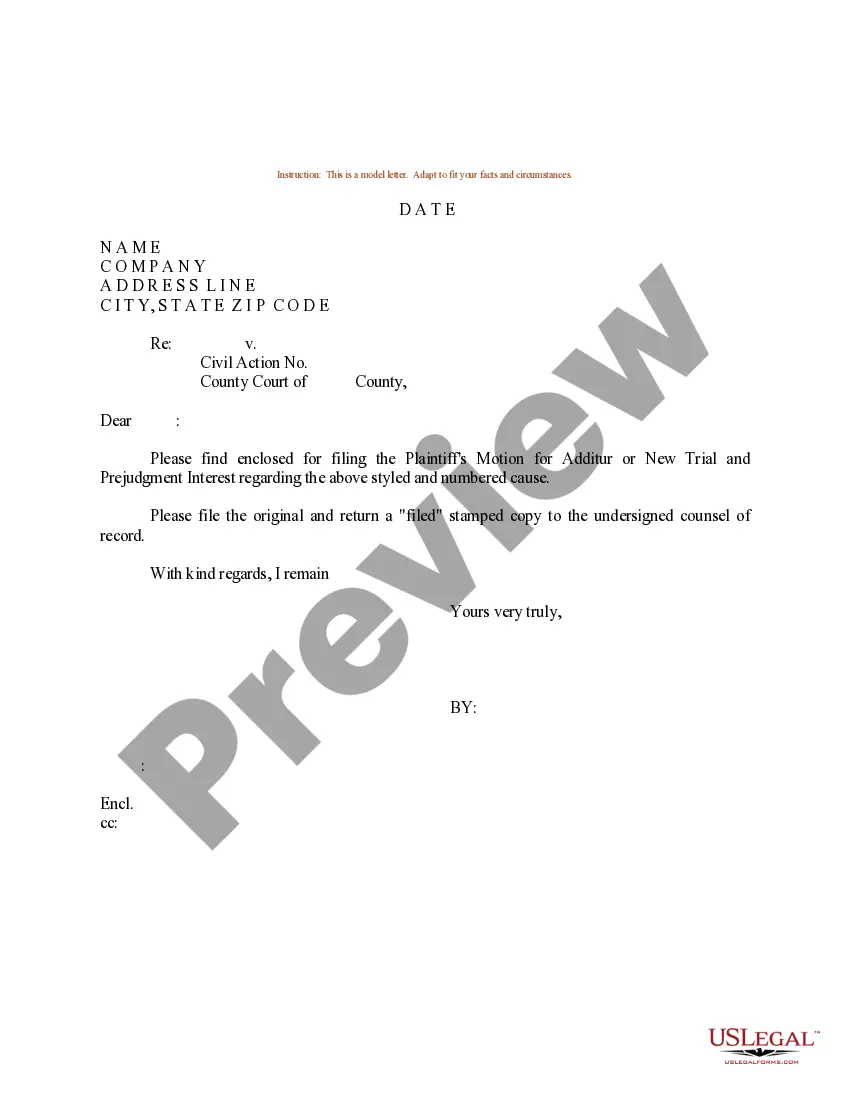
Prejudgment Interest By State
Description
Get your form ready online
Our built-in tools help you complete, sign, share, and store your documents in one place.
Make edits, fill in missing information, and update formatting in US Legal Forms—just like you would in MS Word.
Download a copy, print it, send it by email, or mail it via USPS—whatever works best for your next step.
Sign and collect signatures with our SignNow integration. Send to multiple recipients, set reminders, and more. Go Premium to unlock E-Sign.
If this form requires notarization, complete it online through a secure video call—no need to meet a notary in person or wait for an appointment.
We protect your documents and personal data by following strict security and privacy standards.

Make edits, fill in missing information, and update formatting in US Legal Forms—just like you would in MS Word.

Download a copy, print it, send it by email, or mail it via USPS—whatever works best for your next step.

Sign and collect signatures with our SignNow integration. Send to multiple recipients, set reminders, and more. Go Premium to unlock E-Sign.

If this form requires notarization, complete it online through a secure video call—no need to meet a notary in person or wait for an appointment.

We protect your documents and personal data by following strict security and privacy standards.
Looking for another form?

How to fill out Sample Letter For Motion For Additur Or New Trial And Prejudgment Interest?
Regardless of whether it is for professional reasons or for personal matters, everyone must confront legal circumstances at some point in their lives.
Filling out legal paperwork requires meticulous attention, starting with choosing the correct form template.
With a vast catalog of US Legal Forms available, you do not need to waste time searching for the appropriate template online. Utilize the library’s user-friendly navigation to find the right form for any circumstance.
- Acquire the template you require by utilizing the search field or browsing the catalog.
- Review the form’s details to ensure it suits your situation, state, and locality.
- Click on the form’s preview to view it.
- If it's the wrong document, return to the search feature to find the Prejudgment Interest By State template you need.
- Download the document if it meets your requirements.
- If you already possess a US Legal Forms account, click Log in to access previously saved documents in My documents.
- If you do not have an account yet, you can obtain the form by clicking Buy now.
- Select the suitable pricing option.
- Complete the account registration form.
- Choose your payment method: you can utilize a credit card or PayPal account.
- Select the file format you prefer and download the Prejudgment Interest By State.
- After it is downloaded, you can fill out the form using editing software or print it and complete it manually.
Form popularity
FAQ
To calculate prejudgment interest in Excel, start by creating a formula to find the appropriate interest amount. You will need the principal sum, the interest rate, and the time duration you are considering. You can use a simple formula like =PrincipalRateTime to find your answer. For more detailed templates and examples, US Legal Forms offers tools and resources to streamline this process.
In Washington, D.C., the statutory rate for prejudgment interest is generally set at 5 percent per annum. This rate applies to award amounts that are due and payable in personal injury and contract cases. Given that rates can change, it's always wise to verify the current rate before proceeding. Resources like US Legal Forms can provide updated information for your specific needs.
In a default judgment scenario, interest is generally calculated from the date the claim arose until the judgment is entered. Depending on the state's laws, you may apply the statutory prejudgment interest rate to the total amount awarded. It is crucial to confirm the interest rate and any specific rules surrounding default judgments in your state, which you can easily research through US Legal Forms.
In New York, the statutory rate for prejudgment interest is typically set at 9% per annum. This may apply to certain types of claims and is designed to cover the time between the date of the loss and the resolution of the claim. However, it is essential to check case-specific laws, as some cases might utilize different rates. If you're unsure, consult resources at US Legal Forms to clarify your specific situation.
To calculate prejudgment interest by state, start by identifying the applicable interest rate for your state. You then multiply that rate by the amount owed and the duration for which you are claiming interest. It’s important to check state-specific guidelines, as each state may have unique rules regarding how interest accrues. For accurate calculations, consider using the tools available on US Legal Forms.
The interest rate for prejudgment depends on the state in which the case is being heard. In New York, for instance, it is set at 9% per year. Being aware of the varying prejudgment interest by state can help individuals make informed decisions regarding their cases, and platforms like US Legal Forms offer resources to simplify this complex information.
Calculating prejudgment interest requires knowing the principal amount and the interest rate applicable for the specific state. In New York, use the formula: Interest = Principal x Rate x Time. Understanding how to calculate prejudgment interest by state not only benefits plaintiffs but also enhances their strategy during litigation.
The prejudgment interest rate in New York is generally 9% per annum, as outlined in the CPLR. This rate applies to cases where there is a monetary award, making it essential for plaintiffs to consider when evaluating their potential recovery. By being informed about the prejudgment interest by state, individuals can better prepare themselves for legal proceedings.
In New York State, the default interest rate for prejudgment interest can often be found in New York Civil Practice Law and Rules. Typically, this rate is set at 9% per year, unless otherwise specified by law. Understanding the default rate is crucial when dealing with prejudgment interest by state, as it can impact the financial outcome of your case.
Prejudgment interest is generally considered to be a substantive right rather than purely procedural. This distinction means that it can affect the outcome of a case significantly, depending on the state law ruling it. Understanding whether prejudgment interest by state categorizes as procedural or substantive can help you better prepare your legal strategy.