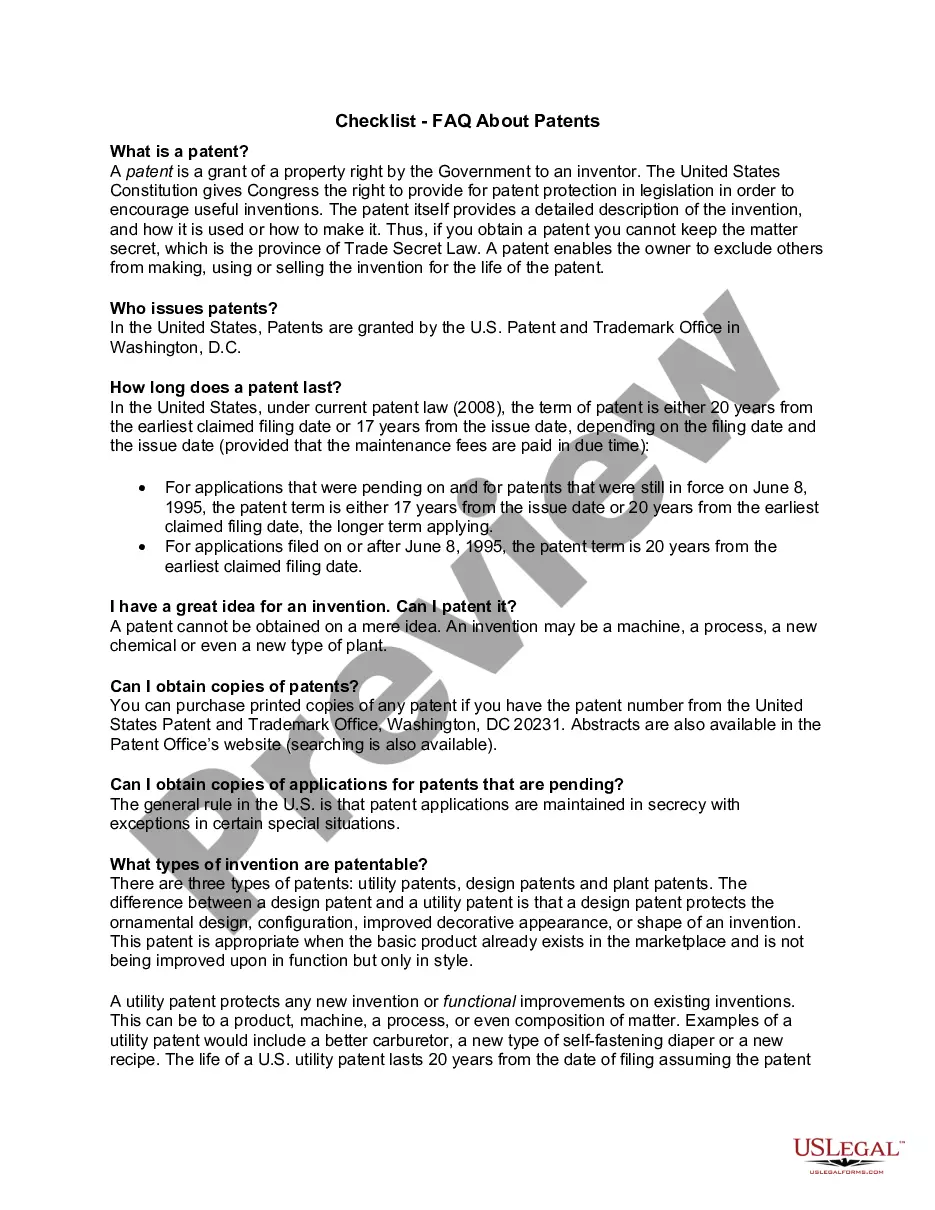
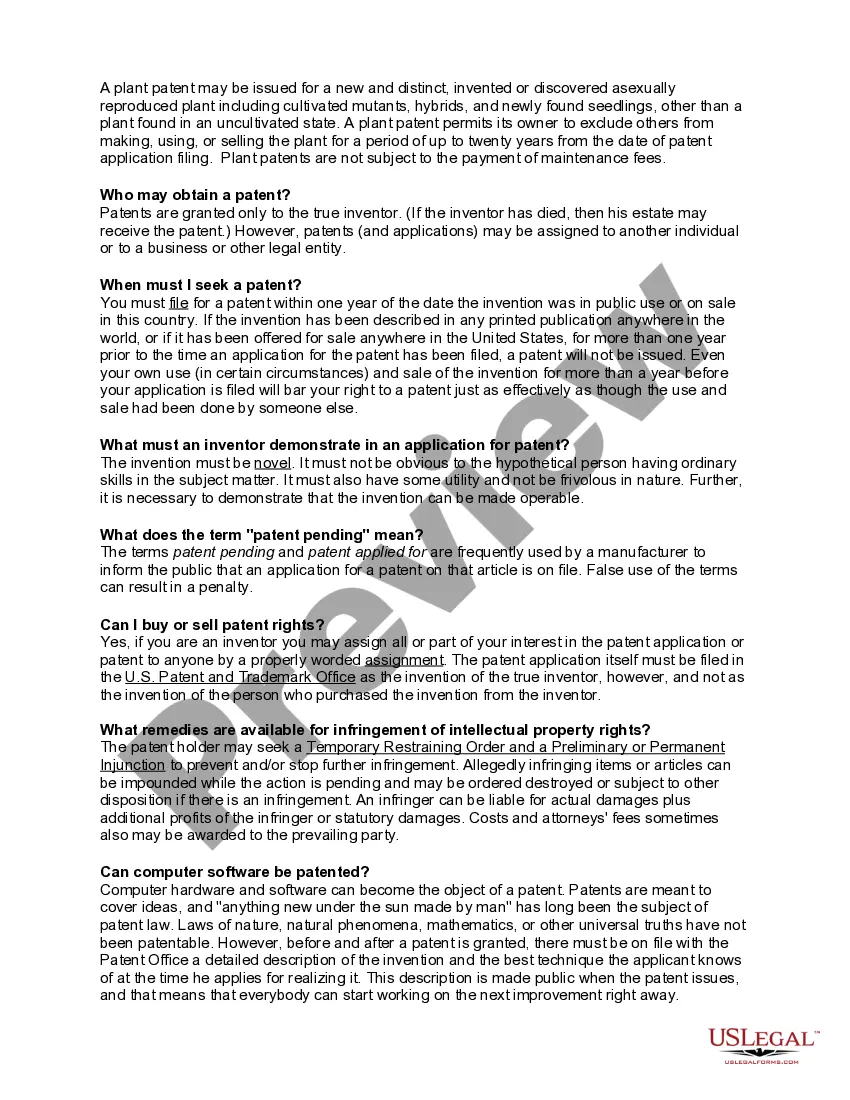
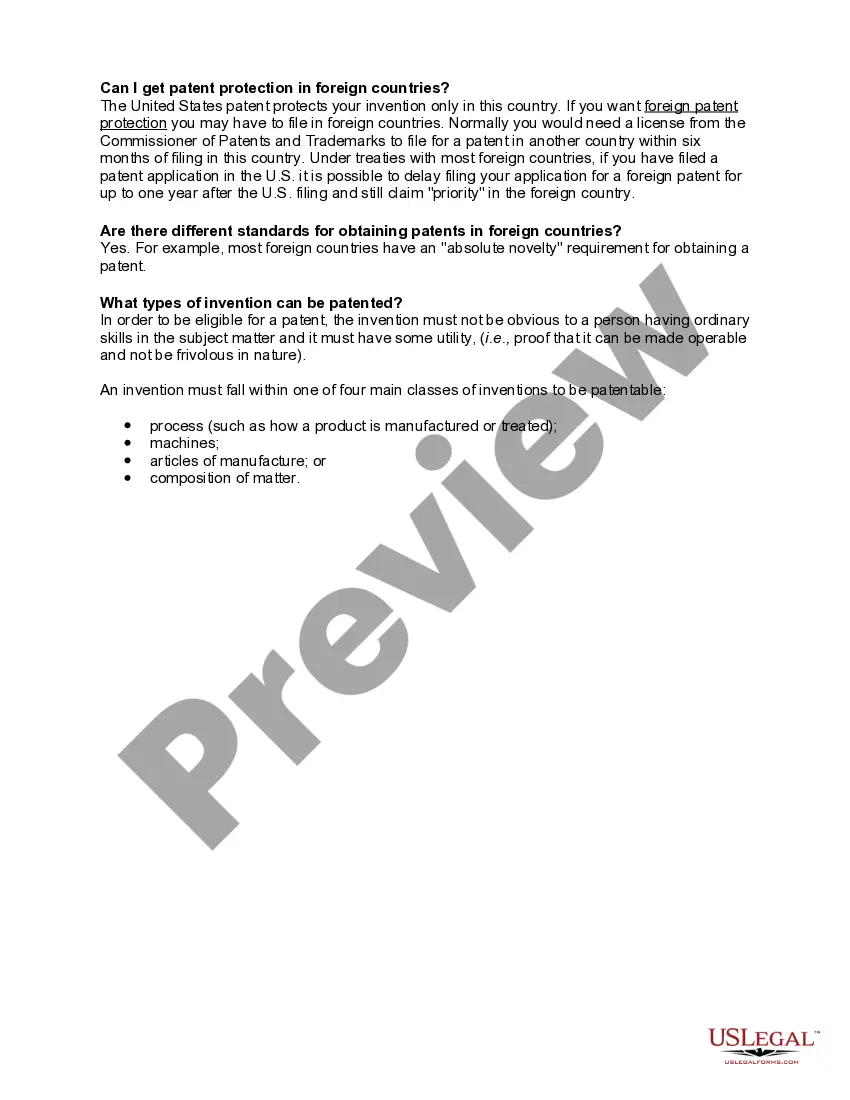
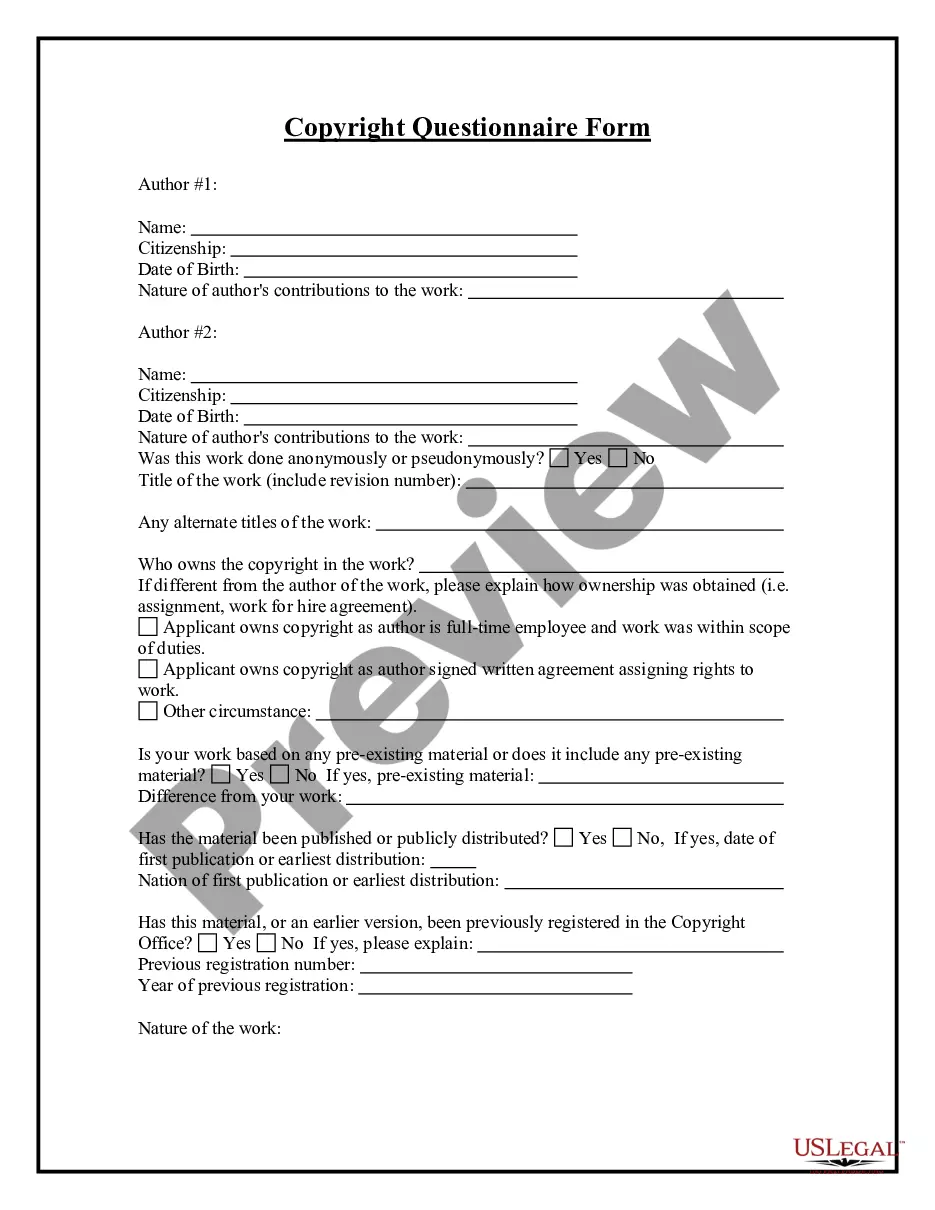
About Patents For The Future
Description
Get your form ready online
Our built-in tools help you complete, sign, share, and store your documents in one place.
Make edits, fill in missing information, and update formatting in US Legal Forms—just like you would in MS Word.
Download a copy, print it, send it by email, or mail it via USPS—whatever works best for your next step.
Sign and collect signatures with our SignNow integration. Send to multiple recipients, set reminders, and more. Go Premium to unlock E-Sign.
If this form requires notarization, complete it online through a secure video call—no need to meet a notary in person or wait for an appointment.
We protect your documents and personal data by following strict security and privacy standards.

Make edits, fill in missing information, and update formatting in US Legal Forms—just like you would in MS Word.

Download a copy, print it, send it by email, or mail it via USPS—whatever works best for your next step.

Sign and collect signatures with our SignNow integration. Send to multiple recipients, set reminders, and more. Go Premium to unlock E-Sign.

If this form requires notarization, complete it online through a secure video call—no need to meet a notary in person or wait for an appointment.

We protect your documents and personal data by following strict security and privacy standards.
Looking for another form?










How to fill out Checklist - FAQ About Patents?
- Start by visiting the US Legal Forms website and log into your account, ensuring your subscription is active. If you're a new user, create an account to gain access.
- Browse the extensive collection of over 85,000 legal forms to find the patent template that best fits your requirements. Use the Preview mode to verify details.
- If you need an alternative template, utilize the Search tab to find a suitable option that aligns with your local jurisdiction.
- Select the desired document and click the Buy Now button to choose your subscription plan. This step requires account registration if you're a first-time user.
- Complete your purchase by entering your payment details, either via credit card or PayPal, to finalize the subscription.
- Once payment is processed, download the patent form to your device. You can also access it anytime in the My Forms section of your account.
In conclusion, US Legal Forms empowers both individuals and attorneys by streamlining the legal document preparation process. With its vast library and the option to receive expert assistance, securing your future patents has never been more straightforward.
Don't wait any longer—explore US Legal Forms today and take the first step towards protecting your innovations.
Form popularity
FAQ
To secure a patent for your idea, start by conducting a thorough search to ensure your invention is unique. Next, prepare a detailed description of your idea, including diagrams or sketches if possible. Then, you can file a patent application with the United States Patent and Trademark Office (USPTO). For guidance during this process, consider using the resources available on US Legal Forms, which can assist you in navigating the complexities and help you understand more about patents for the future.
To secure a patent, an invention must meet five key requirements. Firstly, your idea must be novel, meaning it cannot have been disclosed to the public before your application. Secondly, it must be non-obvious, which means that someone with technical skill in the field would not easily think of it. Additionally, it must be useful and serve a specific function. Lastly, the invention must be adequately described and detailed in the patent application. Understanding these criteria is essential for anyone looking to navigate the complex landscape of patents for the future.
Patents encourage innovation by granting inventors exclusive rights to their inventions for a limited time. Did you know that the first recorded patent was granted in 1421 in England for a method of making a certain type of glass? Additionally, the United States issues more patents than any other country, reflecting its vibrant culture of invention and creativity. Understanding patents is essential for anyone looking to build a secure future for their ideas and might lead you to think about patents for the future.
Elon Musk holds several patents across different industries, particularly in technology and space exploration. While the exact number can vary, his commitment to innovation is clear. Knowing about Musk's patents can inspire others to think about patents for the future and how they can protect their own inventions.
To obtain a patent, start by documenting your idea thoroughly. Next, conduct a patent search to ensure that your idea is unique. Afterward, you can file a patent application online or seek assistance from platforms like uslegalforms, which can simplify the process of securing legal rights about patents for the future.
Elon Musk expresses concern that patents might limit the sharing of ideas and technology. He encourages an open-source approach, believing that collaboration fuels progress. This stance reinforces the ongoing conversation about patents for the future and their role in innovation.
Yes, SpaceX holds numerous patents related to aerospace technology and rocket design. These patents support their innovative processes and help protect their unique technologies. Understanding how patents play a role in tech giants like SpaceX can provide insight into the broader topic of patents for the future.
The concept of a poor man's patent refers to documenting your invention and mailing it to yourself. While it may offer some proof of concept, it does not provide legal protection. For robust protection, pursuing a formal patent is essential, especially if you aim to secure your ideas about patents for the future.
Elon Musk has a distinct perspective on patents. He believes that patents can sometimes hinder innovation rather than promote it. This viewpoint aligns with the idea that sharing knowledge fosters creativity, particularly when we think about patents for the future.