Mediation Vs Arbitration Definition With The
Description



Get your form ready online
Our built-in tools help you complete, sign, share, and store your documents in one place.
Make edits, fill in missing information, and update formatting in US Legal Forms—just like you would in MS Word.
Download a copy, print it, send it by email, or mail it via USPS—whatever works best for your next step.
Sign and collect signatures with our SignNow integration. Send to multiple recipients, set reminders, and more. Go Premium to unlock E-Sign.
If this form requires notarization, complete it online through a secure video call—no need to meet a notary in person or wait for an appointment.
We protect your documents and personal data by following strict security and privacy standards.

Make edits, fill in missing information, and update formatting in US Legal Forms—just like you would in MS Word.

Download a copy, print it, send it by email, or mail it via USPS—whatever works best for your next step.

Sign and collect signatures with our SignNow integration. Send to multiple recipients, set reminders, and more. Go Premium to unlock E-Sign.

If this form requires notarization, complete it online through a secure video call—no need to meet a notary in person or wait for an appointment.

We protect your documents and personal data by following strict security and privacy standards.
Looking for another form?







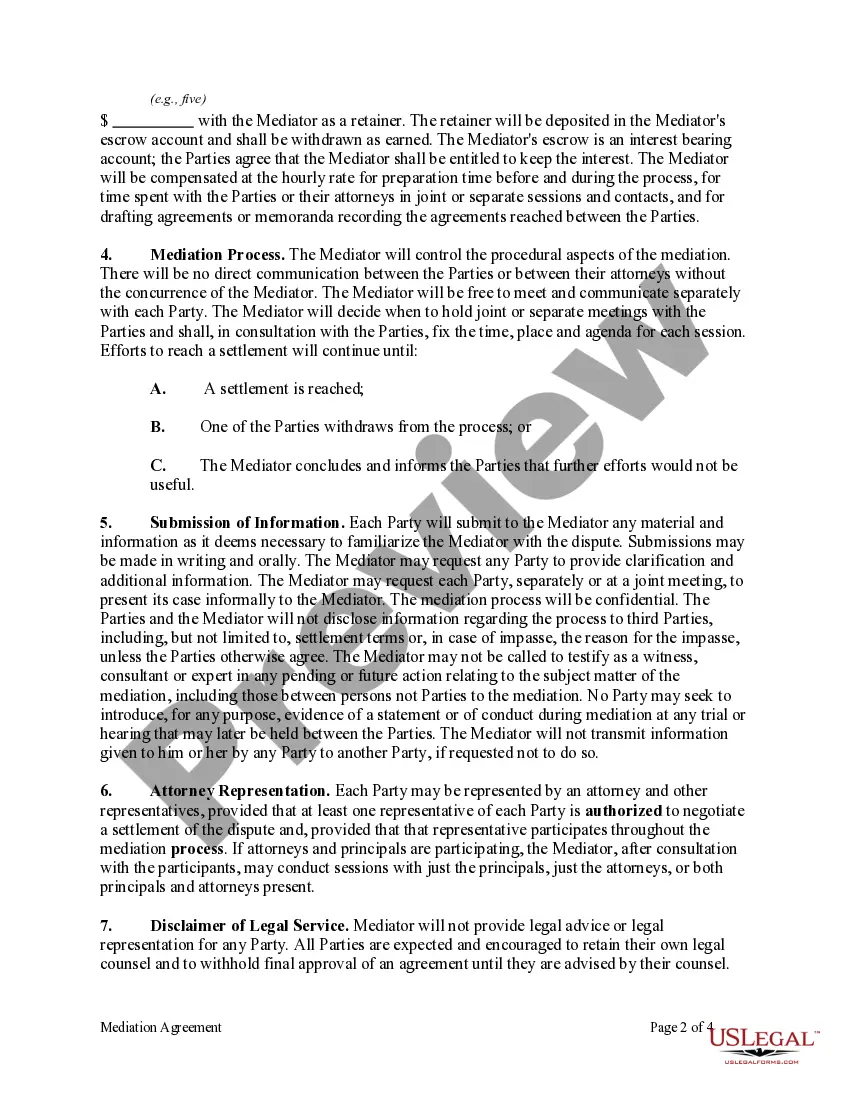
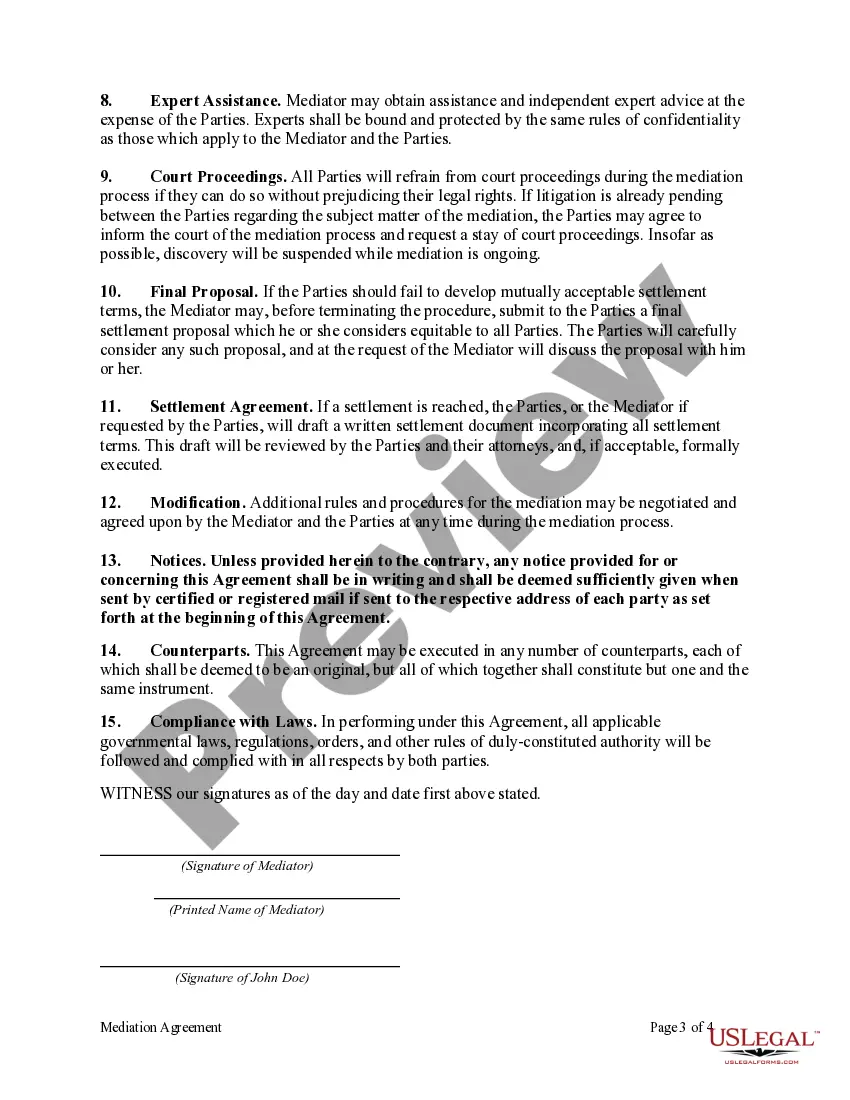
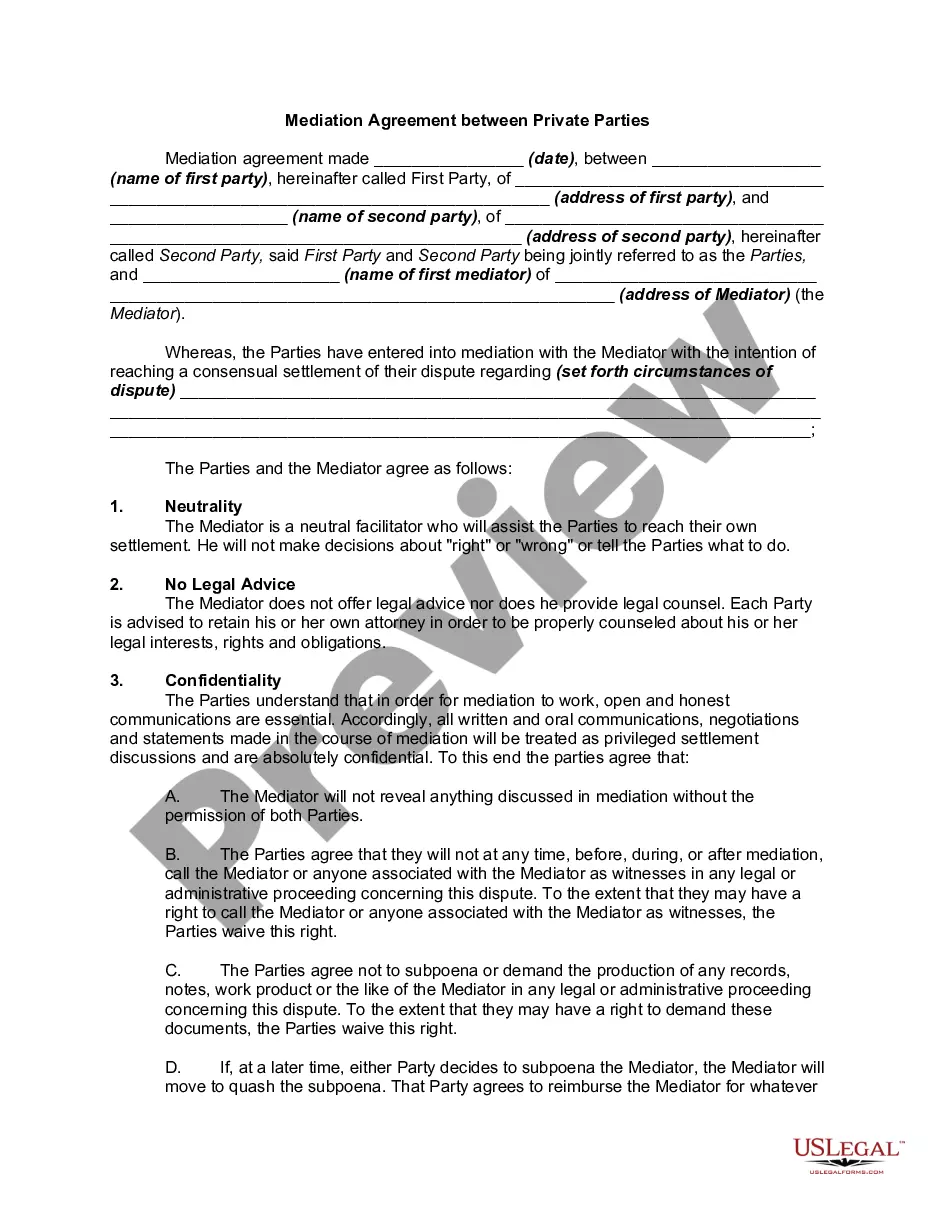
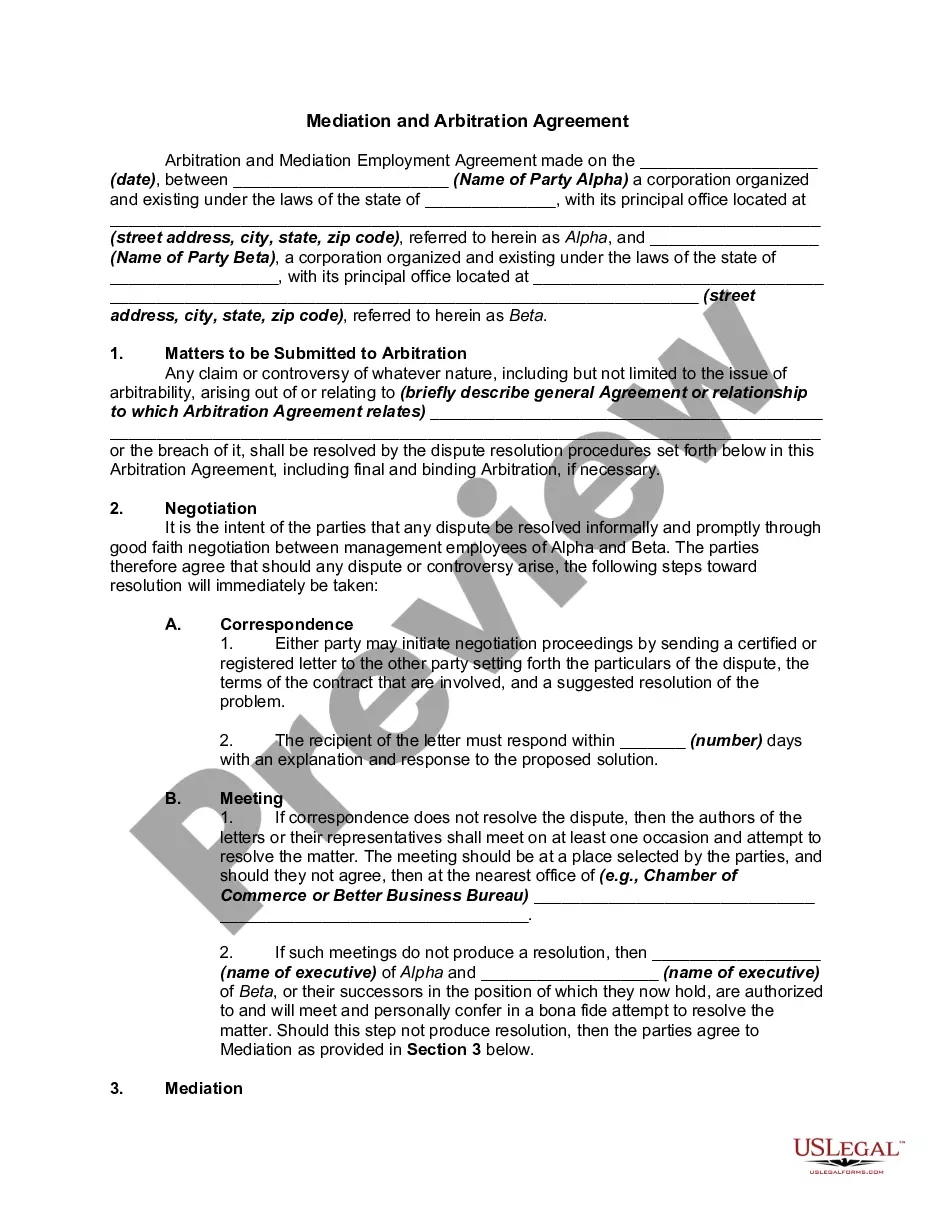
How to fill out Mediation Agreement?
Finding a reliable source for obtaining the most up-to-date and suitable legal templates is a significant part of navigating bureaucracy.
Identifying the correct legal documents requires accuracy and careful consideration, which is why it is crucial to obtain samples of Mediation Vs Arbitration Definition With The solely from trustworthy sources, such as US Legal Forms.
Once you have acquired the form on your device, you may modify it using the editor, or print it out and complete it by hand. Eliminate the complications associated with your legal documentation. Browse the extensive US Legal Forms collection where you can locate legal templates, verify their suitability for your situation, and download them immediately.
- Utilize the library navigation or search feature to locate your template.
- Review the form’s description to determine if it meets your state's and region's criteria.
- Access the form preview, if available, to ensure it is indeed the form you seek.
- If the Mediation Vs Arbitration Definition With The does not align with your needs, continue searching to find the suitable template.
- If you are certain of the form’s applicability, proceed to download it.
- As a registered user, click Log in to verify and access your selected forms in My documents.
- If you do not possess an account yet, click Buy now to acquire the form.
- Choose the pricing plan that caters to your requirements.
- Advance to the registration process to complete your purchase.
- Finalize your transaction by selecting a payment method (credit card or PayPal).
- Choose the document format for downloading Mediation Vs Arbitration Definition With The.
Form popularity
FAQ
A key advantage of mediation over arbitration is the preservation of relationships between the parties. Mediation encourages open dialogue and mutual understanding, which can be crucial in ongoing relationships, such as business partnerships. In contrast, arbitration may create a winner-loser dynamic that can strain relationships. Embracing the mediation vs arbitration definition with this perspective can lead to more amicable resolutions, and uslegalforms offers resources to assist with this process.
The primary difference between mediation and arbitration, as noted in many educational resources like Quizlet, is the process involved. Mediation focuses on collaboration and communication between parties, while arbitration emphasizes a formal decision-making process. Knowing the mediation vs arbitration definition with these key distinctions can help you better navigate any dispute. Platforms like uslegalforms can provide guidance on which method to pursue.
The major difference between mediation and arbitration is the level of control the parties have over the outcome. Mediation allows parties to negotiate and create their own resolution, fostering collaboration. On the other hand, arbitration results in a decision imposed by the arbitrator, which can lead to a more adversarial atmosphere. By understanding the mediation vs arbitration definition with this distinction, you can choose the best path for conflict resolution.
The main difference between mediation and arbitration lies in the role of the third party involved. In mediation, the mediator facilitates dialogue and helps both parties reach a mutual agreement. In contrast, an arbitrator makes a decision for the parties, which they are obligated to follow. Familiarizing yourself with the mediation vs arbitration definition with these roles can clarify which process may be more suitable for your needs.
In arbitration, the outcome often depends on the specific circumstances of each case. Typically, the party that presents stronger evidence and arguments has a higher chance of winning. It's important to note that arbitration is usually binding, meaning that the decision made by the arbitrator is final and enforceable. Understanding the mediation vs arbitration definition with the context of your situation can help you prepare more effectively.
Typically, mediation can come first as a way to resolve disputes amicably before resorting to arbitration. However, in certain cases, parties may agree to a specific order based on their preferences or contractual obligations. Understanding the mediation vs arbitration definition with the sequence can guide individuals in choosing the best approach for their situation.
Someone might choose mediation over arbitration for its informal nature and focus on collaboration. Mediation allows for more control over the outcome, as parties actively participate in crafting their agreement. This approach can lead to solutions that better fit their needs, fostering better relationships and understanding.
Yes, mediation and arbitration can be combined in a process known as 'med-arb.' In this approach, parties start with mediation to try to reach an agreement. If mediation fails, they can then proceed to arbitration for a binding decision, providing flexibility and efficiency in resolving disputes.
You should use mediation when you want to maintain relationships and seek a collaborative solution. In contrast, choose arbitration when you desire a definitive, legally binding decision from an impartial third party. Understanding the mediation vs arbitration definition with the benefits of each approach helps individuals make informed decisions based on their specific circumstances.
Mediation should be used when both parties seek a collaborative resolution and are open to negotiation. It is ideal for disputes where parties have an ongoing relationship, such as family matters or business partnerships. This method encourages communication and often leads to mutually beneficial outcomes, making it a valuable option.