Stipulation Vs Condition
Description
Get your form ready online
Our built-in tools help you complete, sign, share, and store your documents in one place.
Make edits, fill in missing information, and update formatting in US Legal Forms—just like you would in MS Word.
Download a copy, print it, send it by email, or mail it via USPS—whatever works best for your next step.
Sign and collect signatures with our SignNow integration. Send to multiple recipients, set reminders, and more. Go Premium to unlock E-Sign.
If this form requires notarization, complete it online through a secure video call—no need to meet a notary in person or wait for an appointment.
We protect your documents and personal data by following strict security and privacy standards.

Make edits, fill in missing information, and update formatting in US Legal Forms—just like you would in MS Word.

Download a copy, print it, send it by email, or mail it via USPS—whatever works best for your next step.

Sign and collect signatures with our SignNow integration. Send to multiple recipients, set reminders, and more. Go Premium to unlock E-Sign.

If this form requires notarization, complete it online through a secure video call—no need to meet a notary in person or wait for an appointment.

We protect your documents and personal data by following strict security and privacy standards.
Looking for another form?


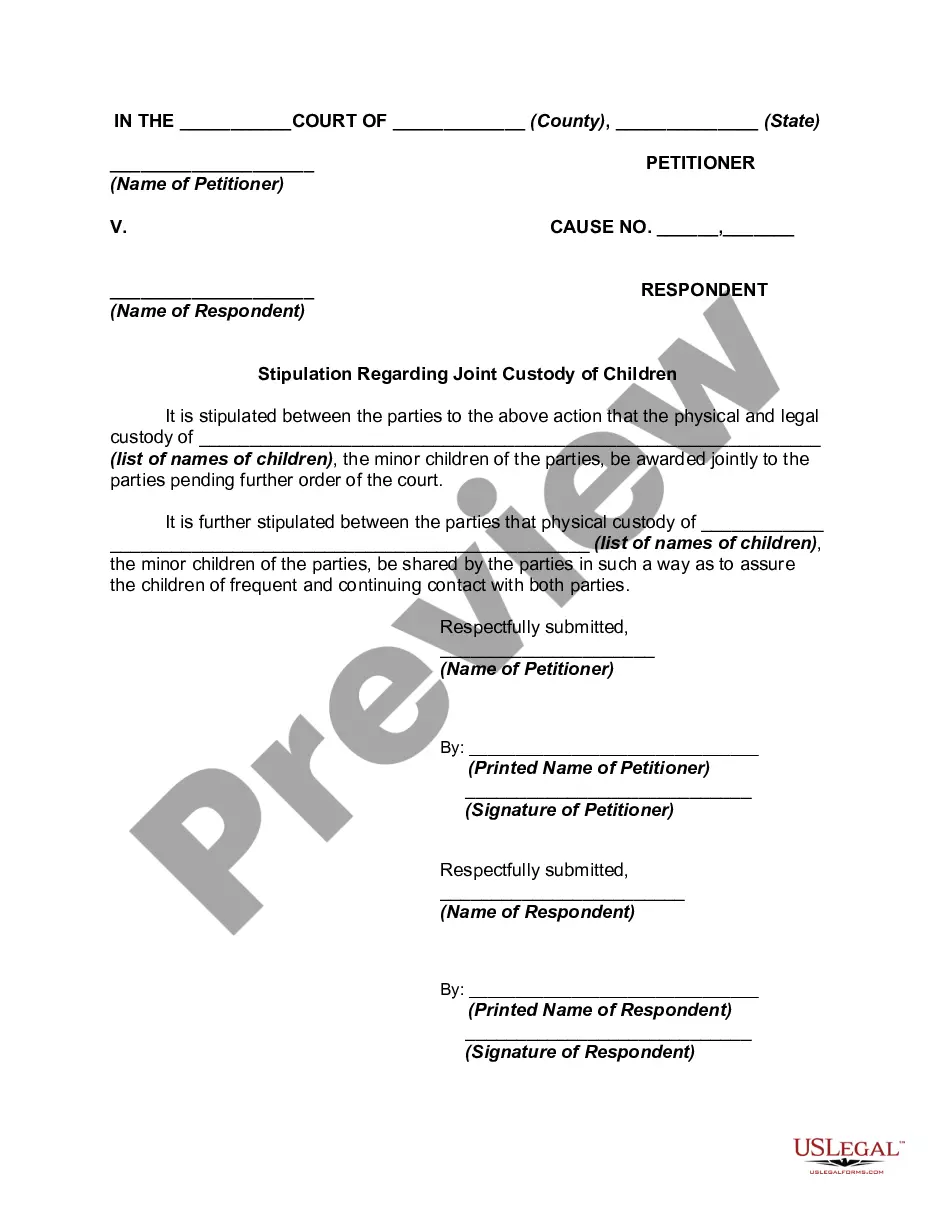
How to fill out Stipulation Regarding Joint Custody Of Children?
Crafting legal documents from the ground up can occasionally feel daunting.
Some situations may require extensive investigation and a significant financial investment.
If you’re seeking a more straightforward and cost-effective method for generating Stipulation Vs Condition or other forms without unnecessary obstacles, US Legal Forms is always available to assist you.
Not registered yet? No worries. Setting up an account takes only a few minutes and allows you to browse the library. However, before rushing to download Stipulation Vs Condition, consider these tips: Check the form preview and descriptions to confirm you’ve located the correct form. Ensure that the form you select aligns with your state and county’s requirements. Pick the appropriate subscription plan to acquire the Stipulation Vs Condition. Download the form, then complete, verify, and print it. US Legal Forms prides itself on having an impeccable reputation and over 25 years of experience. Join us today and make the process of form execution simple and efficient!
- Our online library houses over 85,000 current legal forms that cover nearly every aspect of your financial, legal, and personal affairs.
- With just a few clicks, you can quickly access state- and county-specific templates meticulously created by our legal professionals.
- Utilize our platform whenever you seek trustworthy and dependable services to effortlessly find and download the Stipulation Vs Condition.
- If you’re familiar with our services and have previously established an account, simply Log In, find the template, and download it or re-download it anytime from the My documents section.
Form popularity
FAQ
Filing a stipulation refers to the formal submission of a written agreement between parties in a legal case. This action informs the court of the agreed-upon terms, which may help streamline legal proceedings. Understanding the distinction between stipulation vs condition can clarify the implications of your filing. The US Legal platform offers resources that simplify the filing process, ensuring you meet all necessary legal standards.
To establish a stipulation, both parties must mutually agree to its terms. This agreement is typically documented in writing to ensure clarity and legal standing. Furthermore, it is important to specify the exact nature of the stipulation, especially when comparing stipulation vs condition. By using the US Legal platform, you can access templates that guide you in creating a precise stipulation that meets legal requirements.
In legal terminology, a condition refers to a specific requirement or stipulation that must be fulfilled for a contract or agreement to be effective. Conditions often define what actions or events will trigger obligations under a contract. Clarifying this definition is vital when examining how it operates in contrast to stipulations.
Both plaintiffs and defendants can benefit from using stipulations. By agreeing to certain facts, parties can reduce the time and resources spent on disputes during a trial. This efficiency often leads to quicker resolutions and is a practical approach when considering stipulation vs condition.
The key difference between stipulation and condition lies in their nature. A stipulation is an acknowledgment of facts accepted by both parties, while a condition refers to specific requirements that must be met for an agreement to be enforceable. Understanding this distinction can significantly impact legal strategy and outcomes.
Proof of stipulation is a formal document that verifies the existence and acceptance of the stipulation between parties. This proof can include signed agreements or court filings. Proper documentation serves as a clear reference point, which can be crucial when exploring the differences between stipulation vs condition.
The condition of stipulation refers to the specific circumstances under which a stipulation takes effect. It can involve particular actions that must take place for the stipulation to be valid. Understanding these conditions helps clarify how they differ from standard stipulations, especially when considering the nuances in the context of legal agreements.
The process of stipulation typically involves both parties agreeing to specific terms, which are then documented in writing. This document outlines the agreed facts or conditions and serves as a formal acknowledgment. By following this process, parties can enhance the efficiency of their case, especially when comparing stipulation vs condition.
In legal terms, a stipulation is an agreement between parties in a legal case that certain facts or conditions are accepted as true. This agreement can streamline the legal process by eliminating the need to argue about these facts during a trial. Understanding the details of a stipulation can clarify its differences from a condition, particularly in terms of obligations and settings.