Psychotherapy Form Template For Patients
Description
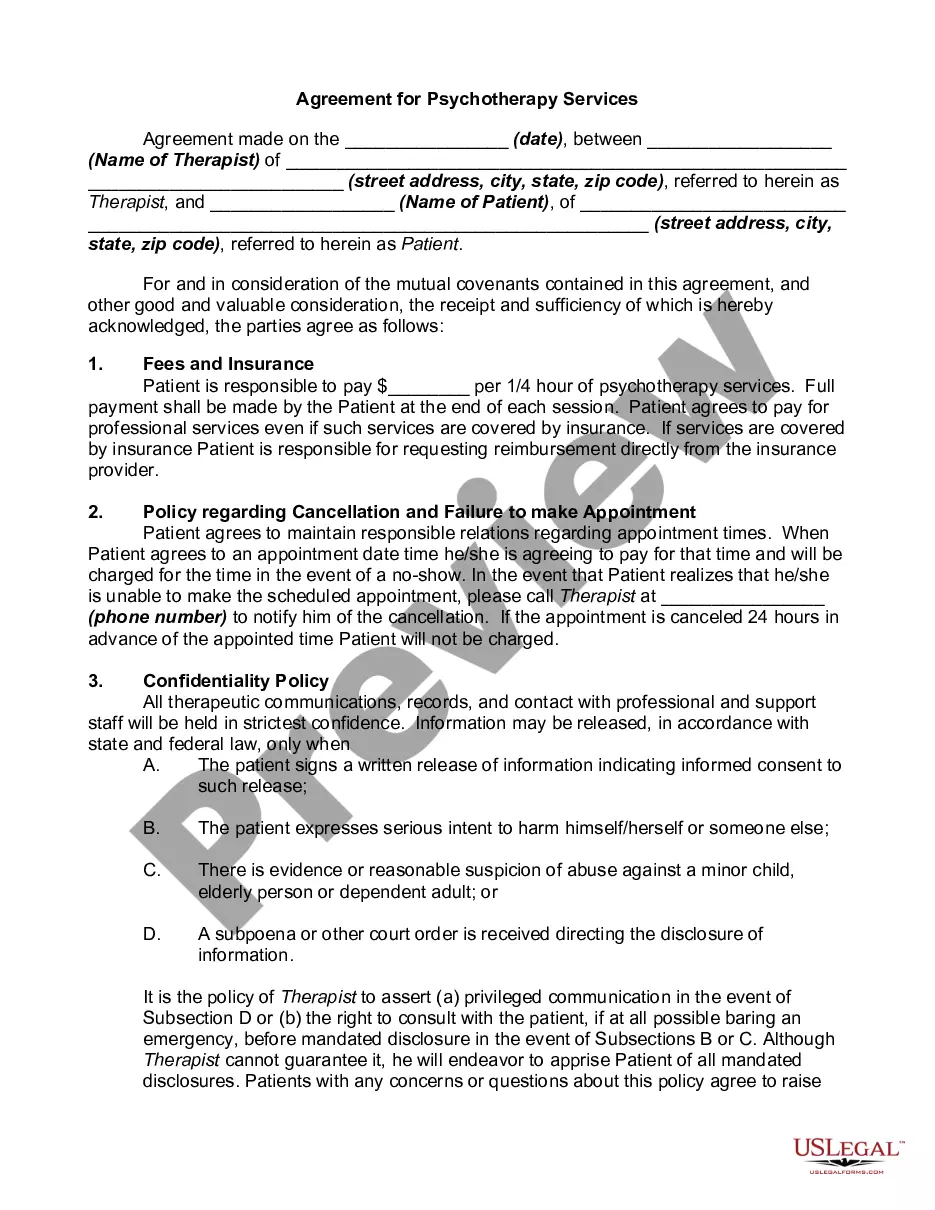
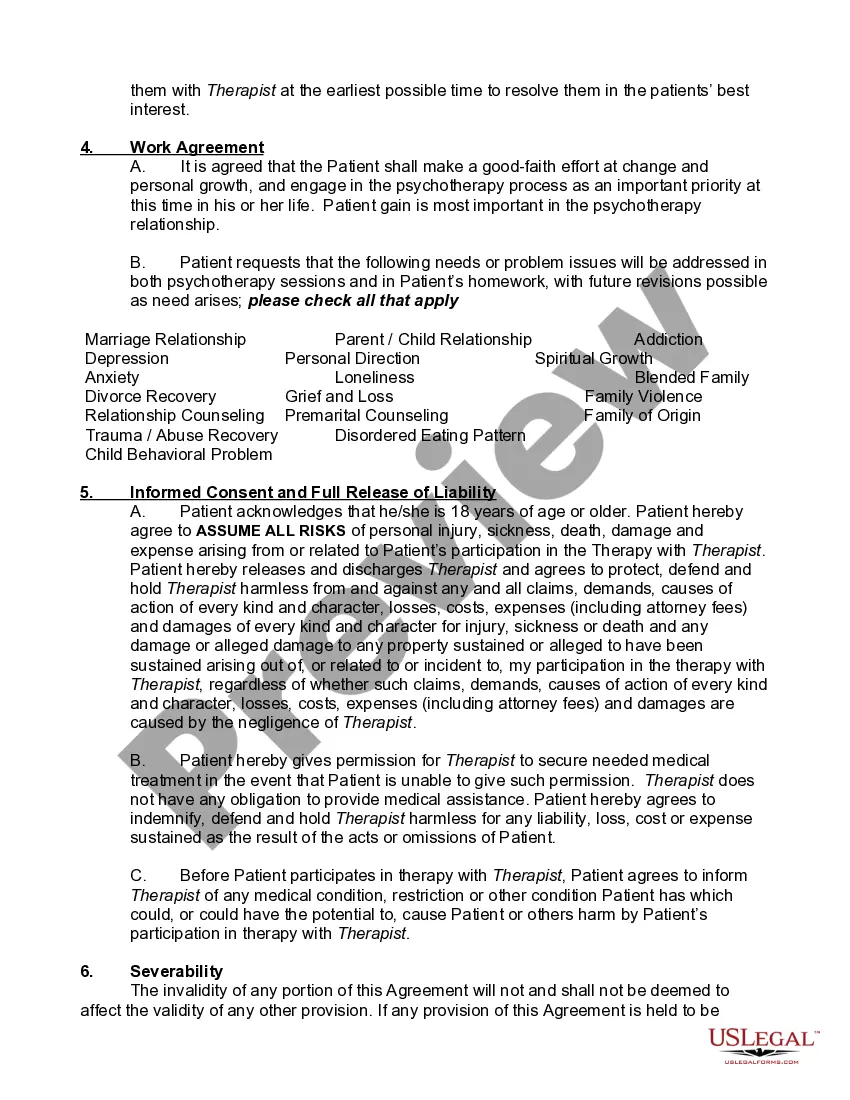


Get your form ready online
Our built-in tools help you complete, sign, share, and store your documents in one place.
Make edits, fill in missing information, and update formatting in US Legal Forms—just like you would in MS Word.
Download a copy, print it, send it by email, or mail it via USPS—whatever works best for your next step.
Sign and collect signatures with our SignNow integration. Send to multiple recipients, set reminders, and more. Go Premium to unlock E-Sign.
If this form requires notarization, complete it online through a secure video call—no need to meet a notary in person or wait for an appointment.
We protect your documents and personal data by following strict security and privacy standards.

Make edits, fill in missing information, and update formatting in US Legal Forms—just like you would in MS Word.

Download a copy, print it, send it by email, or mail it via USPS—whatever works best for your next step.

Sign and collect signatures with our SignNow integration. Send to multiple recipients, set reminders, and more. Go Premium to unlock E-Sign.

If this form requires notarization, complete it online through a secure video call—no need to meet a notary in person or wait for an appointment.

We protect your documents and personal data by following strict security and privacy standards.
Looking for another form?

How to fill out Agreement For Psychotherapy Services?
- Log in to your US Legal Forms account if you're a returning user. Confirm your subscription is active, and download the needed psychotherapy form template by clicking the 'Download' button.
- For first-time users, start by previewing the available forms to ensure they meet your specific needs and local regulations.
- If you don’t find what you need, utilize the search feature to locate the appropriate template that accurately reflects your requirements.
- Select the 'Buy Now' button for your desired document, choose your preferred subscription plan, and create an account to unlock access to our extensive library.
- Complete your purchase by providing the required payment information via credit card or PayPal.
- Finally, download the form directly onto your device. You can always access it later through the 'My Forms' section in your account.
In conclusion, US Legal Forms is designed to empower both individuals and attorneys with an extensive collection of legal documents. With easy access to over 85,000 forms and expert assistance, you're equipped to handle your psychotherapy documentation professionally.
Get started today and ensure your practice runs smoothly with the right forms at your fingertips!
Form popularity
FAQ
Creating a client intake form in Word involves opening a new document and setting up the layout. Start with a header that includes your practice information, then outline sections for personal details, medical history, and therapy goals. Utilize a psychotherapy form template for patients for a structured format, and customize it as needed. After completion, you can save and print it for clients, ensuring a seamless intake process.
To create a custom intake form, assess the specific information your practice needs from clients. Use a psychotherapy form template for patients as a foundation, then modify or add fields that reflect your therapeutic approach. This customization helps gather relevant details that support effective treatment planning. Software solutions like USLegalForms can assist you in designing professional forms easily.
Filling out a therapy intake form begins with gathering necessary personal information about the patient. Utilize a psychotherapy form template for patients to ensure you capture essential details, such as medical history, presenting issues, and goals for treatment. Encourage open communication as this helps create a safe environment for your clients. Properly completed forms provide valuable insights that enhance the therapeutic process.
To write an effective treatment plan note, start by outlining the patient's current condition and objectives for therapy. Include specific goals and interventions tailored to their needs, ensuring you reference your psychotherapy form template for patients as a guide. Document any changes in their condition and adjust the plan as necessary. This structured approach helps you track progress and maintain an effective therapeutic relationship.
A psychotherapy intake is the initial assessment process where a therapist gathers key information from the client, such as health history, current issues, and therapy expectations. This comprehensive evaluation is vital in establishing a treatment plan. To simplify this step, many practitioners opt for a psychotherapy form template for patients that ensures all relevant details are collected efficiently.
Counseling often addresses specific life challenges and uses more straightforward approaches, while psychological therapy, or psychotherapy, seeks to explore deeper emotional and mental health issues. The goal of both is to help individuals find closure and improve their quality of life. Utilizing a psychotherapy form template for patients can significantly enhance the effectiveness of these treatments.
A client intake form should include personal information, medical history, therapy goals, and any previous mental health treatment details. This information is crucial for understanding the client's background and tailoring the therapeutic approach. For efficiency, consider our psychotherapy form template for patients, which integrates all necessary components to simplify this process.
Psychotherapy typically involves a longer-term process, where the therapist addresses complex psychological issues, while counseling usually centers on short-term problem-solving. Both methods aim to improve mental well-being but differ in their depth and approach. You can enhance your practice with a psychotherapy form template for patients to facilitate effective communication in either service.
Yes, there is a notable difference between counseling and psychotherapy. Counseling often focuses on present issues and practical solutions, while psychotherapy explores deeper emotional and psychological concerns. Both approaches can benefit from a well-structured psychotherapy form template for patients, helping to streamline the intake process.
The term 'therapist' can apply to various professionals, including counselors, social workers, and psychologists, while 'psychotherapist' specifically refers to those trained in psychotherapy practices. Psychotherapists often have advanced degrees and extensive training. For those seeking structured sessions, utilizing a psychotherapy form template for patients can enhance the therapeutic experience.