Final Account Estate Sample Withholding Tax
Description
Get your form ready online
Our built-in tools help you complete, sign, share, and store your documents in one place.
Make edits, fill in missing information, and update formatting in US Legal Forms—just like you would in MS Word.
Download a copy, print it, send it by email, or mail it via USPS—whatever works best for your next step.
Sign and collect signatures with our SignNow integration. Send to multiple recipients, set reminders, and more. Go Premium to unlock E-Sign.
If this form requires notarization, complete it online through a secure video call—no need to meet a notary in person or wait for an appointment.
We protect your documents and personal data by following strict security and privacy standards.

Make edits, fill in missing information, and update formatting in US Legal Forms—just like you would in MS Word.

Download a copy, print it, send it by email, or mail it via USPS—whatever works best for your next step.

Sign and collect signatures with our SignNow integration. Send to multiple recipients, set reminders, and more. Go Premium to unlock E-Sign.

If this form requires notarization, complete it online through a secure video call—no need to meet a notary in person or wait for an appointment.

We protect your documents and personal data by following strict security and privacy standards.
Looking for another form?





How to fill out Contest Of Final Account And Proposed Distributions In A Probate Estate?
The Concluding Account Estate Sample Withholding Tax displayed on this page is a reusable official template crafted by qualified attorneys in accordance with federal and state laws.
For over 25 years, US Legal Forms has supplied individuals, enterprises, and legal practitioners with more than 85,000 verified, state-specific documents for various business and personal situations. It’s the fastest, simplest, and most dependable method to access the forms you require, as the service ensures bank-level data security and anti-malware safeguards.
Select the format you desire for your Concluding Account Estate Sample Withholding Tax (PDF, DOCX, RTF) and download the sample to your device.
- Search for the document you need and assess it.
- Browse through the file you located and preview it or review the form description to confirm it meets your requirements. If it doesn’t, utilize the search function to discover the appropriate one. Click Buy Now when you have identified the template you require.
- Subscribe and Log In.
- Select the pricing plan that best fits you and create an account. Use PayPal or a credit card for prompt payment. If you already have an account, Log In and check your subscription to proceed.
- Acquire the editable template.
Form popularity
FAQ
To get assets out of a taxable estate, you should first evaluate the potential tax implications of each asset. Utilizing strategic methods, such as gifting or establishing trusts, can help mitigate tax burdens. Working with estate planning professionals can provide tailored solutions that suit your specific situation. You may refer to a final account estate sample withholding tax to ensure all tax aspects are addressed.
Every state sets the priority ing to which claims must be paid. The estate's beneficiaries only get paid once all the creditor claims have been satisfied. Usually, estate administration fees, funeral expenses, support payments, and taxes have priority over other claims.
An informal accounting for an estate is a document that outlines the financial activities of the estate. This type of accounting is often used to prepare financial statements of affairs. It includes details about assets and liabilities, income and expenses, donations or transfers from the estate, and tax information.
A petition for final distribution of probate is a legal document that asks the court to distribute the remaining assets of an estate to the beneficiaries or heirs. It is usually filed by the executor or administrator of the estate after all debts, taxes, and other matters have been resolved.
If the personal administrator decides to pay creditors from an insolvent estate, they must do so in the following order. Secured creditors. Reasonable funeral, administration and testamentary expenses. Testamentary expenses can include things like probate fees and solicitor fees.
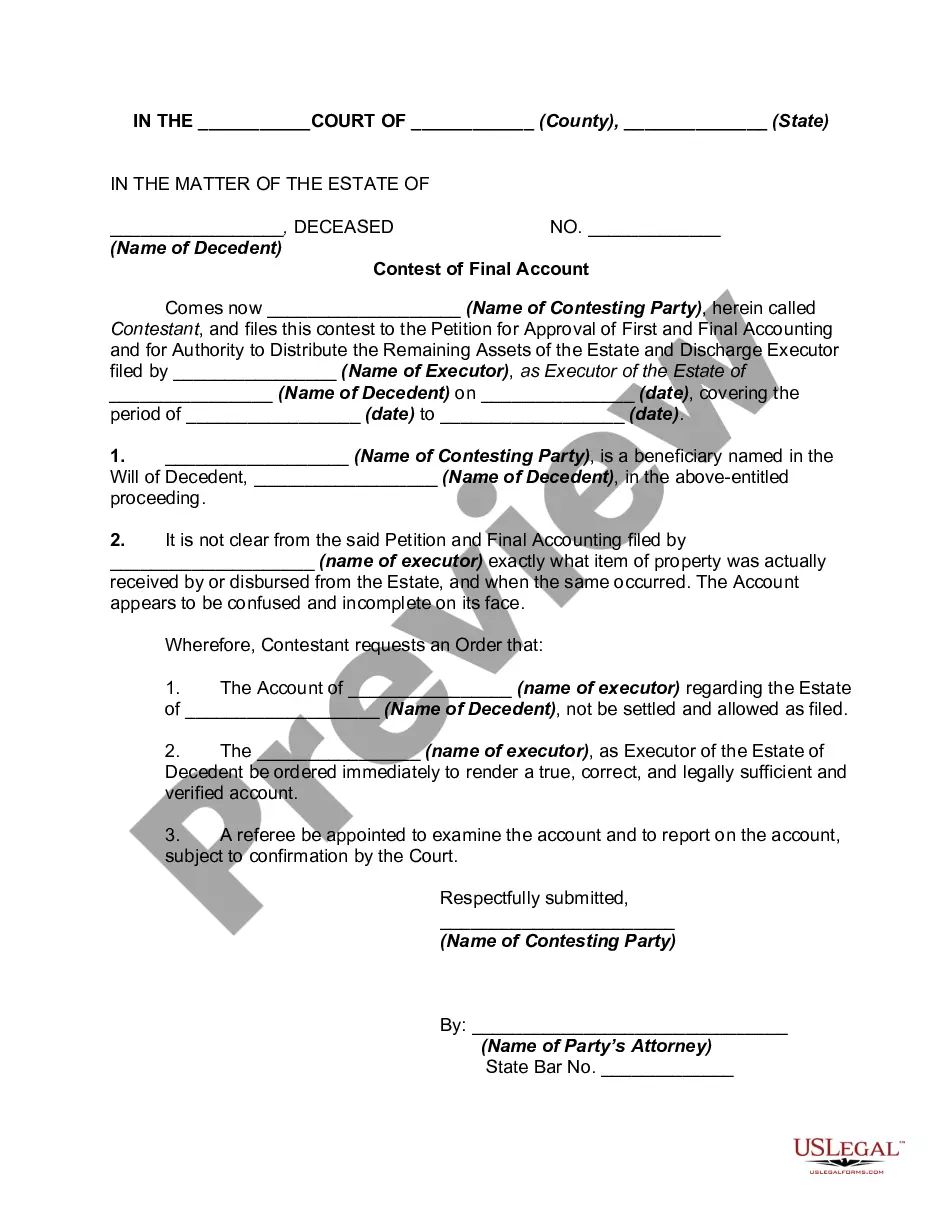
A Final Account is a complete record detailing the assets, receipts, and disbursements made during a probate administration.