Final Accounting Form For Estate
Description
Get your form ready online
Our built-in tools help you complete, sign, share, and store your documents in one place.
Make edits, fill in missing information, and update formatting in US Legal Forms—just like you would in MS Word.
Download a copy, print it, send it by email, or mail it via USPS—whatever works best for your next step.
Sign and collect signatures with our SignNow integration. Send to multiple recipients, set reminders, and more. Go Premium to unlock E-Sign.
If this form requires notarization, complete it online through a secure video call—no need to meet a notary in person or wait for an appointment.
We protect your documents and personal data by following strict security and privacy standards.

Make edits, fill in missing information, and update formatting in US Legal Forms—just like you would in MS Word.

Download a copy, print it, send it by email, or mail it via USPS—whatever works best for your next step.

Sign and collect signatures with our SignNow integration. Send to multiple recipients, set reminders, and more. Go Premium to unlock E-Sign.

If this form requires notarization, complete it online through a secure video call—no need to meet a notary in person or wait for an appointment.

We protect your documents and personal data by following strict security and privacy standards.
Looking for another form?

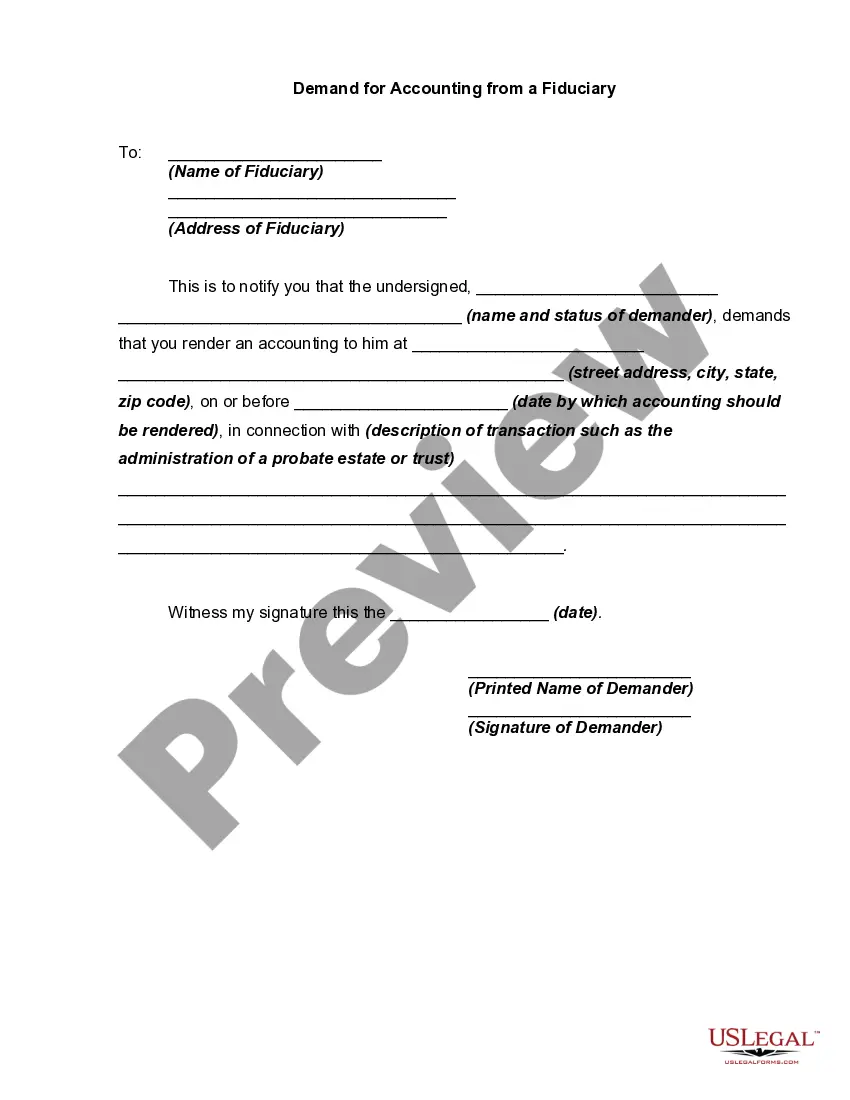
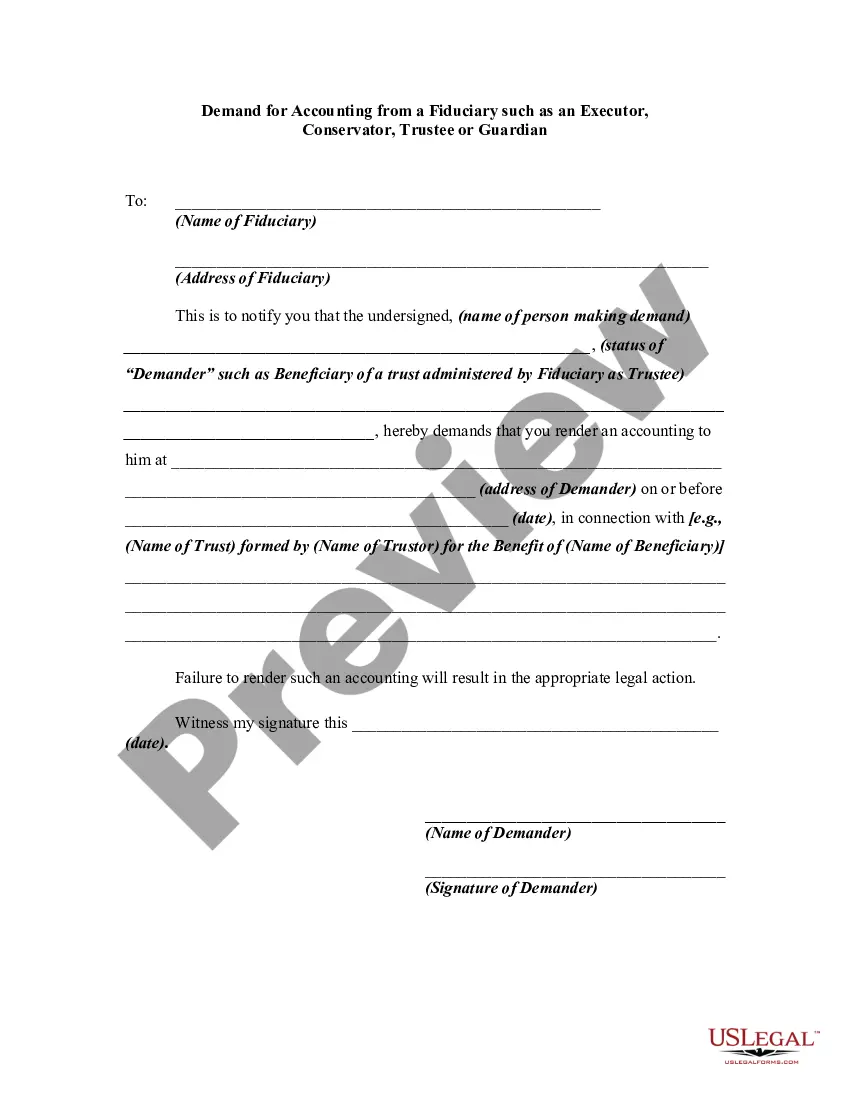
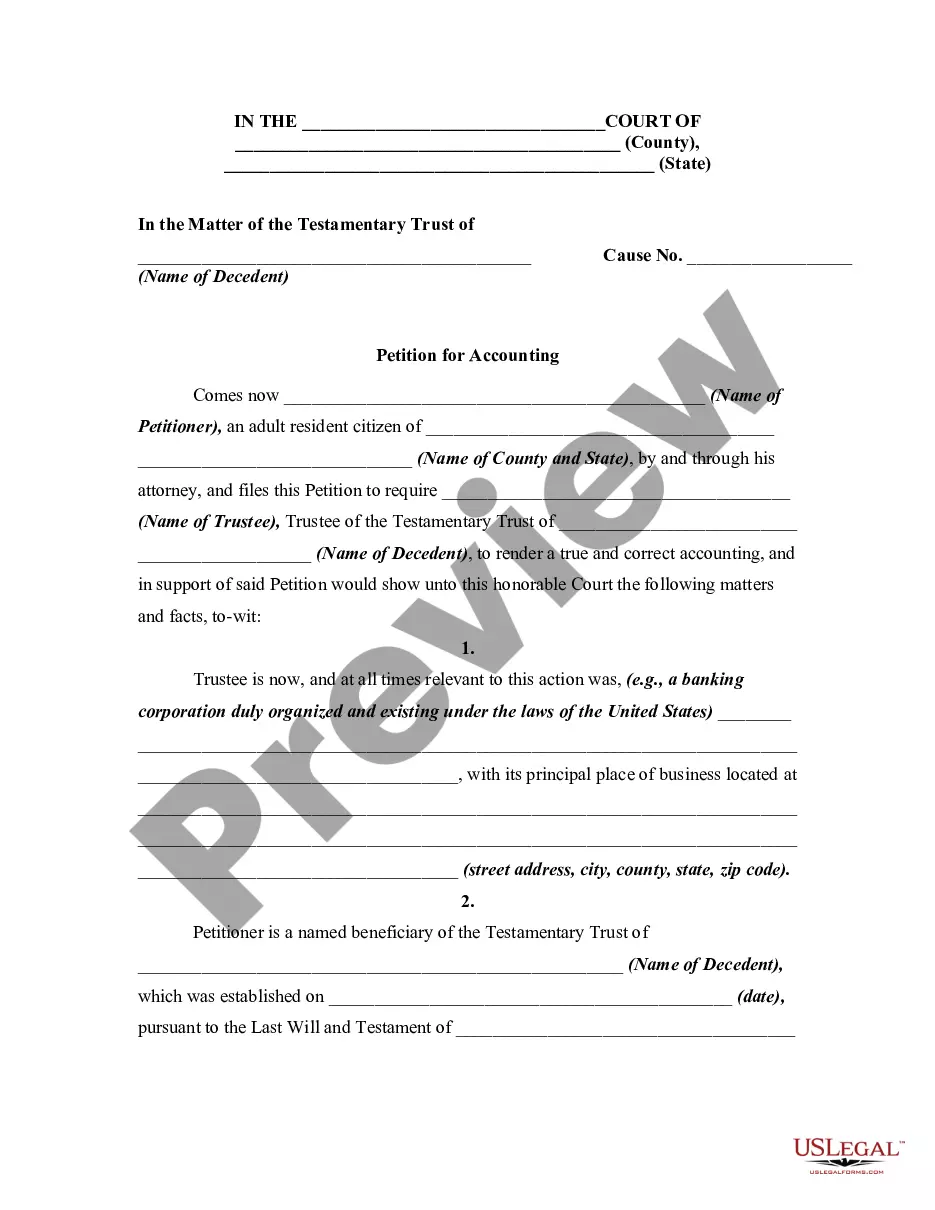
How to fill out Demand For Accounting From A Fiduciary?
There is no longer a reason to squander time searching for legal documents to comply with your local state laws. US Legal Forms has gathered all of them in a single location and simplified their accessibility.
Our platform offers more than 85,000 templates for any business and individual legal requirements categorized by state and application area. All forms are appropriately constructed and verified for legality, so you can be assured in securing an up-to-date Final Accounting Form For Estate.
If you are acquainted with our service and already possess an account, ensure your subscription is active before acquiring any templates. Log In to your account, select the document, and click Download. You can also retrieve all saved documents at any time by accessing the My documents tab in your profile.
Print your form to fill it out manually or upload the sample if you prefer to use an online editor. Preparing official documents under federal and state laws and regulations is quick and straightforward with our platform. Try US Legal Forms today to keep your documentation organized!
- If you have not interacted with our service previously, the procedure will require a few additional steps to finalize.
- Carefully examine the page content to confirm it includes the sample you need.
- To do this, use the form description and preview options if available.
- Use the Search field above to look for another template if the current one does not meet your needs.
- Click Buy Now next to the template name when you locate the correct one.
- Choose your preferred pricing plan and register for an account or sign in.
- Pay for your subscription with a credit card or through PayPal to proceed.
- Select the file format for your Final Accounting Form For Estate and download it to your device.
Form popularity
FAQ
The PC 450 probate form in Connecticut is a standard document used in the probate process to report the assets and debts of an estate. This form is often part of the final accounting form for estate, providing the necessary information for the court to review the executor's financial management of the estate. It's important for executors to complete this form accurately to comply with legal requirements and facilitate the smooth settlement of the estate.
A final account for an estate is an official document that summarizes the estate's financial activities, including income, expenses, and distributions. This account is essential for providing an overview of how the estate has been managed and ensuring that all obligations have been fulfilled. Completing the final accounting form for estate allows the executor to formally close the estate once approved by the court.
An executor account is a specific type of account used to manage the financial transactions associated with an estate. Unlike a normal account, which is typically personal, an executor account holds funds specifically for settling estate matters. When preparing the final accounting form for estate, the executor will use this account to track and report all income, expenses, and distributions related to the estate.
Yes, the executor of an estate typically has the final authority in making decisions regarding the estate’s assets and debts. However, the executor must ensure that all actions comply with applicable laws and the wishes of the deceased. In the context of preparing the final accounting form for estate, the executor presents a detailed report of all transactions and distributions, which must be approved by the court or beneficiaries.
The final account report for an estate is a formal document detailing all financial transactions of the estate. It serves as a comprehensive summary of the estate's financial activities, transforming complex information into an easily digestible format. Completing the final accounting form for estate is critical for maintaining transparency and fulfilling legal requirements.
To do a final estate accounting, compile and organize all financial records related to the estate. Document income received, payments made, and any distributions to beneficiaries. Utilizing a structured final accounting form for estate enhances clarity and ensures compliance with estate laws.
The final account of an estate is the complete financial record summarizing the estate's activities after the individual's death. It includes detailed reports on income, expenses, assets, and liabilities. By accurately completing the final accounting form for estate, you provide beneficiaries with a transparent overview of the financial management process.
Preparing a final accounting for an estate involves documenting all income and expenses associated with the estate. Start by listing all assets, liabilities, and transaction details. A well-structured final accounting form for estate aids in presenting a clear financial picture to beneficiaries and avoids potential conflicts.
To prepare a final accounting for an estate, collect all financial documents, including income records and expense receipts. Clearly outline all transactions and categorize them appropriately. Using a tailored final accounting form for estate helps to ensure that all details are organized and compliant with legal standards.
Yes, an estate must file a final 1041 if it generated income after the person's death. This is especially important for estates that hold assets or investments that produce earnings. Completing the final accounting form for estate using information from form 1041 is essential to meet tax responsibilities.