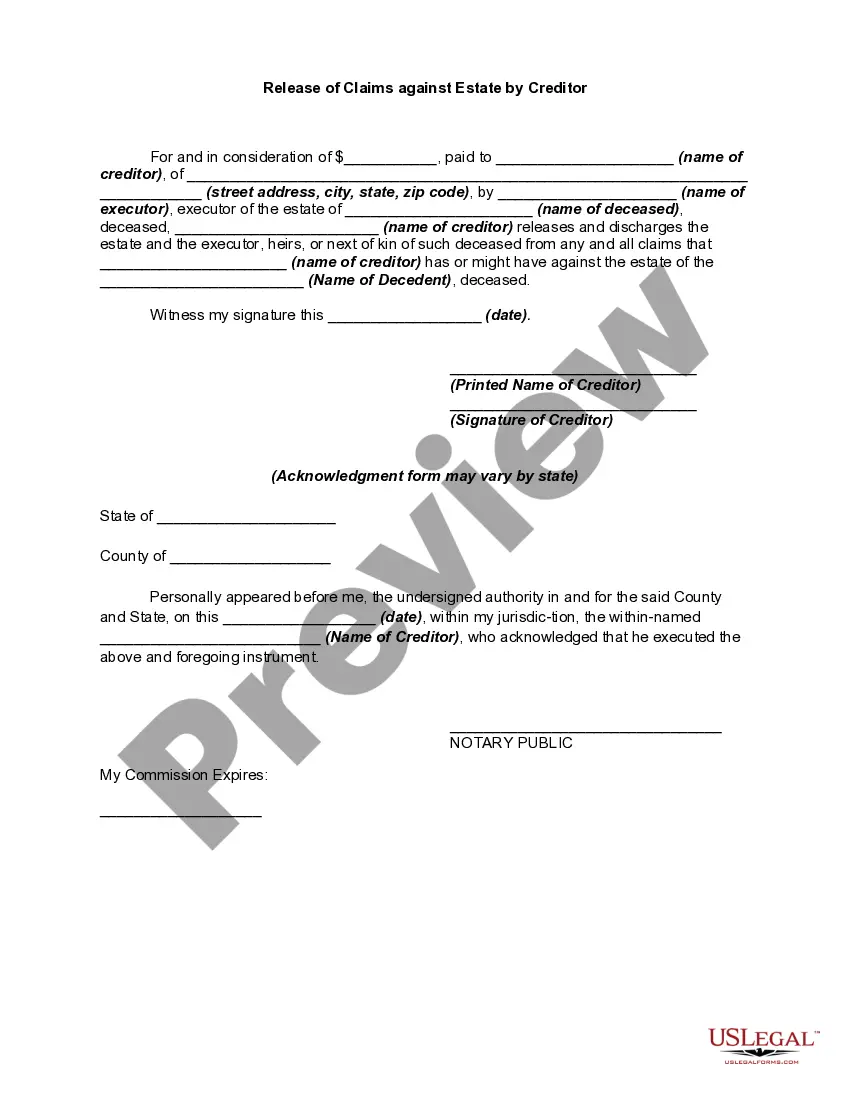
Release Against Estate With The Law
Description
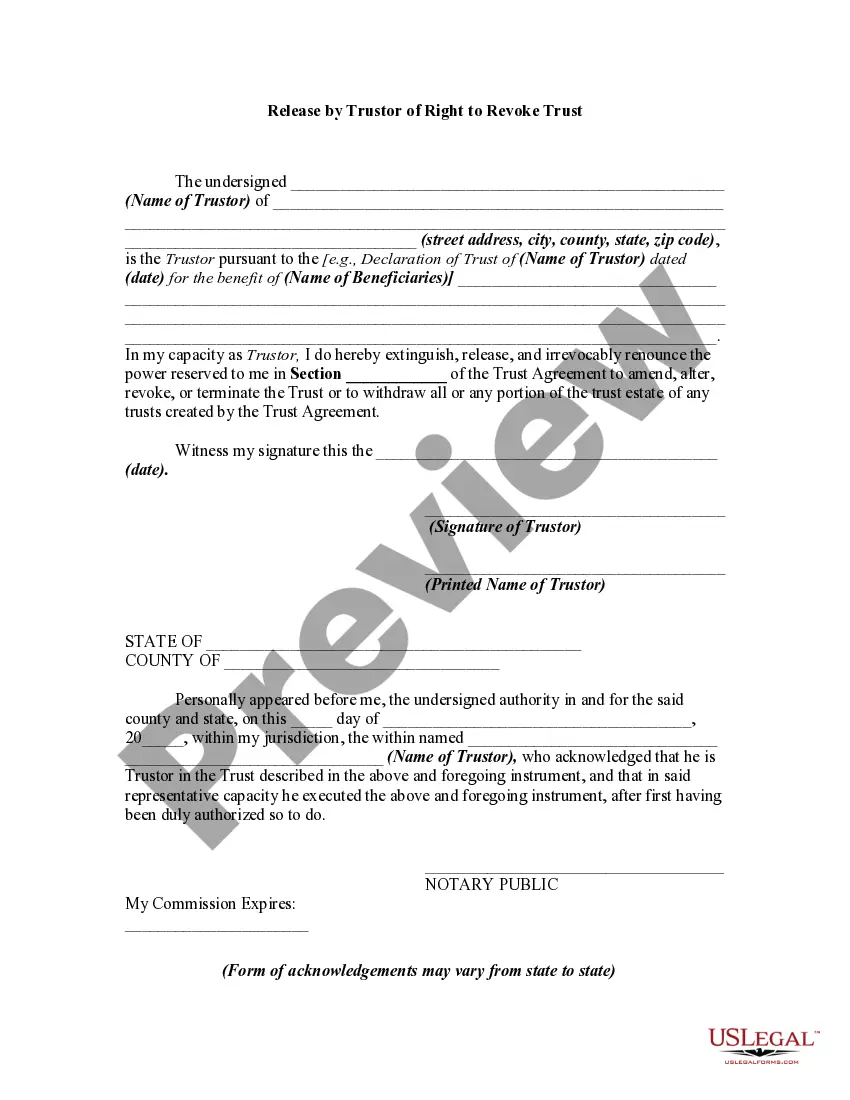
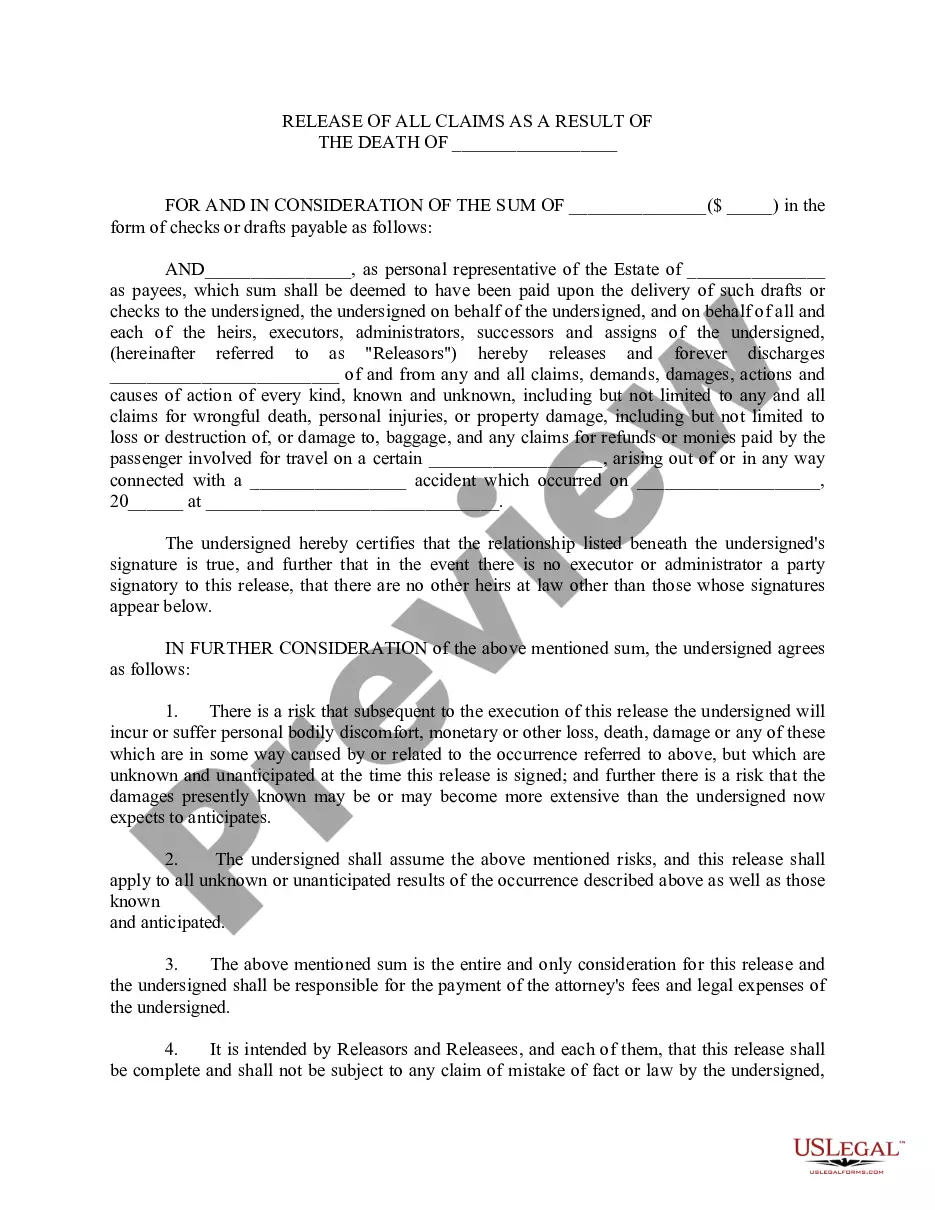
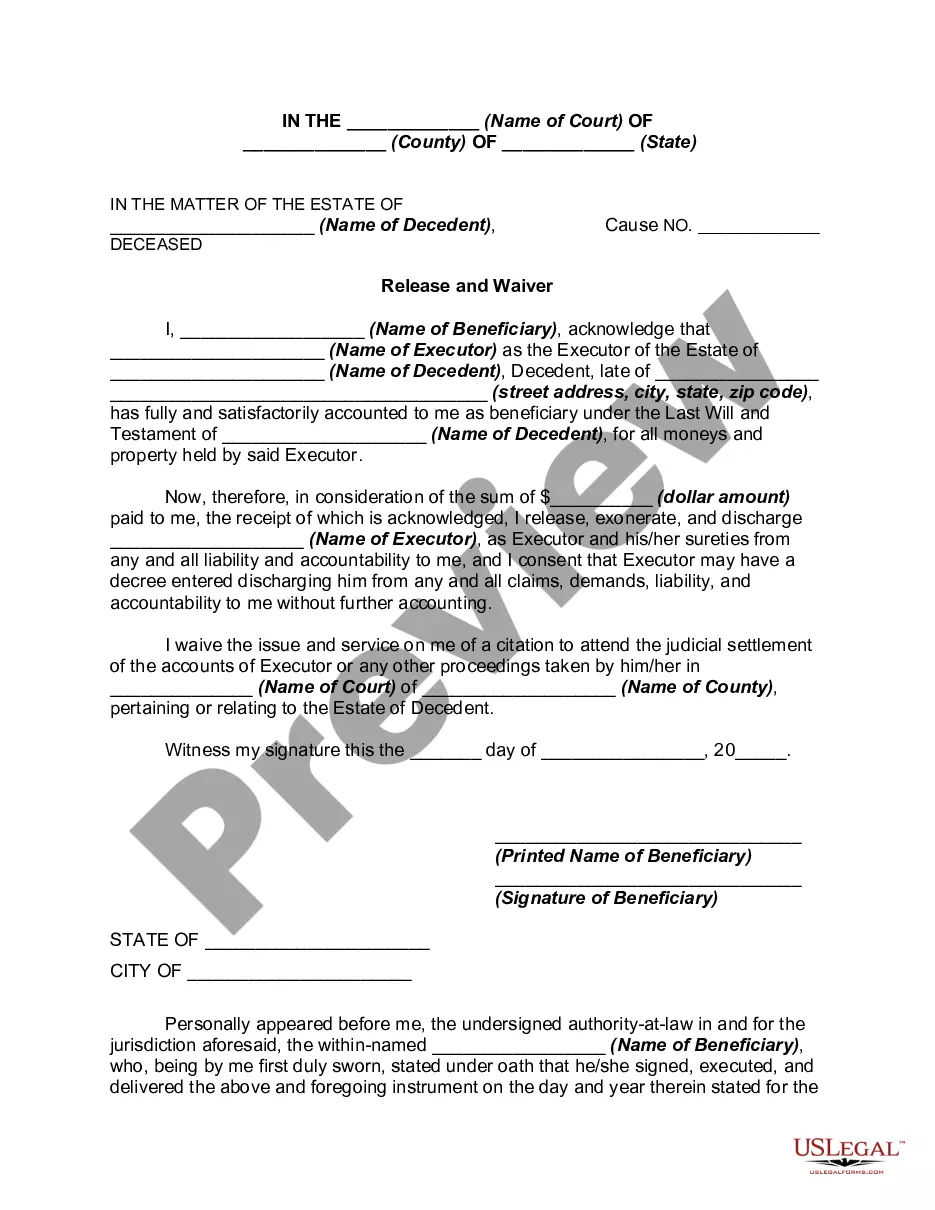
Get your form ready online
Our built-in tools help you complete, sign, share, and store your documents in one place.
Make edits, fill in missing information, and update formatting in US Legal Forms—just like you would in MS Word.
Download a copy, print it, send it by email, or mail it via USPS—whatever works best for your next step.
Sign and collect signatures with our SignNow integration. Send to multiple recipients, set reminders, and more. Go Premium to unlock E-Sign.
If this form requires notarization, complete it online through a secure video call—no need to meet a notary in person or wait for an appointment.
We protect your documents and personal data by following strict security and privacy standards.

Make edits, fill in missing information, and update formatting in US Legal Forms—just like you would in MS Word.

Download a copy, print it, send it by email, or mail it via USPS—whatever works best for your next step.

Sign and collect signatures with our SignNow integration. Send to multiple recipients, set reminders, and more. Go Premium to unlock E-Sign.

If this form requires notarization, complete it online through a secure video call—no need to meet a notary in person or wait for an appointment.

We protect your documents and personal data by following strict security and privacy standards.
Looking for another form?



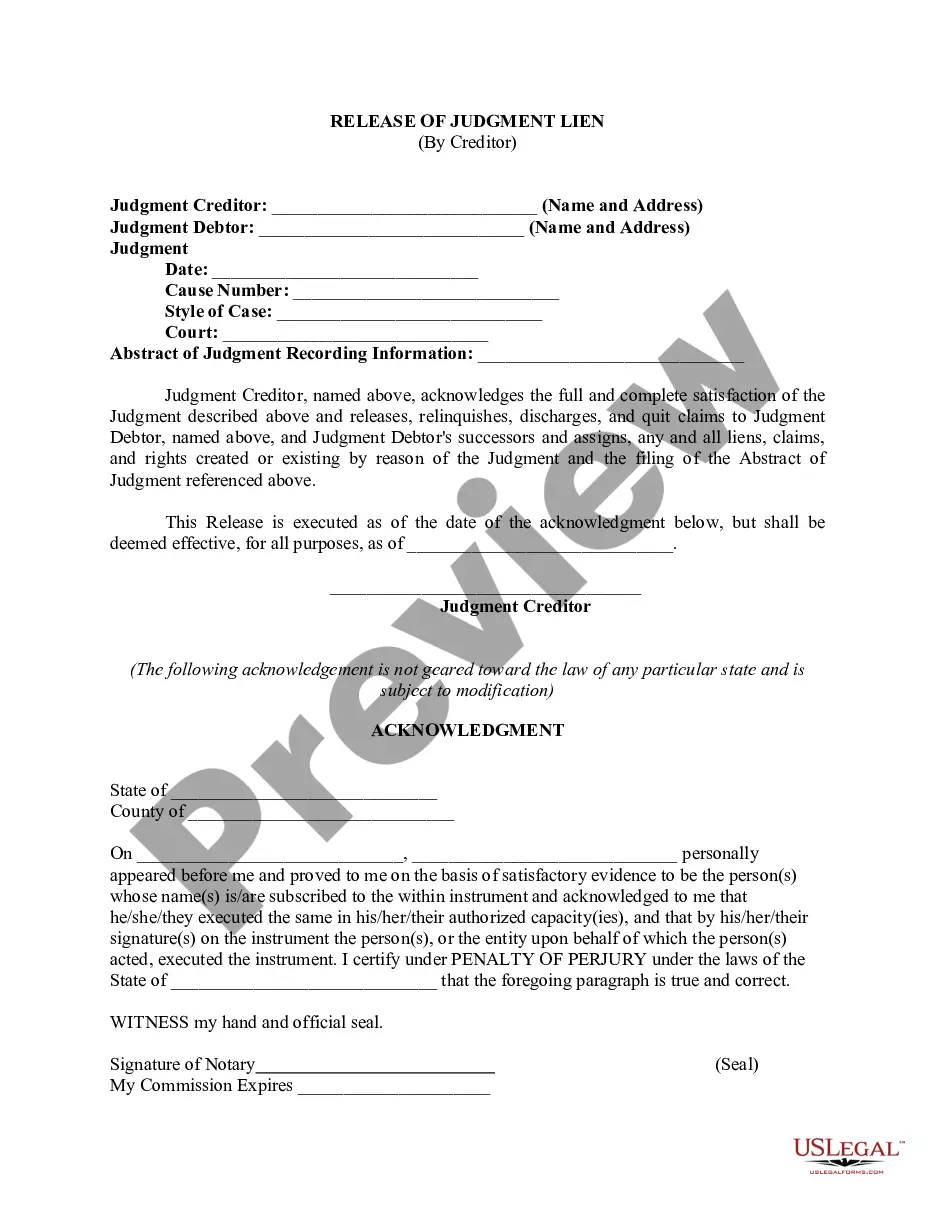
How to fill out Release Of Claims Against Estate By Creditor?
- If you’re a returning user, log in to your account by visiting the US Legal Forms website and click the Download button for the form template you need. Ensure your subscription is active; if not, renew based on your current payment plan.
- For first-time users, start by browsing the extensive form collection. Check the Preview mode and form description carefully to ensure it meets your needs and complies with your jurisdiction.
- If the current form isn’t suitable, use the Search feature to locate a more appropriate template that fits your requirements.
- Once you find the correct document, click the Buy Now button and select your desired subscription plan. You will need to create an account to access the full library.
- Next, proceed with your purchase by entering your credit card details or using your PayPal account to complete the transaction.
- Finally, download your chosen form and save it on your device. You can easily access this template later in the My Forms section of your profile whenever needed.
In conclusion, US Legal Forms equips you with a user-friendly platform to efficiently release against estate with the law. With an extensive library and expert guidance, you can ensure your documents are accurate and legally compliant.
Start your journey to hassle-free legal documentation today by visiting US Legal Forms!
Form popularity
FAQ
To put a claim against someone's estate, you typically need to file a formal claim with the probate court handling the estate. This process often involves providing documentation that supports your claim. Understanding the release against estate with the law is essential to ensure your claim is valid and timely. US Legal Forms offers resources that can guide you through this process efficiently.
Generally, an administrator cannot sell property of the estate without obtaining approval from all the beneficiaries. The law requires that the administrator act in the best interest of the estate and its heirs. If there is a disagreement among beneficiaries, legal consultation may be needed to navigate the release against estate with the law. You can explore solutions from US Legal Forms for the necessary documents and procedures.
Yes, beneficiaries designated in a trust or through payable-on-death accounts typically bypass probate. These assets transfer directly to beneficiaries, allowing for a quicker distribution process. This means that understanding how beneficiary designations work is key for anyone looking to simplify estate distribution under the umbrella of Release against estate with the law.
To make a claim against an estate, you typically need to submit a formal written claim to the executor. This claim should outline the debt and relevant documentation to support your position. Upon submission, the executor will review the claim and decide whether to approve or deny it. Following the correct procedures related to the Release against estate with the law ensures you adhere to established legal protocols.
Certain assets explicitly bypass probate, including life insurance policies, retirement accounts, and jointly owned properties with rights of survivorship. Additionally, assets held in a trust are not subjected to probate. Knowing which assets are exempt can significantly relieve the burden on your estate and support the goals of Release against estate with the law.
One method that does not exist to avoid probate is simply assuming that your will alone will prevent it. A will must go through probate to be validated by the court. Thus, relying solely on a will does not exempt your estate from this process. Understanding the importance of Release against estate with the law can help clarify what methods truly work.
To get assets out of an estate, the executor must first follow the steps outlined in the will or state law. This may involve assessing the value of assets, settling any debts, and then distributing the remaining assets to the designated beneficiaries. It’s crucial to execute these actions legally and in accordance with the Release against estate with the law to prevent future disputes.
Yes, there are several ways to circumvent probate. For example, joint ownership of property or setting up a payable-on-death account can simplify the process. Additionally, using a living trust can help you avoid probate altogether. Keeping in mind strategies for a Release against estate with the law can make the transition smoother for your heirs.
Typically, an executor has about nine months to a year to settle an estate, although this can vary by state. The process includes gathering assets, paying debts, and distributing what remains to beneficiaries. It’s essential to follow the timeline carefully to ensure compliance with state laws on estate settlement. This is particularly relevant when considering how to navigate the Release against estate with the law.
One of the most effective ways to avoid probate is through a living trust. This legal arrangement allows you to transfer assets into the trust while you are alive. Upon your passing, the assets in the trust can be distributed directly to your beneficiaries without going through the court system. This method aligns well with the idea of Release against estate with the law.