Attorney Law Information For Clients
Description

Get your form ready online
Our built-in tools help you complete, sign, share, and store your documents in one place.
Make edits, fill in missing information, and update formatting in US Legal Forms—just like you would in MS Word.
Download a copy, print it, send it by email, or mail it via USPS—whatever works best for your next step.
Sign and collect signatures with our SignNow integration. Send to multiple recipients, set reminders, and more. Go Premium to unlock E-Sign.
If this form requires notarization, complete it online through a secure video call—no need to meet a notary in person or wait for an appointment.
We protect your documents and personal data by following strict security and privacy standards.

Make edits, fill in missing information, and update formatting in US Legal Forms—just like you would in MS Word.

Download a copy, print it, send it by email, or mail it via USPS—whatever works best for your next step.

Sign and collect signatures with our SignNow integration. Send to multiple recipients, set reminders, and more. Go Premium to unlock E-Sign.

If this form requires notarization, complete it online through a secure video call—no need to meet a notary in person or wait for an appointment.

We protect your documents and personal data by following strict security and privacy standards.
Looking for another form?







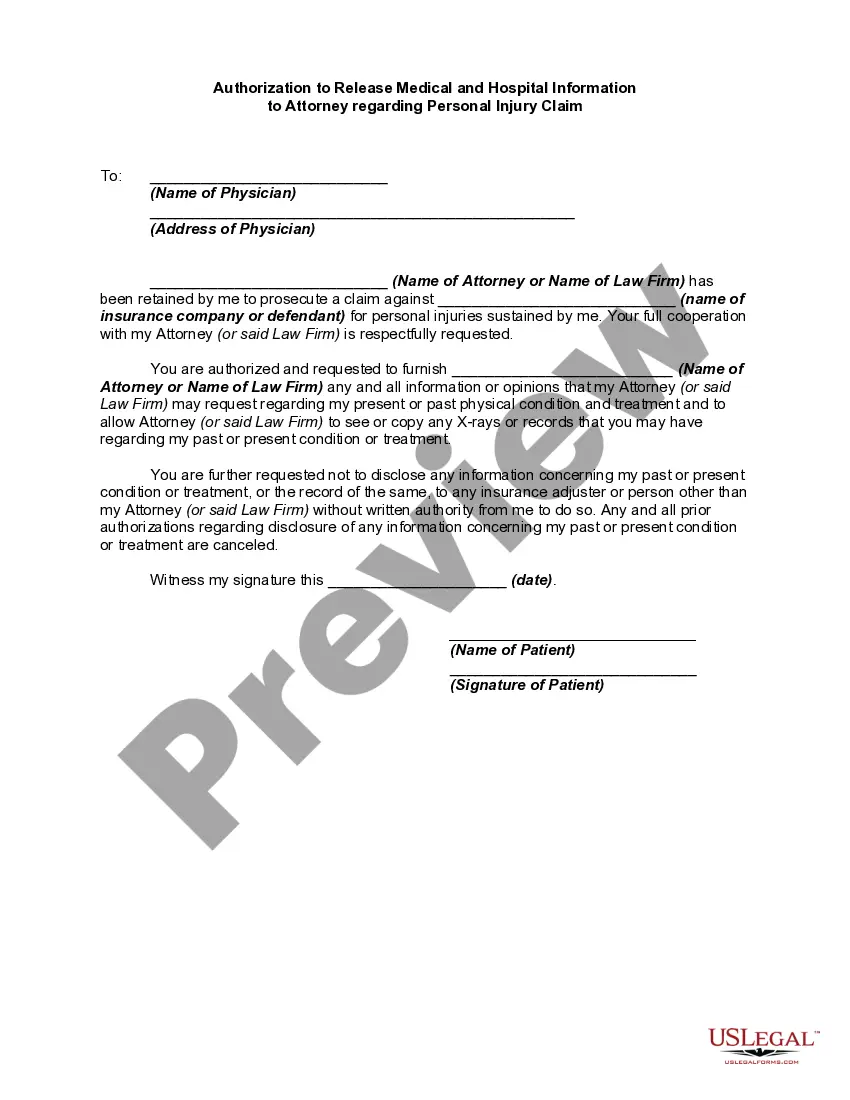
How to fill out Authorization To Release Medical And Hospital Information To Attorney?
Whether for commercial reasons or for individual matters, everyone must handle legal situations at some stage in their lifetime.
Filling out legal documents requires meticulous attention, beginning with selecting the correct form template.
Once saved, you can fill out the form using editing software or print it and complete it manually. With an extensive US Legal Forms catalog available, you never need to waste time searching for the right sample online. Utilize the library’s user-friendly navigation to find the correct form for any situation.
- For instance, if you choose an incorrect version of the Attorney Law Information For Clients, it will be denied upon submission.
- Thus, it is crucial to obtain a trustworthy source of legal documents like US Legal Forms.
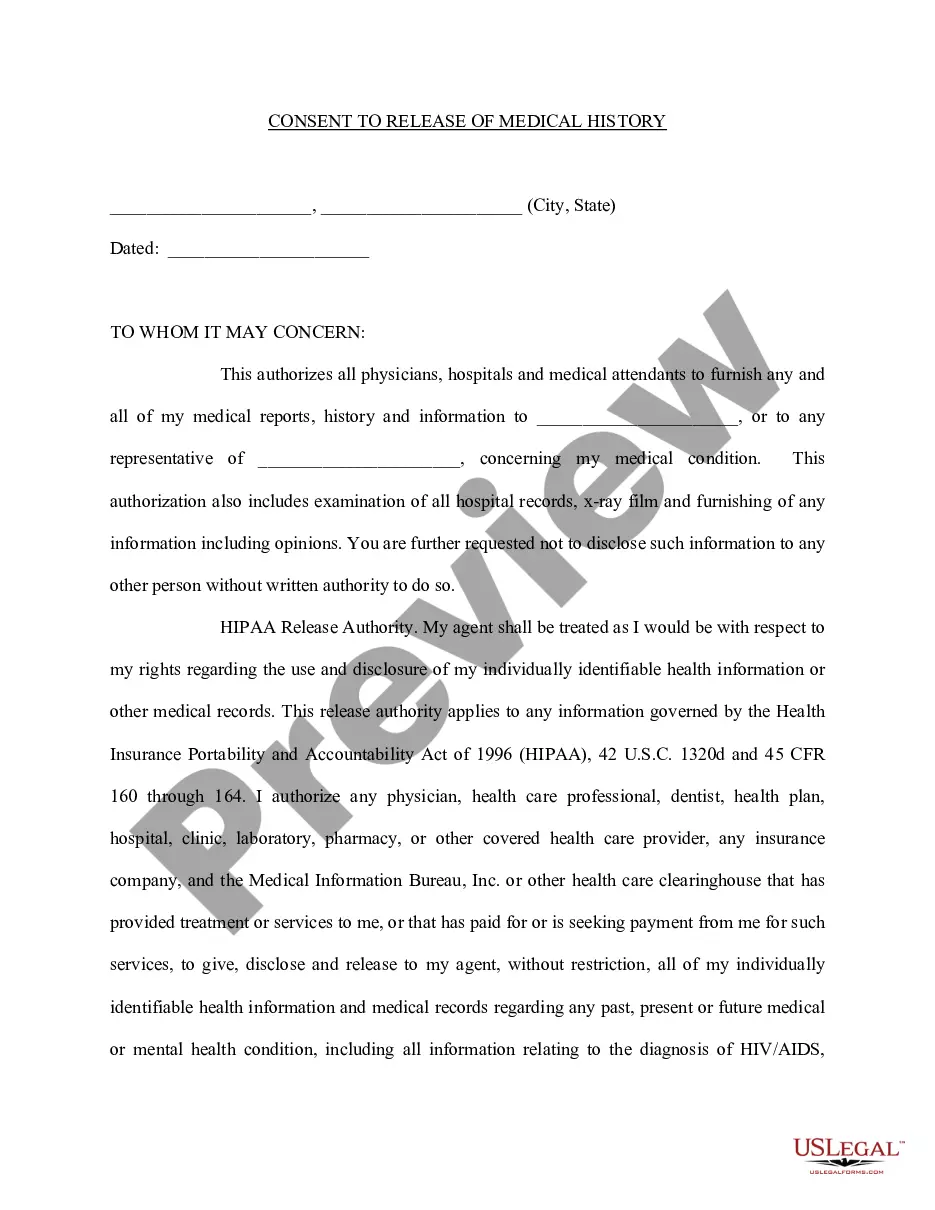
- If you wish to acquire an Attorney Law Information For Clients template, follow these straightforward steps.
- Locate the sample you require using the search box or catalog navigation.
- Review the form’s description to confirm it suits your case, state, and area.
- Click on the form’s preview to view it.
- If it is the incorrect document, return to the search function to find the Attorney Law Information For Clients sample you seek.
- Obtain the file if it meets your specifications.
- If you already possess a US Legal Forms account, simply click Log in to access previously saved templates in My documents.
- If you do not yet have an account, you can acquire the form by clicking Buy now.
- Select the appropriate pricing option.
- Complete the account registration form.
- Choose your payment method: either use a credit card or a PayPal account.
- Select the document format you desire and download the Attorney Law Information For Clients.
Form popularity
FAQ
Another example of attorney-client privilege can be illustrated by written communications, such as emails or letters, between you and your lawyer. If these messages pertain to legal advice or the specifics of your case, they remain confidential under this privilege. Familiarity with attorney law information for clients ensures you can safeguard this vital aspect of your legal defense.
If a defendant later discloses the contents of a conversation with their attorney to a third party, the confidentiality of that conversation will be waived. There are exceptions to this rule for spouses and sometimes religious figures, such as priests.
Some of the most common exceptions to the privilege include: Death of a Client. ... Fiduciary Duty. ... Crime or Fraud Exception. ... Common Interest Exception.
Client-Lawyer Relationship (a) A lawyer shall not reveal information relating to the representation of a client unless the client gives informed consent, the disclosure is impliedly authorized in order to carry out the representation or the disclosure is permitted by paragraph (b).
4 Things Clients Want in a Law Firm Making the payment process convenient with online payments. Maintaining a strong and informative web presence. Responding quickly to client inquiries. Communicating effectively and setting clear goals.
The law firm will gather information about the client, their legal issue, and the case. This includes personal information about the client, such as their name, address, and contact details. Information about the client's legal issue, such as the nature of the claim and the parties involved, is also documented.