Probate Grant On Credit
Description

Get your form ready online
Our built-in tools help you complete, sign, share, and store your documents in one place.
Make edits, fill in missing information, and update formatting in US Legal Forms—just like you would in MS Word.
Download a copy, print it, send it by email, or mail it via USPS—whatever works best for your next step.
Sign and collect signatures with our SignNow integration. Send to multiple recipients, set reminders, and more. Go Premium to unlock E-Sign.
If this form requires notarization, complete it online through a secure video call—no need to meet a notary in person or wait for an appointment.
We protect your documents and personal data by following strict security and privacy standards.

Make edits, fill in missing information, and update formatting in US Legal Forms—just like you would in MS Word.

Download a copy, print it, send it by email, or mail it via USPS—whatever works best for your next step.

Sign and collect signatures with our SignNow integration. Send to multiple recipients, set reminders, and more. Go Premium to unlock E-Sign.

If this form requires notarization, complete it online through a secure video call—no need to meet a notary in person or wait for an appointment.

We protect your documents and personal data by following strict security and privacy standards.
Looking for another form?







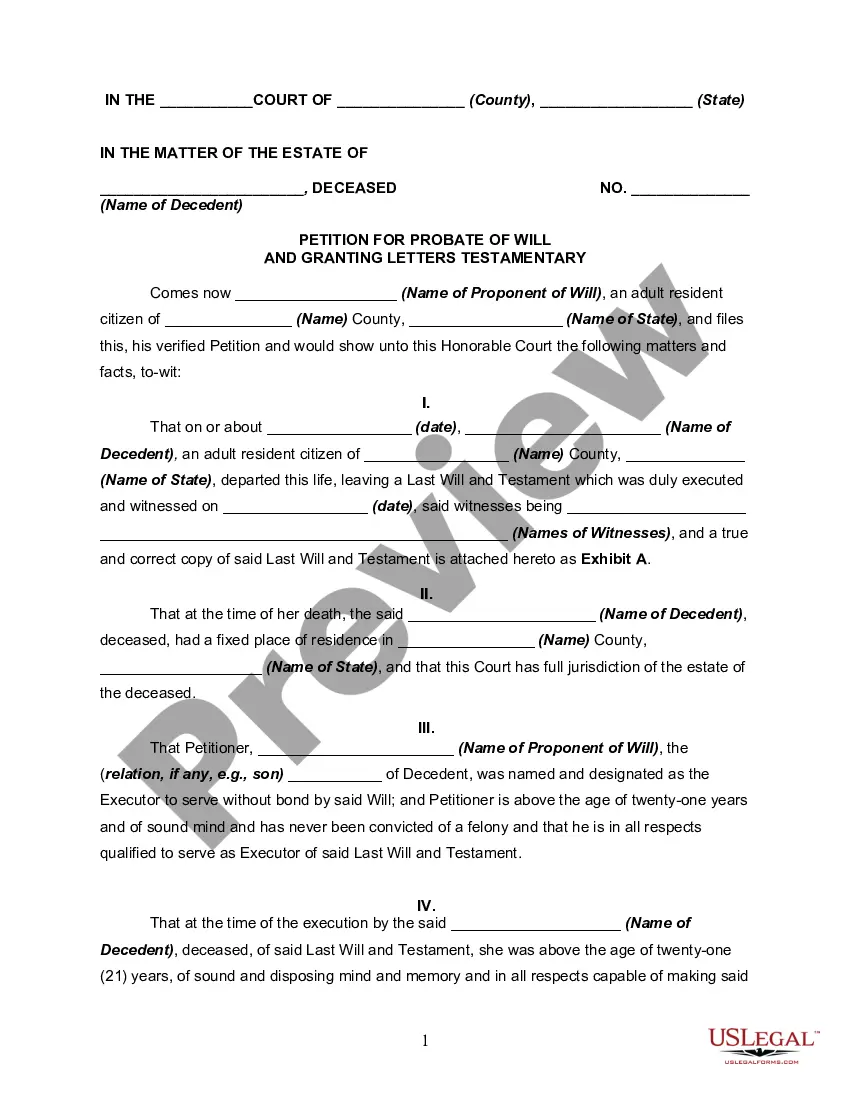
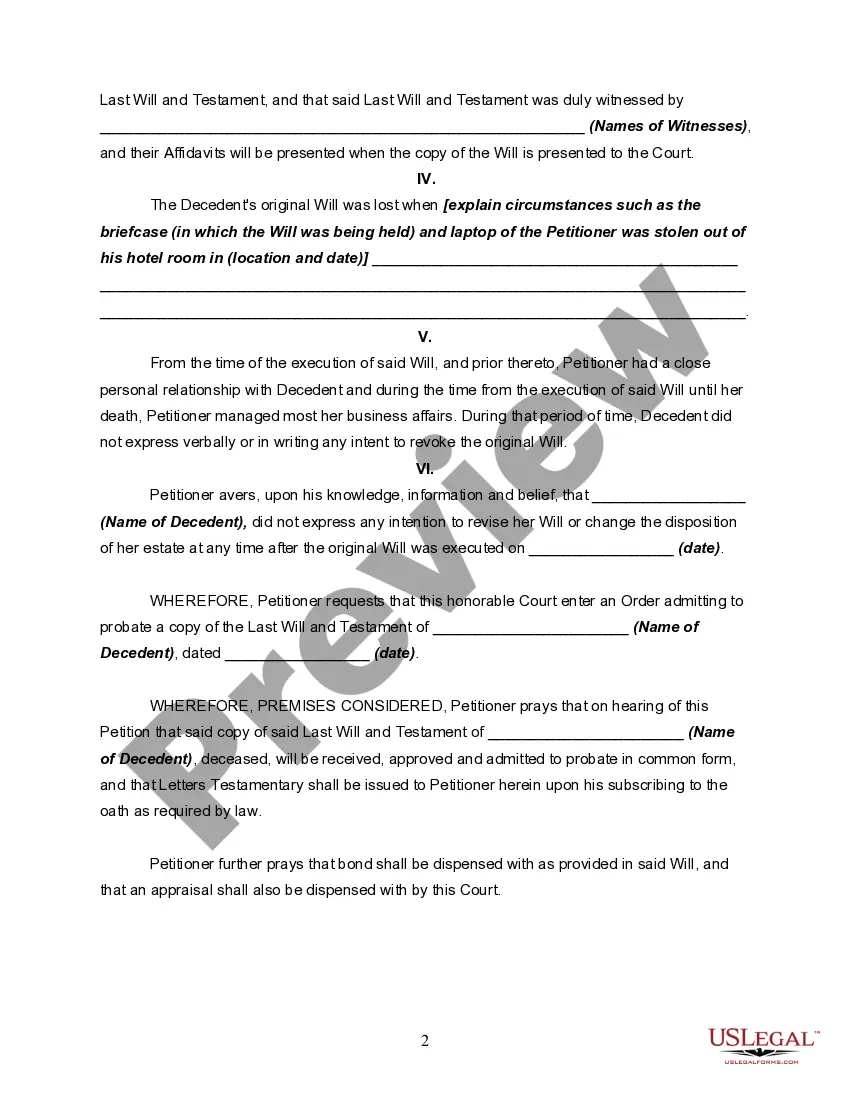
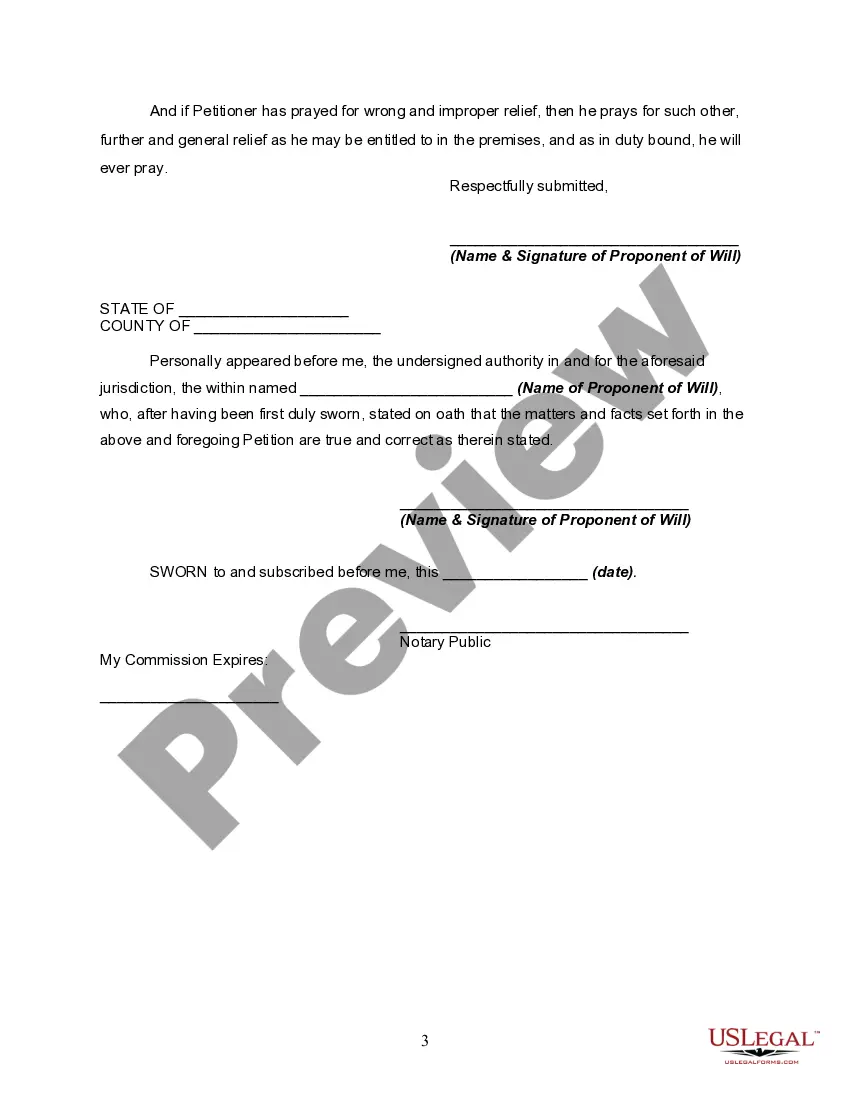
How to fill out Petition To Probate Lost Will?
It’s well known that you cannot transform into a legal authority instantly, nor can you swiftly grasp how to prepare a Probate Grant On Credit without possessing specialized knowledge.
Drafting legal documents is a lengthy endeavor necessitating particular training and expertise. So why not entrust the preparation of the Probate Grant On Credit to professionals.
With US Legal Forms, one of the largest legal document repositories, you can discover everything from court documents to templates for internal communications.
If you need another form, you can start your search again.
Create a free account and select a subscription plan to acquire the template.
- We recognize how important compliance and conformity to federal and local statutes and regulations are.
- That’s the reason all templates on our platform are location-specific and current.
- Here’s how to get started with our website and obtain the form you need in just moments.
- Locate the form you seek using the search bar at the top of the page.
- View it (if this feature is available) and read the accompanying description to decide if Probate Grant On Credit is what you require.
Form popularity
FAQ
Grant credit refers to a type of funding that is offered, typically without the expectation of repayment. In relation to estates, a probate grant on credit enables executors to access required funds for probate costs. This form of financing can alleviate the burden on beneficiaries and ensure that estate matters progress efficiently.
A grant is not considered a debt. Instead, it is a provision of funds that do not require repayment, often intended for specific purposes. When you receive a probate grant on credit, you benefit from financial support without accruing traditional debt burdens. This support can help with various expenses during the probate process.
Claiming deceased bank accounts without probate can be challenging, but there are options available. If the account has a payable-on-death designation or is held jointly, you may be able to access funds without formal probate. However, obtaining a probate grant on credit may simplify the process and provide clearer legal boundaries.
Waiting six months after receiving the probate grant on credit allows time for creditor claims to be processed. It also provides the executor time to manage estate assets effectively. This waiting period is crucial for ensuring that all debts are settled before any distributions to beneficiaries occur.
The time allowed to settle an estate varies by state, but it typically falls within one to two years. Courts expect executors to act diligently in finalizing the probate grant on credit and distributing assets. Prolonged delays can lead to increased legal complications and potential disputes among heirs.
Delays in probate can lead to increased costs and complications. When probate is delayed, you may face challenges with estate management and creditor claims. It's essential to address probate grant on credit promptly to maintain timely resolutions for all involved parties.
After six months from the probate grant on credit, the executor typically completes the estate settlement process. This timeframe allows any creditor claims to be resolved and ensures that assets can be distributed to beneficiaries. Failure to settle within this period may delay inheritance.
The six-month rule often refers to the time frame for creditors to make claims against the estate. After the probate grant on credit is issued, creditors typically have six months to submit their claims. This period allows the estate to manage debts effectively before distributing assets to heirs.
You generally have a limited time to file for probate after a person's death. In most states, you must initiate this process within six months to a year. Delaying the probate grant on credit may complicate settling the estate and could lead to further financial complications.
The minimum value for probate is determined by state regulations and can range significantly. Many states have a threshold below which estates can avoid formal probate proceedings. Understanding the requirements can help you make informed decisions about utilizing a probate grant on credit, and UsLegalForms can provide comprehensive support for your needs.