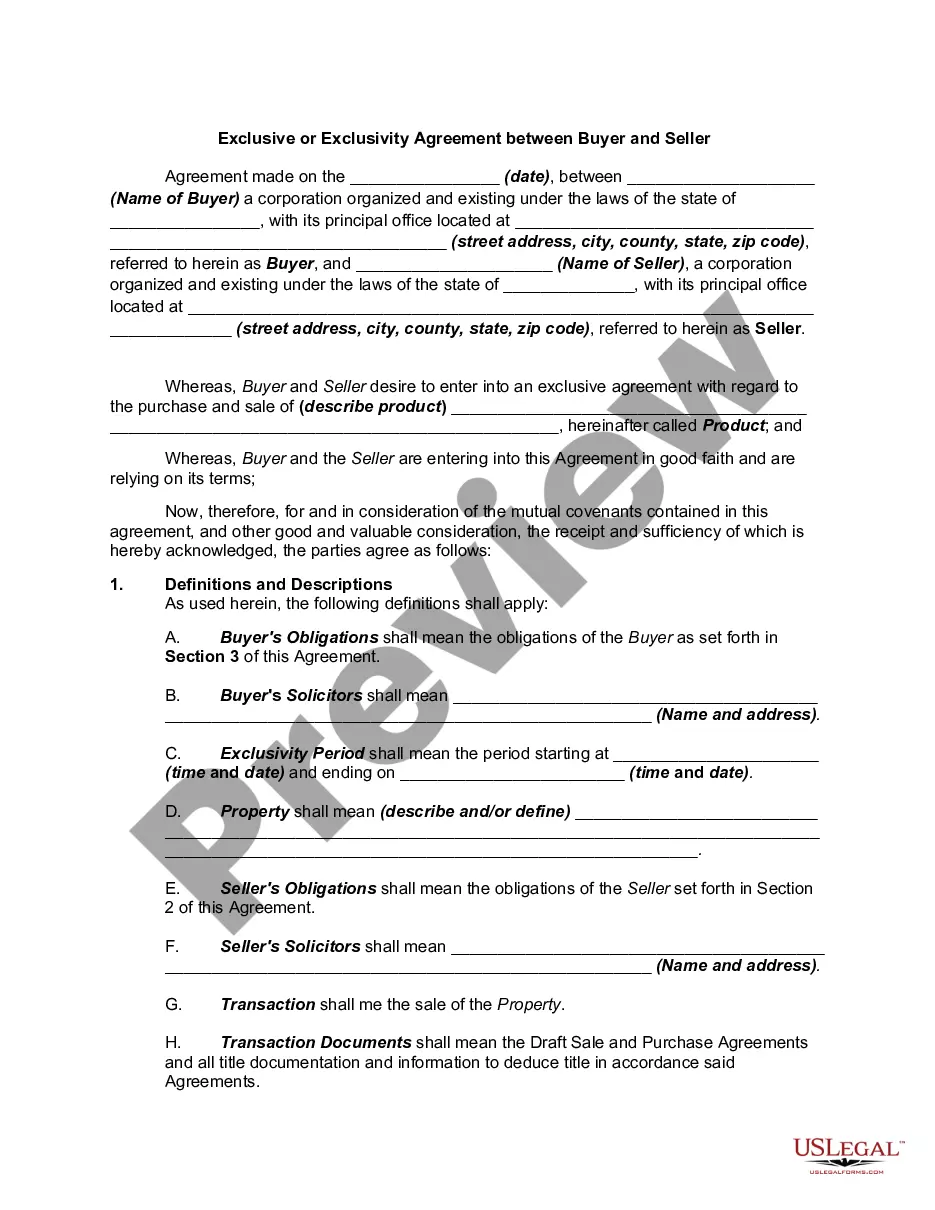
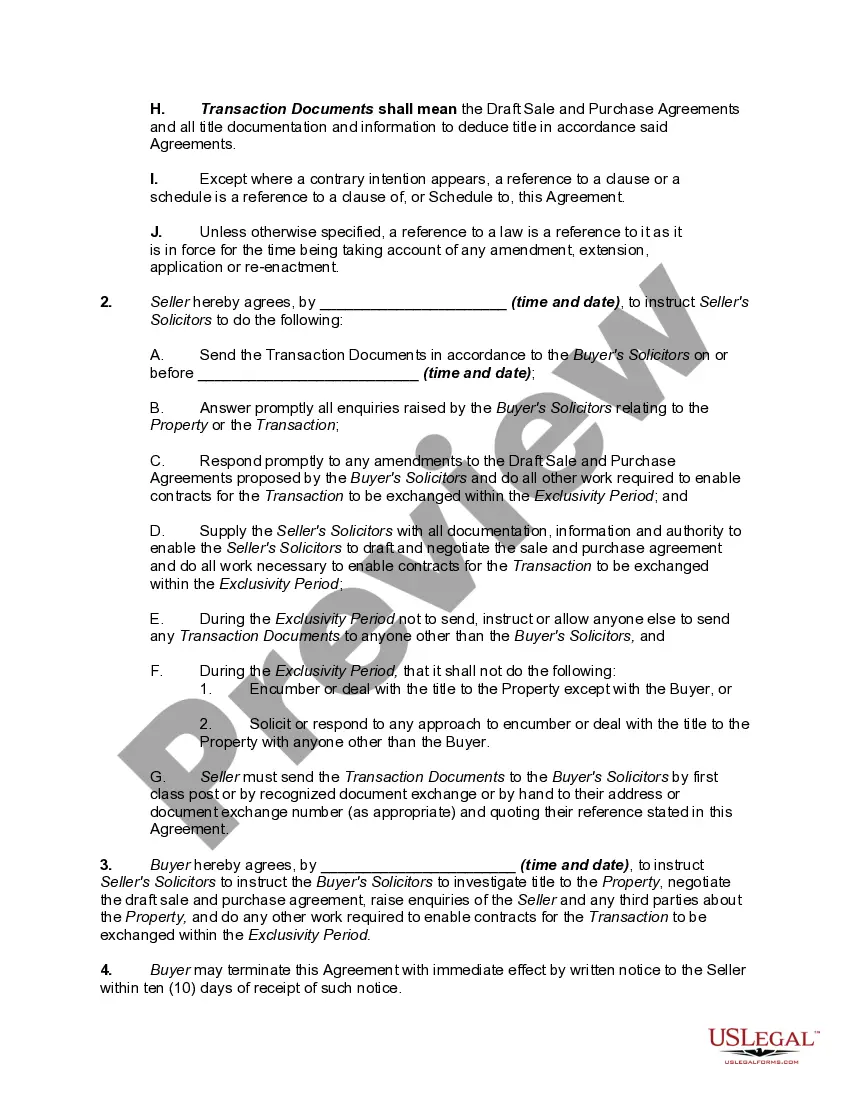
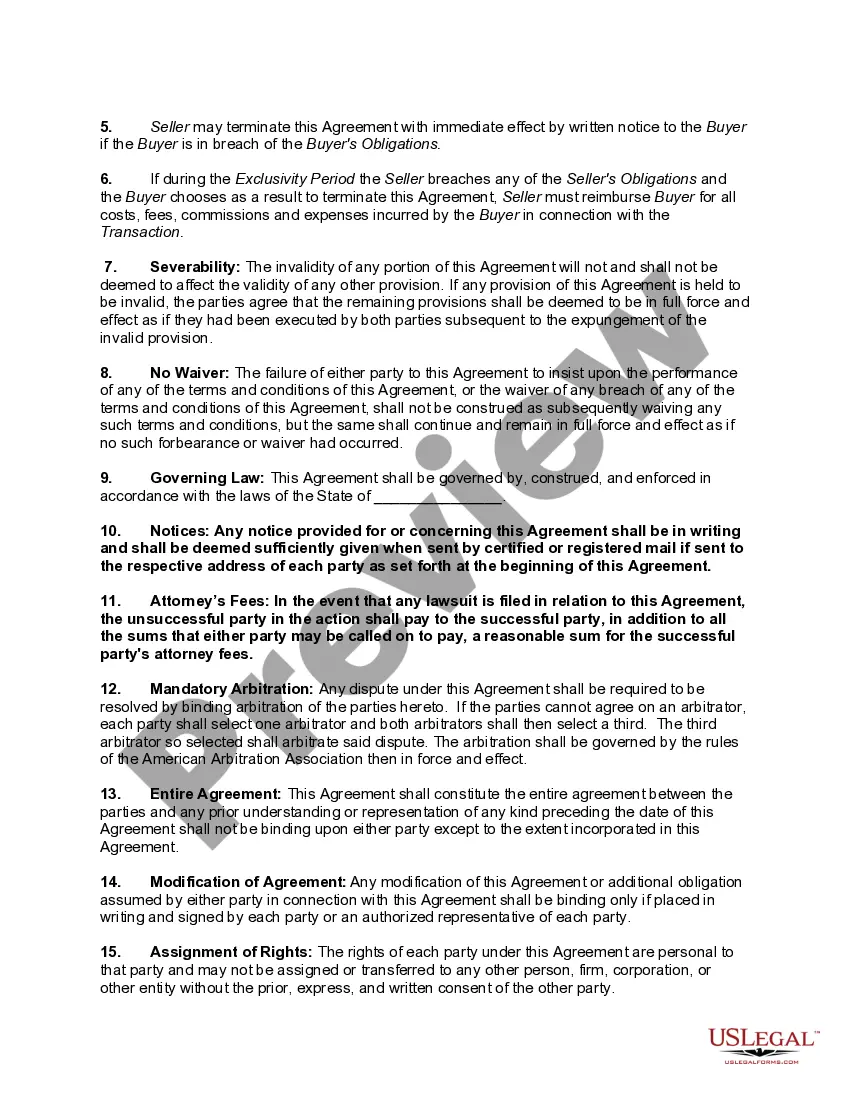
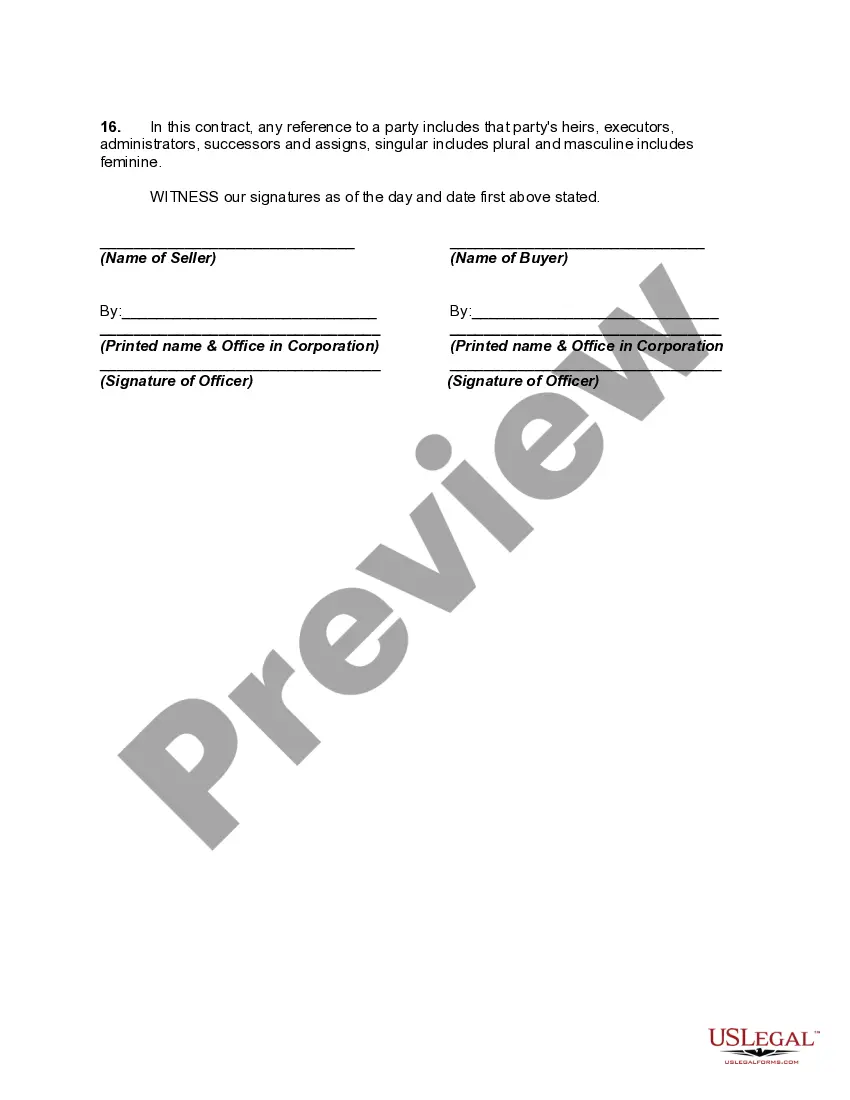
Exclusivity Agreement For Lease
Description
Get your form ready online
Our built-in tools help you complete, sign, share, and store your documents in one place.
Make edits, fill in missing information, and update formatting in US Legal Forms—just like you would in MS Word.
Download a copy, print it, send it by email, or mail it via USPS—whatever works best for your next step.
Sign and collect signatures with our SignNow integration. Send to multiple recipients, set reminders, and more. Go Premium to unlock E-Sign.
If this form requires notarization, complete it online through a secure video call—no need to meet a notary in person or wait for an appointment.
We protect your documents and personal data by following strict security and privacy standards.

Make edits, fill in missing information, and update formatting in US Legal Forms—just like you would in MS Word.

Download a copy, print it, send it by email, or mail it via USPS—whatever works best for your next step.

Sign and collect signatures with our SignNow integration. Send to multiple recipients, set reminders, and more. Go Premium to unlock E-Sign.

If this form requires notarization, complete it online through a secure video call—no need to meet a notary in person or wait for an appointment.

We protect your documents and personal data by following strict security and privacy standards.
Looking for another form?



How to fill out Exclusive Or Exclusivity Agreement Between Buyer And Seller?
Securing a reliable source for the most up-to-date and pertinent legal documents is a significant part of dealing with bureaucracy.
Identifying the appropriate legal documents demands accuracy and meticulousness, which is why it is essential to obtain samples of Exclusivity Agreement For Lease exclusively from reputable providers, such as US Legal Forms.
Eliminate the stress associated with your legal documentation. Explore the extensive US Legal Forms catalog where you can discover legal templates, verify their applicability to your circumstances, and download them instantly.
- Make use of the directory navigation or search function to find your document.
- Review the description of the form to determine if it meets the requirements for your state and locality.
- Access the form preview, if available, to ensure that it is indeed the document you need.
- Return to the search if the Exclusivity Agreement For Lease does not fulfill your requirements to find the correct document.
- Once you are confident about the form's suitability, download it.
- If you are a registered user, click Log in to verify your identity and access your chosen documents in My documents.
- If you have not yet created an account, click Buy now to purchase the template.
- Select the pricing option that best fits your needs.
- Proceed to the registration process to complete your purchase.
- Conclude your transaction by selecting a payment method (credit card or PayPal).
- Choose the file format for downloading the Exclusivity Agreement For Lease.
- Once the document is on your device, you can edit it using the editor or print it to complete manually.
Form popularity
FAQ
The purpose of an exclusivity agreement is to safeguard a tenant's business by preventing competition in proximity. This agreement serves to fortify the tenant's position within the market, allowing them to grow and thrive without worry. Thus, an exclusivity agreement for lease is vital for establishing a secure operational environment.
The exclusivity clause in a lease outlines the specific rights of the tenant in terms of competition from other businesses. This clause effectively prevents the landlord from leasing to direct competitors within the premises. When formulating an exclusivity agreement for lease, clarity in the exclusivity clause is essential to ensure both parties have a mutual understanding of their rights.
An exclusive lease agreement is a contract that allows one tenant to operate without competition from similar businesses in the same property. This type of agreement protects the tenant's investment and fosters a conducive operating environment. In crafting an exclusivity agreement for lease, it is vital to delineate the specific rights and restrictions to maximize its effectiveness.
Exclusive use in a lease refers to the tenant's right to be the only business operating under a specific category within the leased space. This ensures that no competing businesses can disrupt their operations or dilute their brand presence. When included in an exclusivity agreement for lease, exclusive use provisions can significantly enhance a tenant’s marketability.
The benefits of an exclusive agreement include clear advantages like enhanced customer loyalty, increased foot traffic, and reduced competitive pressures. For tenants, it means they can build their brand without the uncertainty of nearby competitors. Overall, an exclusivity agreement for lease fosters a stable environment that can drive profitability for all parties involved.
The purpose of the exclusivity agreement is to ensure that a tenant can operate without the direct competition arising from the landlord leasing to others in the same business category. This agreement enhances the tenant's market position by solidifying their presence in a strategic location. Ultimately, an exclusivity agreement for lease creates a mutually beneficial arrangement for both landlords and tenants.
The exclusivity clause is important because it protects the tenant's interests by restricting the landlord from leasing similar spaces to competitors. This protection fosters a favorable environment for the tenant to thrive without the threat of direct competition. When drafting an exclusivity agreement for lease, both parties should clearly outline the terms to prevent future conflicts.
Exclusivity is crucial in lease agreements as it grants one party the sole right to conduct business in a specified location. This arrangement can help tenants secure a competitive edge in the market. In terms of an exclusivity agreement for lease, it defines the limits of competition within the premises, ensuring that the tenant can achieve their business goals.
An exclusive dealing agreement often involves a supplier requiring a retailer to sell only their products. For example, a manufacturer may enter an exclusivity agreement for lease that enables a retail store to sell only their branded goods. This exclusivity helps maintain brand integrity and ensures consistency in product offerings.
Exclusivity in a lease means that certain rights are granted to one party, restricting the other party from entering similar agreements or leases with competitors. For example, when a tenant signs an exclusivity agreement for lease, it may prevent the landlord from leasing space to similar businesses. This ensures that the tenant can leverage a unique market position.