Taxes On Escrow Interest
Description
Get your form ready online
Our built-in tools help you complete, sign, share, and store your documents in one place.
Make edits, fill in missing information, and update formatting in US Legal Forms—just like you would in MS Word.
Download a copy, print it, send it by email, or mail it via USPS—whatever works best for your next step.
Sign and collect signatures with our SignNow integration. Send to multiple recipients, set reminders, and more. Go Premium to unlock E-Sign.
If this form requires notarization, complete it online through a secure video call—no need to meet a notary in person or wait for an appointment.
We protect your documents and personal data by following strict security and privacy standards.

Make edits, fill in missing information, and update formatting in US Legal Forms—just like you would in MS Word.

Download a copy, print it, send it by email, or mail it via USPS—whatever works best for your next step.

Sign and collect signatures with our SignNow integration. Send to multiple recipients, set reminders, and more. Go Premium to unlock E-Sign.

If this form requires notarization, complete it online through a secure video call—no need to meet a notary in person or wait for an appointment.

We protect your documents and personal data by following strict security and privacy standards.
Looking for another form?






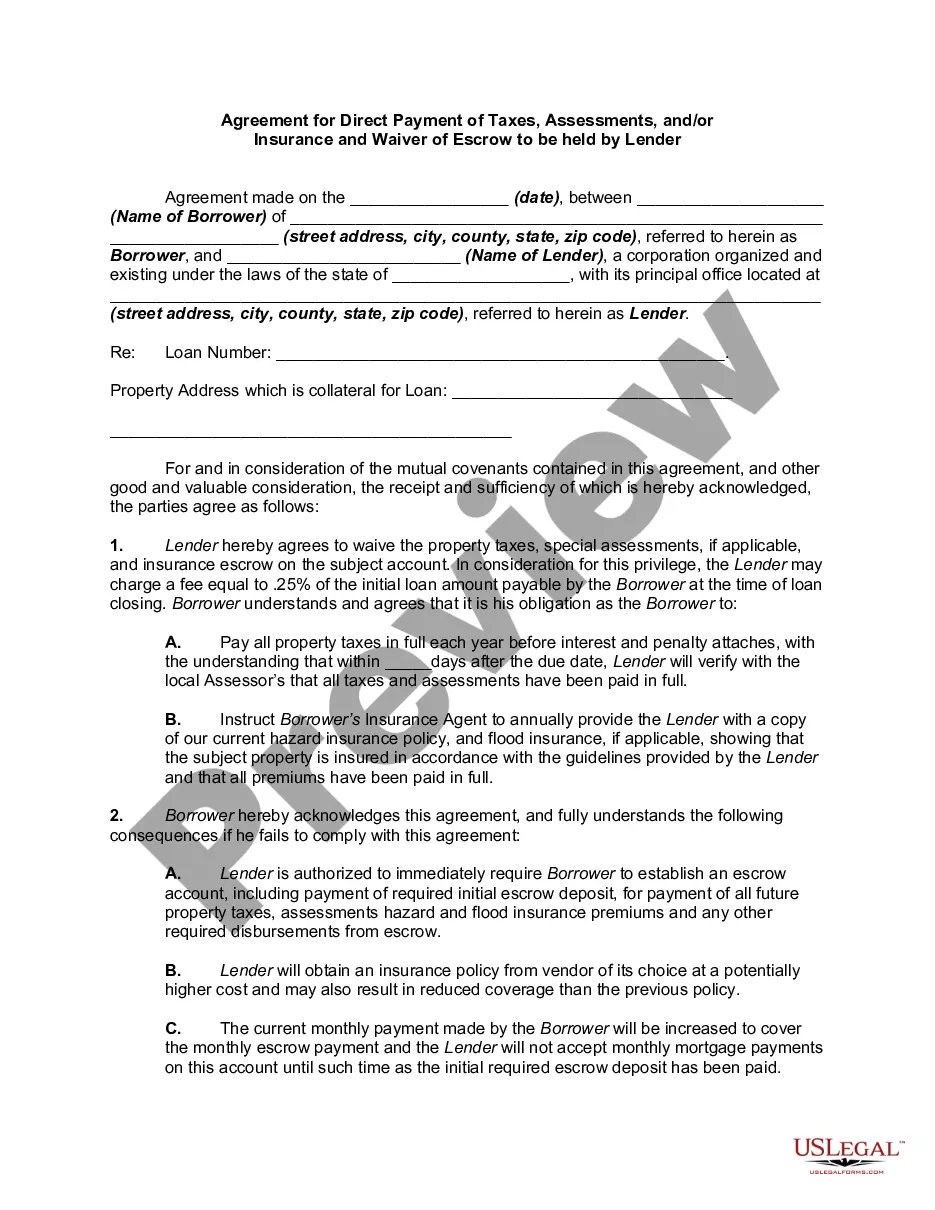
How to fill out Agreement For Direct Payment Of Taxes, Assessments, And/or Insurance And Waiver Of Escrow To Be Held By Lender?
It’s well known that you cannot become a legal authority instantly, nor can you learn how to swiftly prepare Taxes On Escrow Interest without possessing a specialized skill set.
Assembling legal documents is a lengthy process that necessitates particular education and expertise. So why not entrust the preparation of the Taxes On Escrow Interest to the experts.
With US Legal Forms, one of the most comprehensive legal document repositories, you can discover anything from court papers to templates for internal corporate correspondence. We understand how crucial compliance with federal and local statutes and regulations is.
You can revisit your forms from the My documents tab at any point. If you’re a current client, you can easily Log In, and find and download the template from the same tab.
Regardless of the purpose of your documents—whether they are financial and legal or personal—our platform has your needs covered. Give US Legal Forms a try today!
- Begin by locating the document you require using the search bar at the top of the page.
- Review it (if this option is available) and examine the accompanying description to see if Taxes On Escrow Interest meets your needs.
- If you need another template, initiate your search once more.
- Create a free account and select a subscription plan to purchase the template.
- Click Buy now. Once the transaction is completed, you can download the Taxes On Escrow Interest, complete it, print it, and send or mail it to the appropriate individuals or organizations.
Form popularity
FAQ
Interest on escrow may accumulate and can be subject to taxes. Typically, escrow accounts hold funds for property taxes and insurance, and any interest earned is reported to the IRS. If you're concerned about how this affects your tax situation, consult a tax professional. Understanding taxes on escrow interest can help you avoid surprises come tax season.
To claim mortgage interest on your taxes, you need to fill out Schedule A of Form 1040. Enter the total amount of mortgage interest from your 1098 statement. If you're unsure, consider using a tax preparation service or software to guide you through the process. Correctly claiming this interest can help you benefit from the taxes on escrow interest.
Yes, you must report your mortgage interest on your taxes if you itemize your deductions. The IRS allows you to deduct this interest, which can significantly reduce your taxable income. Ensure you include the amount from your 1098 statement when filing. This step is essential for properly managing taxes on escrow interest.
To obtain your 1098 mortgage interest statement, contact your mortgage lender or servicer. They typically send this form by January 31st each year. If you do not receive it, reach out to them directly for assistance. This statement is crucial for accurately reporting your taxes on escrow interest.
Yes, interest on escrow accounts is generally considered taxable income. When you earn interest from your escrow account, it must be reported on your tax return. This aspect of taxes on escrow interest can be confusing, but accurate reporting ensures compliance with IRS guidelines. To simplify this process, consider using US Legal Forms for guidance on how to report your interest income.
Certain types of interest income, such as interest from municipal bonds, are not subject to federal taxes. However, when it comes to taxes on escrow interest, the interest earned on your escrow account usually is taxable. Therefore, it's important to differentiate between taxable and non-taxable interest when filing your taxes. Consulting resources like US Legal Forms can provide clarity on these distinctions.
Yes, you should report certain aspects of your escrow account on your taxes. Specifically, if you receive interest from your escrow account, it may qualify as taxable income. It's essential to track these details, as they relate to taxes on escrow interest. US Legal Forms can assist you in managing and reporting this information accurately.
If you don't file your 1098 mortgage interest statement, you may miss out on valuable tax deductions. The IRS expects you to report all relevant financial information, including taxes on escrow interest. Not filing could lead to an audit or penalties, so it's crucial to keep accurate records. You can use platforms like US Legal Forms to help you understand your filing requirements.