Seeking Damages For Patent Infringement
Description

Get your form ready online
Our built-in tools help you complete, sign, share, and store your documents in one place.
Make edits, fill in missing information, and update formatting in US Legal Forms—just like you would in MS Word.
Download a copy, print it, send it by email, or mail it via USPS—whatever works best for your next step.
Sign and collect signatures with our SignNow integration. Send to multiple recipients, set reminders, and more. Go Premium to unlock E-Sign.
If this form requires notarization, complete it online through a secure video call—no need to meet a notary in person or wait for an appointment.
We protect your documents and personal data by following strict security and privacy standards.

Make edits, fill in missing information, and update formatting in US Legal Forms—just like you would in MS Word.

Download a copy, print it, send it by email, or mail it via USPS—whatever works best for your next step.

Sign and collect signatures with our SignNow integration. Send to multiple recipients, set reminders, and more. Go Premium to unlock E-Sign.

If this form requires notarization, complete it online through a secure video call—no need to meet a notary in person or wait for an appointment.

We protect your documents and personal data by following strict security and privacy standards.
Looking for another form?





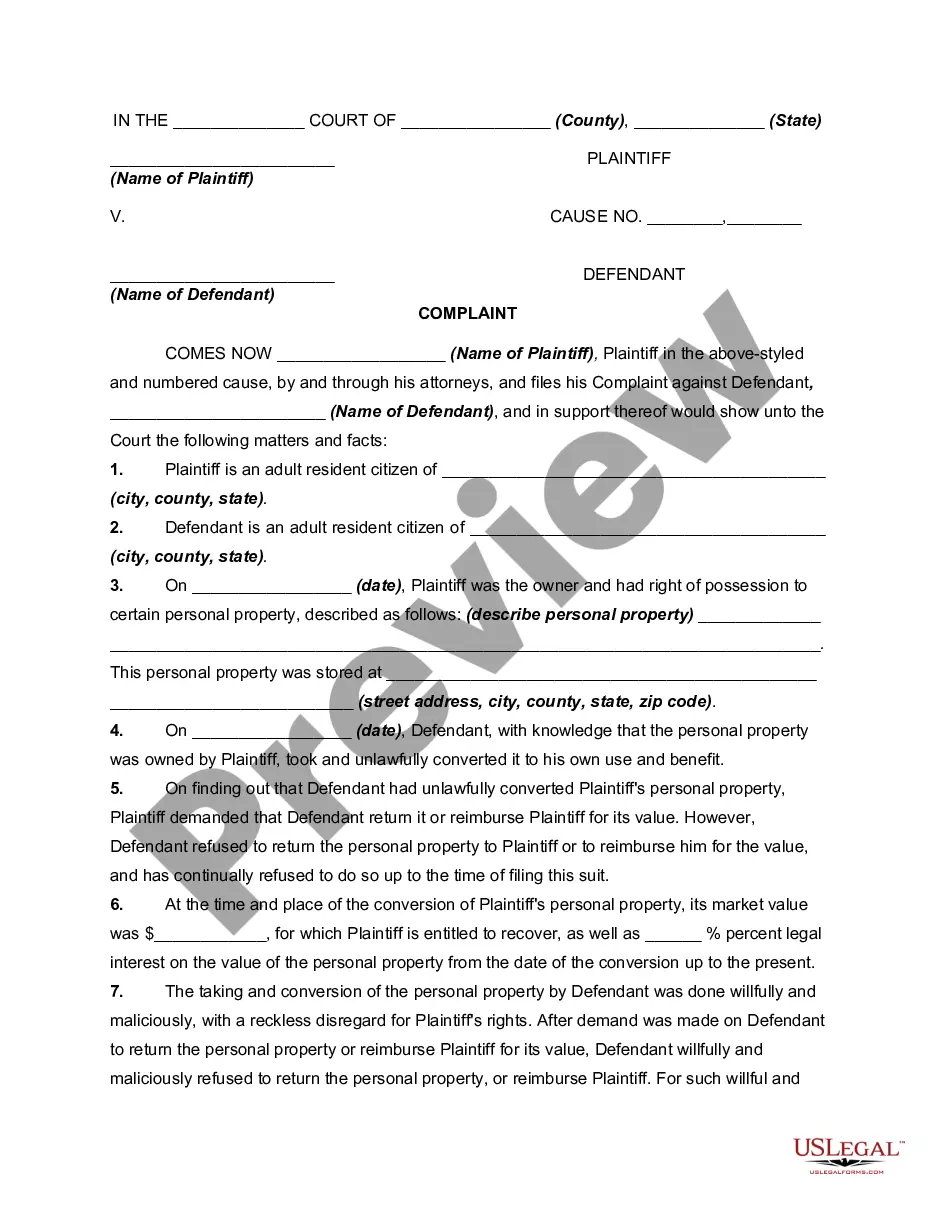
How to fill out Complaint For Conversion Seeking Punitive Damages?
Regardless of whether it’s for corporate needs or personal issues, everyone must confront legal matters at some stage in life.
Completing legal paperwork demands meticulous focus, beginning with selecting the correct form template.
With an extensive catalog from US Legal Forms available, you won’t need to waste time searching for the right template online. Utilize the library’s user-friendly navigation to locate the suitable template for any situation.
- For instance, choosing an incorrect version of the Seeking Damages For Patent Infringement will result in its rejection upon submission.
- Thus, it's vital to have a trustworthy source for legal documents like US Legal Forms.
- To acquire a Seeking Damages For Patent Infringement template, follow these simple instructions.
- Utilize the search feature or browse the catalog to find the required template.
- Review the form’s description to confirm it aligns with your situation, state, and locality.
- Click on the form’s preview to examine it.
- If it’s not the right document, return to the search option to find the Seeking Damages For Patent Infringement sample you need.
- Download the file once it meets your specifications.
- If you possess a US Legal Forms account, just click Log in to access previously saved templates in My documents.
- If you haven't created an account yet, you can download the form by clicking Buy now.
- Select the appropriate pricing option.
- Fill out the account registration form.
- Choose your payment method: either a credit card or a PayPal account.
- Decide on the document format you desire and download the Seeking Damages For Patent Infringement.
- After downloading, you can complete the form using editing software or print it out and fill it in manually.
Form popularity
FAQ
Under the theory of willful infringement, a court may increase ?damages up to three times the amount found or assessed,? after finding a defendant to have willfully infringed.
A patent owner can file a civil lawsuit to recover damages for past infringement and obtain injunctions against further infringing activities. Proving patent infringement in court requires a plaintiff to prove two broad elements: ownership and validity of the patent, and infringement of the patent by the defendant.
There are many types of patent infringements, and the most common one is selling a patented product without authorization (see 35 U.S. Code § 271 for more details). For example, if a company sells a product on Amazon without authorization from the patent owner, the company may be an infringer.
This process is highly evidence-based, and experts will often be brought in to testify. The court will typically calculate the license of a single item's fair market value and then multiply that calculation by how many items the defendant infringed (e.g. Cost of invention license: $100 x 500 units sold = $50,000).
BASICS: ?To collect lost profits [from lost sales], a 'patentee must show 'a reasonable probability that 'but for' the infringing activity, the patentee would have made the infringer's sales. ' This is done by determining what profits the patentee would have made absent the infringing product.