Trust Creation Forms For The Next Step
Description

Get your form ready online
Our built-in tools help you complete, sign, share, and store your documents in one place.
Make edits, fill in missing information, and update formatting in US Legal Forms—just like you would in MS Word.
Download a copy, print it, send it by email, or mail it via USPS—whatever works best for your next step.
Sign and collect signatures with our SignNow integration. Send to multiple recipients, set reminders, and more. Go Premium to unlock E-Sign.
If this form requires notarization, complete it online through a secure video call—no need to meet a notary in person or wait for an appointment.
We protect your documents and personal data by following strict security and privacy standards.

Make edits, fill in missing information, and update formatting in US Legal Forms—just like you would in MS Word.

Download a copy, print it, send it by email, or mail it via USPS—whatever works best for your next step.

Sign and collect signatures with our SignNow integration. Send to multiple recipients, set reminders, and more. Go Premium to unlock E-Sign.

If this form requires notarization, complete it online through a secure video call—no need to meet a notary in person or wait for an appointment.

We protect your documents and personal data by following strict security and privacy standards.
Looking for another form?









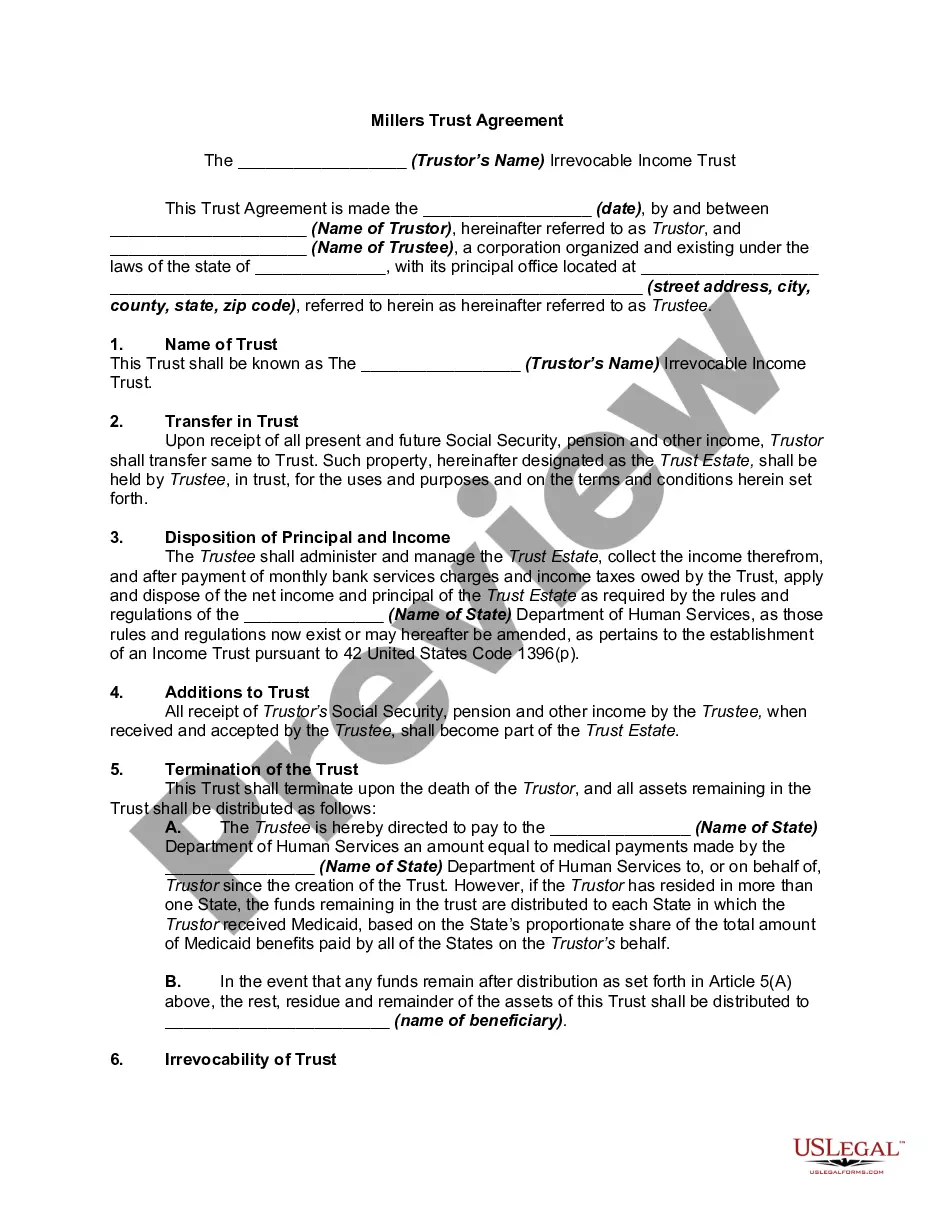
How to fill out Qualified Income Miller Trust?
- Log in to your account on US Legal Forms if you're a returning user. Ensure your subscription is active; renew if necessary.
- For first-time users, begin by checking the Preview mode. Confirm that the selected form aligns with your requirements and complies with local jurisdiction.
- Should you require a different template, utilize the Search tab to find the appropriate form.
- After selecting a suitable document, click on the Buy Now button. Choose a subscription plan that best fits your needs and register for an account.
- Complete your purchase by entering your credit card information or opting for PayPal.
- Finally, download your form to your device, and access it anytime through the My Forms section of your profile.
Using US Legal Forms not only provides access to a vast array of over 85,000 forms but also ensures that your documents are precise and legally enforceable. Our service empowers individuals and attorneys to handle their legal documentation with ease and confidence.
Ready to take the next step in legal preparedness? Start your journey with US Legal Forms today and create trustworthy documents at your fingertips!
Form popularity
FAQ
Certain assets, such as retirement accounts, life insurance policies, and highly-valued personal property, might not be suitable for inclusion in a trust. Additionally, assets that require beneficiary designations may complicate trust management. To navigate these complexities and effectively use trust creation forms for the next step, consider seeking professional guidance.
One significant mistake parents often make when setting up a trust fund is failing to clearly define the terms and conditions of the trust. This can lead to misunderstandings and conflicts among beneficiaries. It's essential to use detailed and precise trust creation forms for the next step to prevent these issues and ensure that your wishes are honored.
The 5 5 trust rule applies to certain types of trusts that allow beneficiaries to withdraw a limited amount each year without tax consequences, specifically up to the greater of $5,000 or 5% of the trust's value. Understanding this rule is crucial for managing distributions effectively. By using proper trust creation forms for the next step, you can ensure compliance with this rule.
The five necessary elements to form a trust include the settlor, who creates the trust, the trustee, who manages it, the trust property, the beneficiaries who receive assets, and a clearly defined purpose of the trust. Each element must align for the trust to function correctly. You can find comprehensive trust creation forms for the next step to help facilitate this process.
You can determine if a trust is valid by confirming that it meets the legal requirements in your state, including proper documentation and signatures on trust creation forms for the next step. An evaluation of the trust's terms can help ensure that the grantor intended to create the trust. Consulting a legal expert can provide additional assurance about trust validity.
To create a valid trust, you need a clear intent to create that trust, a designated trustee, identifiable trust property, specific beneficiaries, and valid trust creation forms for the next step. Each component plays a crucial role, ensuring that the trust operates as intended. It’s important to consult with legal experts to meet state requirements and avoid potential problems.
Formation documents for a trust are essential legal papers that establish the trust and define its terms. These trust creation forms for the next step outline the responsibilities of the trustee and the rights of the beneficiaries. They typically include documents such as the trust agreement, asset list, and any amendments. Understanding these documents helps ensure that your trust functions according to your wishes, providing peace of mind for you and your loved ones.
Avoiding inheritance tax with a trust involves strategic planning and proper trust setup. Utilizing certain trust creation forms for the next step allows you to structure your estate in a way that minimizes tax exposure. Consider gifting assets during your lifetime or setting up a trust that meets specific requirements to reduce or eliminate tax liabilities. Consulting with a legal expert can further enhance your strategy.
The 5-year rule for trusts refers to a period during which assets transferred into a trust can affect Medicaid eligibility. If you transfer assets to an irrevocable trust, those assets could be subject to a look-back period of five years. Knowing this rule helps you plan your estate effectively and avoid potential pitfalls. Using trust creation forms for the next step can simplify compliance with these regulations.
An irrevocable trust can be subject to the 5-year rule, especially when it comes to Medicaid eligibility. This rule states that any assets transferred into the trust may be considered a gift, impacting eligibility for five years. Understanding how this rule applies to your specific situation is vital. Trust creation forms for the next step can help clarify your options and guide you through the process.