Quit Verb Forms V1 V2 V3 V4 V5
Description

Get your form ready online
Our built-in tools help you complete, sign, share, and store your documents in one place.
Make edits, fill in missing information, and update formatting in US Legal Forms—just like you would in MS Word.
Download a copy, print it, send it by email, or mail it via USPS—whatever works best for your next step.
Sign and collect signatures with our SignNow integration. Send to multiple recipients, set reminders, and more. Go Premium to unlock E-Sign.
If this form requires notarization, complete it online through a secure video call—no need to meet a notary in person or wait for an appointment.
We protect your documents and personal data by following strict security and privacy standards.

Make edits, fill in missing information, and update formatting in US Legal Forms—just like you would in MS Word.

Download a copy, print it, send it by email, or mail it via USPS—whatever works best for your next step.

Sign and collect signatures with our SignNow integration. Send to multiple recipients, set reminders, and more. Go Premium to unlock E-Sign.

If this form requires notarization, complete it online through a secure video call—no need to meet a notary in person or wait for an appointment.

We protect your documents and personal data by following strict security and privacy standards.
Looking for another form?



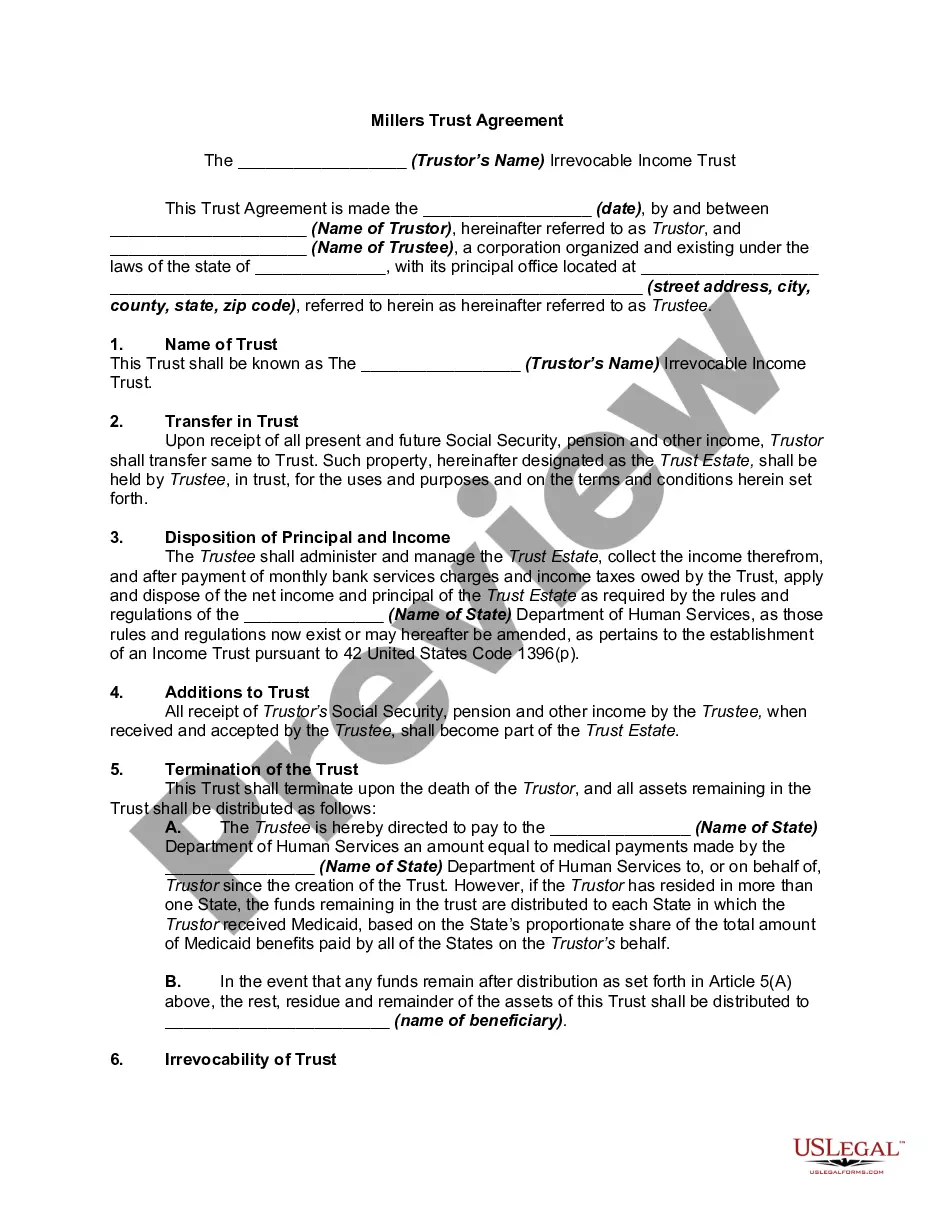
How to fill out Qualified Income Miller Trust?
The Quit Verb Forms V1 V2 V3 V4 V5 displayed on this site is a versatile legal template crafted by experienced attorneys in alignment with federal and state laws and guidelines.
For over 25 years, US Legal Forms has supplied individuals, companies, and legal practitioners with more than 85,000 authenticated, state-specific documents for any business and personal needs.
Complete and sign the documents. Print out the template to finish it by hand. Alternatively, employ an online multifunctional PDF editor to swiftly and precisely fill out and sign your form with a valid signature. Redownload your documents one more time. Use the same document again whenever necessary. Access the My documents section in your profile to redownload any previously saved forms. Register for US Legal Forms to have authenticated legal templates for every situation in life readily available.
- It’s the fastest, most uncomplicated and most trustworthy method to acquire the documents you require, as the service ensures the utmost level of data protection and anti-malware measures.
- Acquiring this Quit Verb Forms V1 V2 V3 V4 V5 will require just a few easy steps.
- Search for the document you need and verify it. Browse the file you looked for and preview it or check the form details to confirm it meets your needs. If it does not, use the search bar to find the right one. Press Buy Now once you have discovered the template you need.
- Register and Log In. Select the subscription plan that fits your needs and create an account. Use PayPal or a credit card to make a quick payment. If you already have an account, Log In and review your subscription to proceed.
- Acquire the editable template. Select the format you desire for your Quit Verb Forms V1 V2 V3 V4 V5 (PDF, DOCX, RTF) and download the document onto your device.
Form popularity
FAQ
V1, V2, V3, V4, V5 verbs refer to the various forms a verb can take. Specifically, V1 is the base form, V2 is the past form, V3 is the past participle, V4 is the present participle, and V5 is the third person singular. Familiarity with Quit verb forms v1 v2 v3 v4 v5 enriches your language skills and facilitates better communication.
The V1, V2, V3, V4, V5 forms of 'do' are do, did, done, doing, and does. Understanding these forms allows you to use the verb correctly in different contexts and tenses. Incorporating Quit verb forms v1 v2 v3 v4 v5 into your learning streamlines your grasp of English structure.
The V1, V2, V3, V4, V5 forms of 'say' are say, said, said, saying, and says. These forms are essential when constructing sentences in various tenses. When studying Quit verb forms v1 v2 v3 v4 v5, it’s useful to remember these specific variations for effective communication.
The terms V1, V2, V3, V4, and V5 represent different forms of verbs. V1 is the base form, V2 is the simple past, V3 is the past participle, V4 is the present participle, and V5 is the third person singular. Mastering Quit verb forms v1 v2 v3 v4 v5 simplifies your comprehension of English verb tenses.
The V1, V2, V3, V4, V5 forms of 'take' are take, took, taken, taking, and takes respectively. Knowing these forms helps in constructing sentences correctly. When learning about Quit verb forms v1 v2 v3 v4 v5, understanding these variations gives you a solid foundation for verb usage.
For the verb 'do', the forms are essential for proper communication. V1 is 'do', V2 is 'did', V3 is 'done', V4 is 'doing', and V5 is 'does'. Mastering these forms aids in constructing sentences that clearly convey actions. Learning about Quit verb forms V1 V2 V3 V4 V5 can complement your understanding of other verbs like 'do'.
The verb 'quit' has specific forms that you need to know for proper usage. V1 is 'quit', V2 is 'quit', and V3 is 'quit'. Unlike many other verbs, 'quit' remains the same in its past forms, which can simplify learning. Understanding Quit verb forms V1 V2 V3 V4 V5 can streamline your English learning process.
V1, V2, V3, V4, and V5 verbs describe the various forms that English verbs can take. Each form corresponds to a different tense or grammatical use, helping convey time and action accurately. Familiarity with these forms allows for clearer communication. Exploring Quit verb forms V1 V2 V3 V4 V5 will enhance your grasp of English verbs.
The verb 'play' also has distinct past and present forms. V1 is 'play', V2 is 'played', V3 is 'played', V4 is 'playing', and V5 is 'plays'. These forms allow you to express actions related to 'play' accurately. By learning these verb forms, including Quit verb forms V1 V2 V3 V4 V5, you can communicate more effectively.
The verb 'get' has different forms based on its usage. V1 is 'get', V2 is 'got', V3 is 'gotten' (or 'got' in British English), V4 is 'getting', and V5 is 'gets'. Knowing these forms will help you use 'get' correctly in various contexts. Familiarizing yourself with Quit verb forms V1 V2 V3 V4 V5 can boost your command of English.