Qualified Purchaser For Trust
Description

Get your form ready online
Our built-in tools help you complete, sign, share, and store your documents in one place.
Make edits, fill in missing information, and update formatting in US Legal Forms—just like you would in MS Word.
Download a copy, print it, send it by email, or mail it via USPS—whatever works best for your next step.
Sign and collect signatures with our SignNow integration. Send to multiple recipients, set reminders, and more. Go Premium to unlock E-Sign.
If this form requires notarization, complete it online through a secure video call—no need to meet a notary in person or wait for an appointment.
We protect your documents and personal data by following strict security and privacy standards.

Make edits, fill in missing information, and update formatting in US Legal Forms—just like you would in MS Word.

Download a copy, print it, send it by email, or mail it via USPS—whatever works best for your next step.

Sign and collect signatures with our SignNow integration. Send to multiple recipients, set reminders, and more. Go Premium to unlock E-Sign.

If this form requires notarization, complete it online through a secure video call—no need to meet a notary in person or wait for an appointment.

We protect your documents and personal data by following strict security and privacy standards.
Looking for another form?







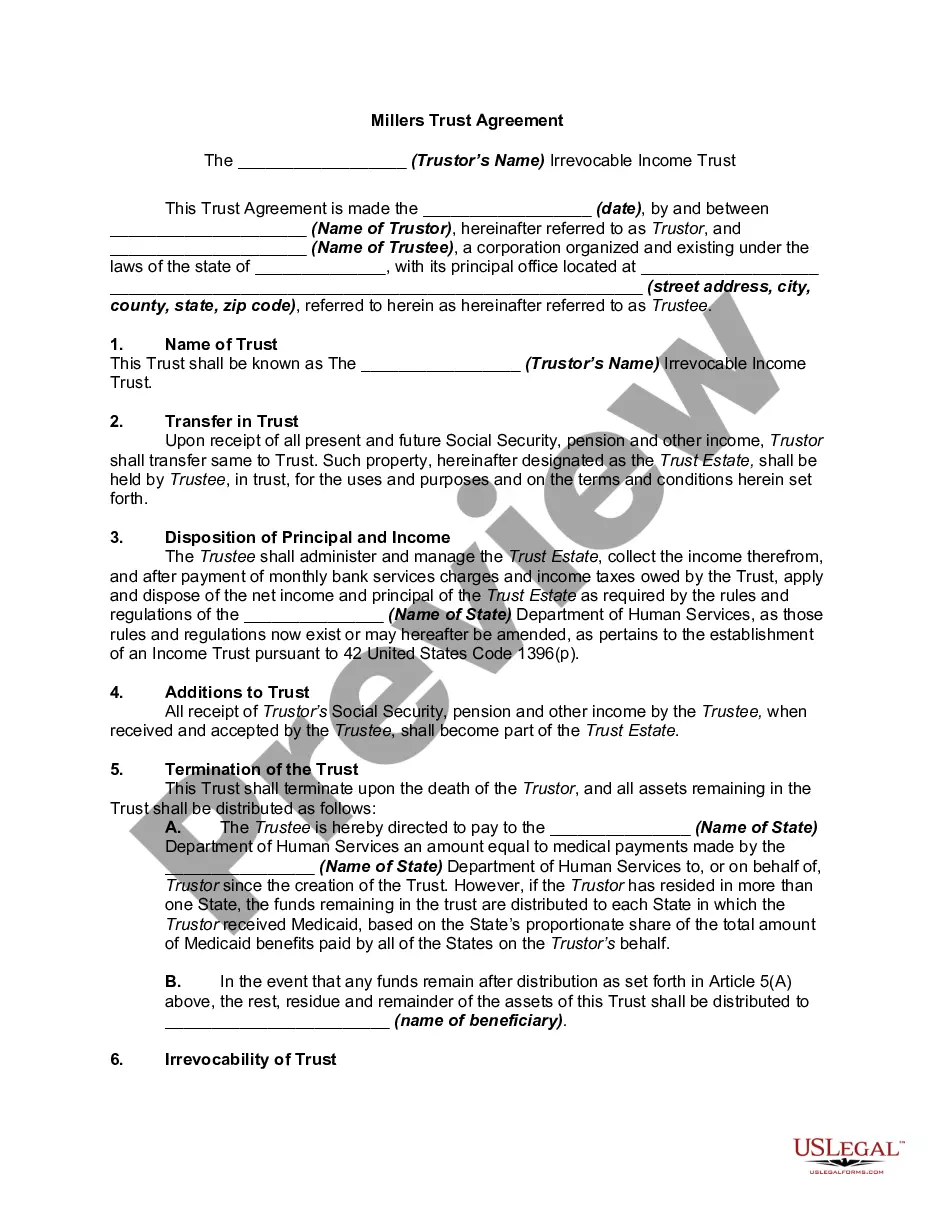
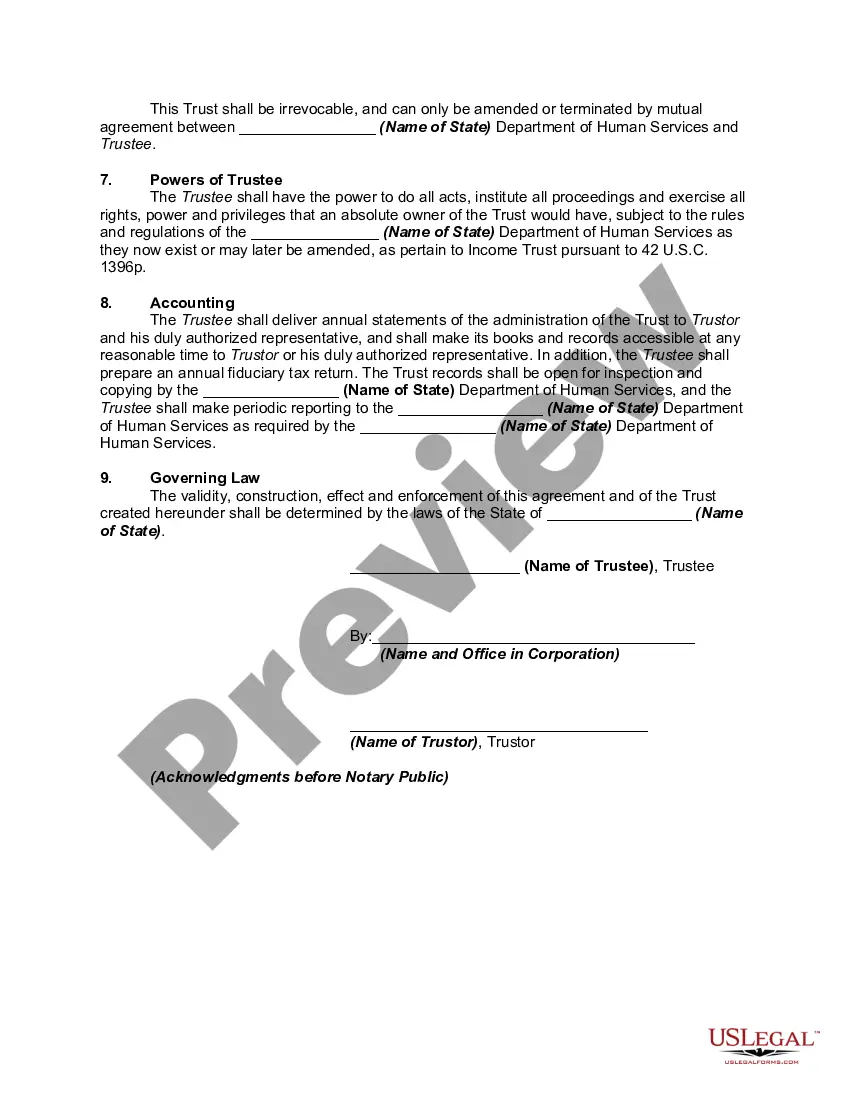
How to fill out Qualified Income Miller Trust?
- Log in to your US Legal Forms account if you are a returning user. Ensure your subscription is active; if not, renew it based on your payment plan.
- For first-time users, start by browsing the Preview mode and form description to confirm you selected the correct document that fits your local jurisdiction requirements.
- If you find the form doesn't match your needs, utilize the Search feature to identify a different template that might be more suitable.
- Once you've found the right document, click on the Buy Now button and select your preferred subscription plan. You will need to create an account to access all resources.
- Complete your purchase using a credit card or PayPal to finalize your subscription.
- Download your selected form and save it on your device. You can also access it later in the My Forms section of your account.
In conclusion, acquiring legal forms through US Legal Forms is a seamless experience. Their robust collection, extensive online library, and access to premium experts ensure that you have the necessary tools to act as a qualified purchaser for trust.
Don’t wait any longer; start your journey with US Legal Forms today!
Form popularity
FAQ
A trust becomes a qualified purchaser when it holds investments that meet the threshold criteria set by regulatory bodies. Generally, this means that the trust has substantial assets, often exceeding $5 million, which enables it to access exclusive investment opportunities. By ensuring your trust qualifies, you can enhance your portfolio and explore avenues that might otherwise be unavailable. US Legal Forms offers comprehensive guidance, assisting you in structuring your trust to achieve qualified purchaser status.
A qualified purchaser for a trust is typically an individual or entity that meets specific financial criteria defined under U.S. securities laws. These individuals usually have significant investments, allowing them to participate in private investment offerings. Understanding who qualifies helps you align your investment strategies with legal requirements, ensuring compliance and safeguarding your interests. If you seek to navigate this landscape effectively, US Legal Forms can provide resources and documents tailored to defining and establishing qualified purchasers.
A qualified eligible purchaser denotes an individual or entity recognized as eligible to participate in specific investment opportunities but with slightly lower thresholds than qualified purchasers. Typically, this includes having at least $2.1 million in investments. Understanding these distinctions can help you make informed decisions about trust and investment opportunities available to you.
To establish a qualified purchaser trust, specific requirements must be met. Primarily, the trust must be funded with assets from qualified purchasers, who generally hold over $5 million in investments. These provisions ensure that the trust remains compliant allowing it to tap into exclusive investment avenues and strategies.
A QP qualified purchaser refers to an individual or entity that meets the regulatory definition set by the SEC. This term indicates those who possess sufficient financial means to invest in private market opportunities. As a qualified purchaser for trust, you gain access to strategies designed for high-net-worth investors, allowing more tailored investment choices.
Determining if you qualify as a qualified purchaser for trust involves evaluating your financial status. If your investment portfolio exceeds the $5 million threshold, you likely meet the criteria. It's important to consider all your financial assets, so reviewing them with a financial advisor may provide clarity and confidence.
To be categorized as a qualified purchaser for trust, an individual or entity must meet specific financial criteria. Generally, this includes having at least $5 million in investments. This status opens the door to investment opportunities not available to the general public, enhancing your portfolio and financial strategy.
To prove your status as a qualified investor, you need to provide documentation of your financial credentials. This may include tax returns, bank statements, or a letter from your financial advisor confirming your status. By using a reliable platform like USLegalForms, you can easily gather and present the necessary proofs needed to establish yourself as a qualified purchaser for trust. This streamlined approach simplifies the verification process.
If someone falsely claims to be an accredited investor, they may face severe legal consequences, including fines and penalties. It can lead to lawsuits and financial ramifications for both the individual and the entity involved. This situation emphasizes the importance of verifying status as a qualified purchaser for trust before entering into any investment agreements. Always ensure due diligence to protect yourself.
To be recognized as a qualified purchaser for trust, you typically need to meet specific financial thresholds. Generally, you should own at least $5 million in investments, either individually or jointly with your spouse. This status allows you to engage in various investment opportunities not available to the general public. Understanding these criteria is crucial for your financial planning.