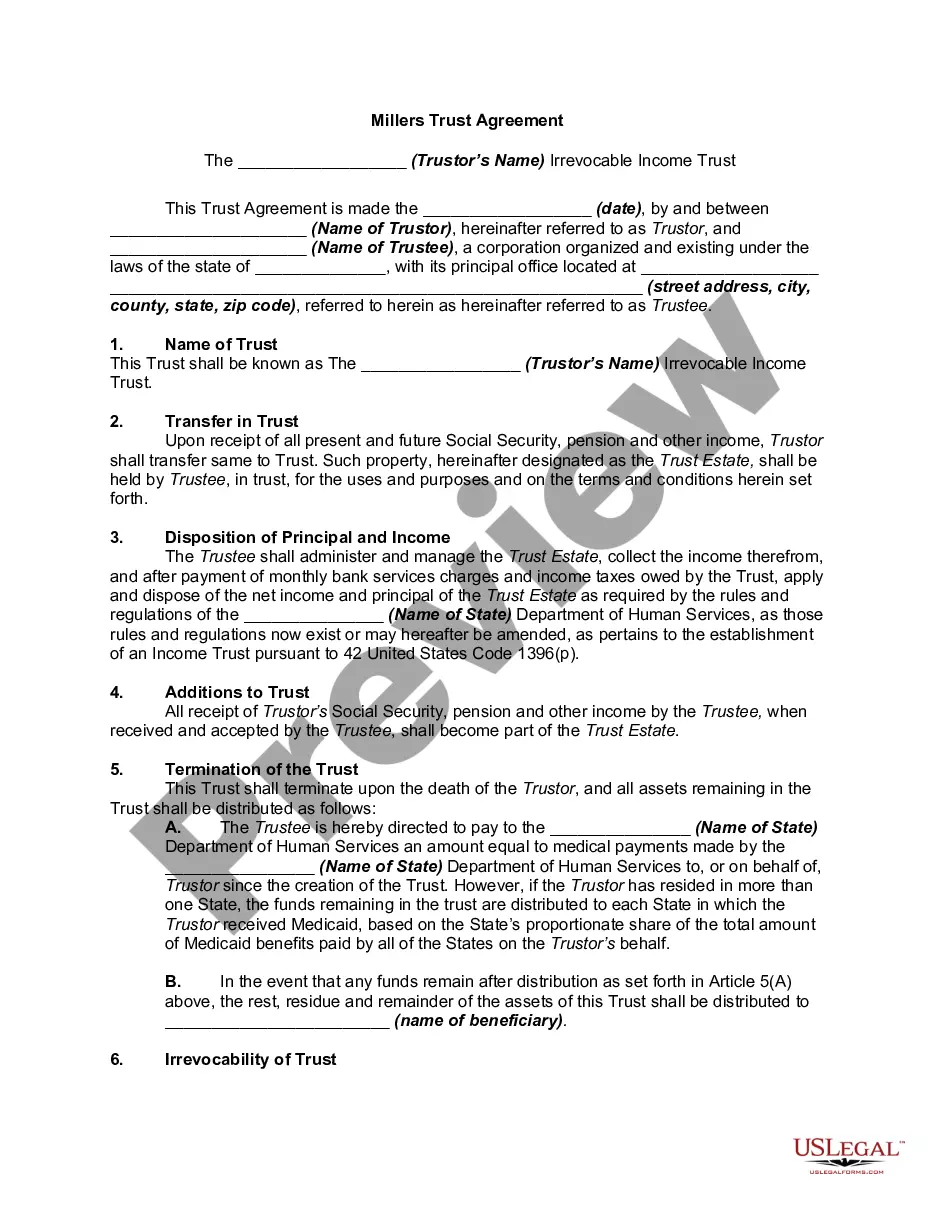
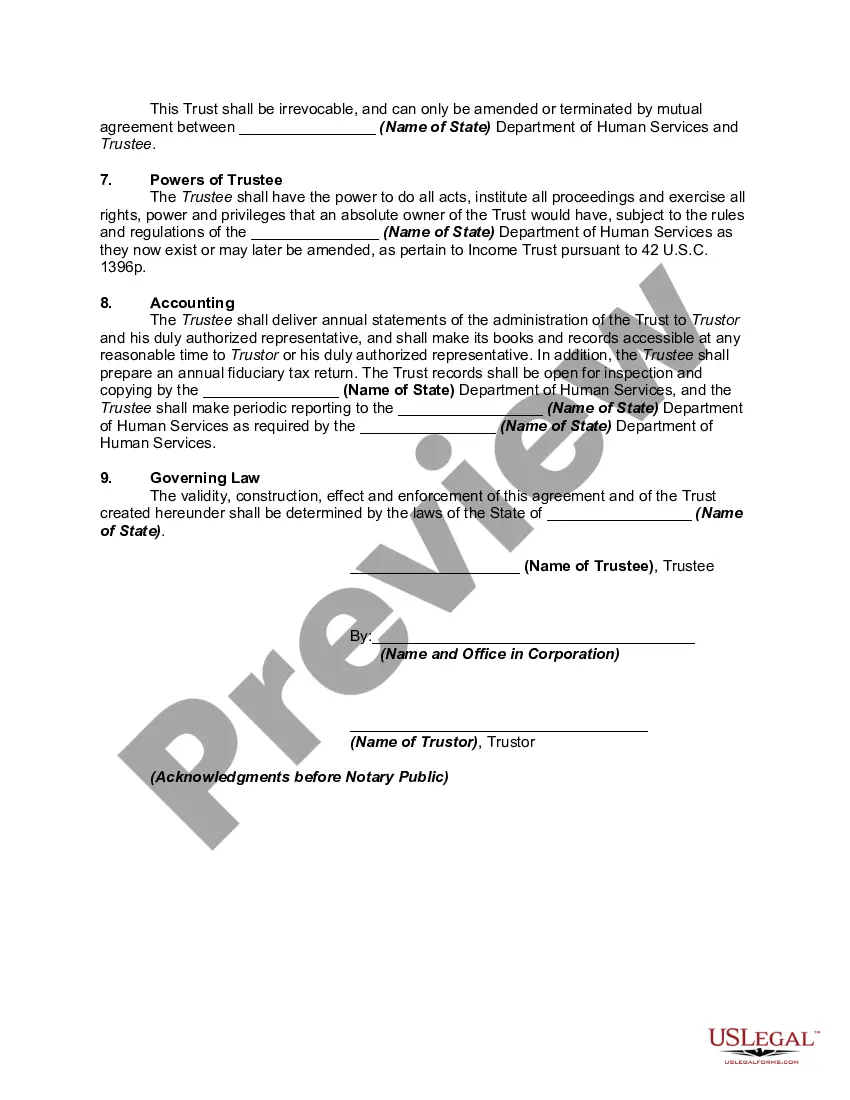
Indiana Miller Trust Form With Beneficiaries

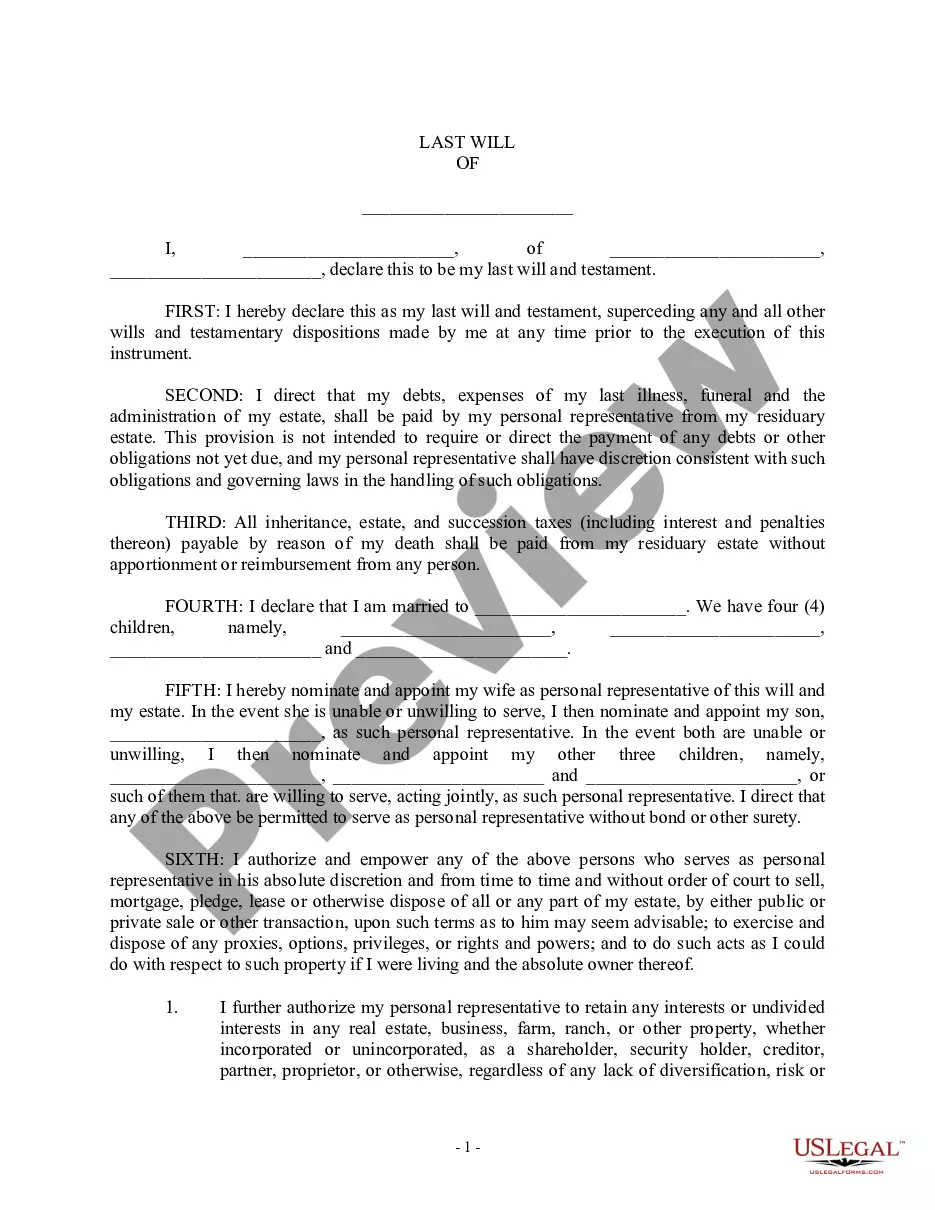
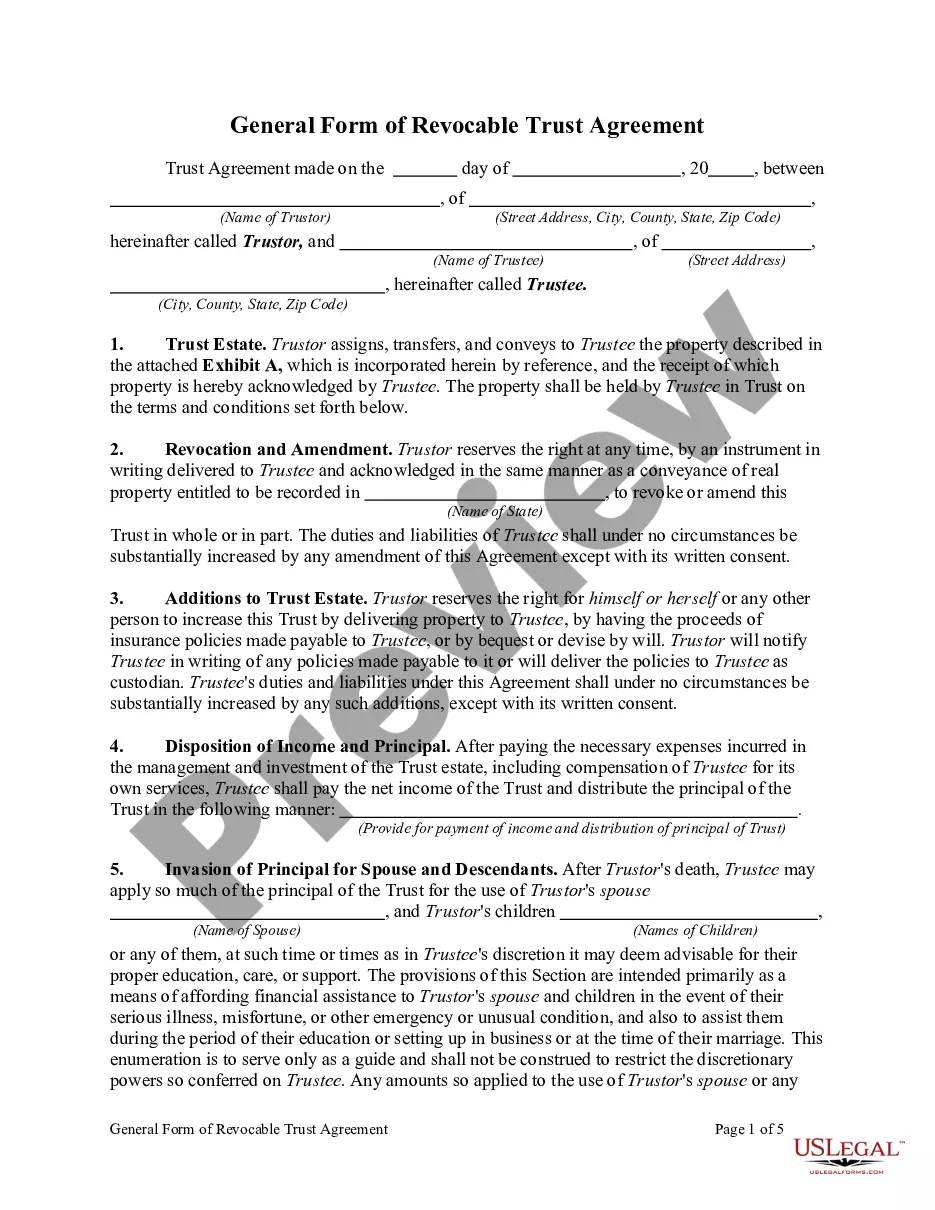
Description
Get your form ready online
Our built-in tools help you complete, sign, share, and store your documents in one place.
Make edits, fill in missing information, and update formatting in US Legal Forms—just like you would in MS Word.
Download a copy, print it, send it by email, or mail it via USPS—whatever works best for your next step.
Sign and collect signatures with our SignNow integration. Send to multiple recipients, set reminders, and more. Go Premium to unlock E-Sign.
If this form requires notarization, complete it online through a secure video call—no need to meet a notary in person or wait for an appointment.
We protect your documents and personal data by following strict security and privacy standards.

Make edits, fill in missing information, and update formatting in US Legal Forms—just like you would in MS Word.

Download a copy, print it, send it by email, or mail it via USPS—whatever works best for your next step.

Sign and collect signatures with our SignNow integration. Send to multiple recipients, set reminders, and more. Go Premium to unlock E-Sign.

If this form requires notarization, complete it online through a secure video call—no need to meet a notary in person or wait for an appointment.

We protect your documents and personal data by following strict security and privacy standards.
Looking for another form?

How to fill out Qualified Income Miller Trust?
Whether for commercial reasons or personal affairs, everyone must handle legal issues at some stage in their life.
Completing legal documents requires meticulous care, starting with choosing the appropriate form template.
With an extensive US Legal Forms catalog available, you don’t have to waste time searching for the right sample across the web. Utilize the library’s user-friendly navigation to find the suitable template for any circumstance.
- Obtain the form you need via the search field or catalog navigation.
- Review the form’s details to ensure it corresponds to your situation, state, and locality.
- Click on the form’s preview to examine it.
- If it is the incorrect form, return to the search feature to locate the Indiana Miller Trust Form With Beneficiaries sample you need.
- Download the document if it aligns with your requirements.
- If you already have a US Legal Forms account, click Log in to access previously saved documents in My documents.
- If you do not have an account yet, you can acquire the form by selecting Buy now.
- Choose the appropriate pricing option.
- Complete the profile registration form.
- Select your payment method: you can use a credit card or PayPal.
- Choose the document format you desire and download the Indiana Miller Trust Form With Beneficiaries.
- Once it is saved, you can fill out the form using editing software or print it and complete it by hand.
Form popularity
FAQ
A Miller trust can be essential for individuals who exceed Medicaid income limits but still require assistance. This type of trust allows for the legal management of income while ensuring eligibility for benefits. Setting up an Indiana miller trust form with beneficiaries can protect your assets and allow for a more streamlined approach to long-term care. It's a strategic way to maintain your financial health while accessing necessary services.
The burden of proof requires a party to produce evidence to establish the truth of facts needed to satisfy all the required legal elements of the dispute. The burden of proof is usually on the person who brings a claim in a dispute.
Proof beyond a reasonable doubt is proof that leaves you firmly convinced the defendant is guilty. It is not required that the government prove guilt beyond all possible doubt. A reasonable doubt is a doubt based upon reason and common sense and is not based purely on speculation.
1) In writing by filing a Motion or responding to a Motion; or 2) In person at a hearing scheduled by the Judge, with both sides present.
Public Access to Court Electronic Records (PACER) You can contact the PACER Service Center at .pacer.uscourts.gov for registration information about obtaining a PACER account. The PACER Locator has the ability to search across multiple court units.
Beyond a reasonable doubt is the legal burden of proof required to affirm a conviction in a criminal case. In a criminal case, the prosecution bears the burden of proving that the defendant is guilty beyond all reasonable doubt.
When a party has the burden of proving any claim [or affirmative defense] by a preponderance of the evidence, it means you must be persuaded by the evidence that the claim [or affirmative defense] is more probably true than not true.
Montana's 56 District Courts are administratively structured into 22 judicial districts and served by 46 District Court Judges.
A party must persuade you, by the evidence presented in court, that what he or she is required to prove is more likely to be true than not true. This is referred to as "the burden of proof."