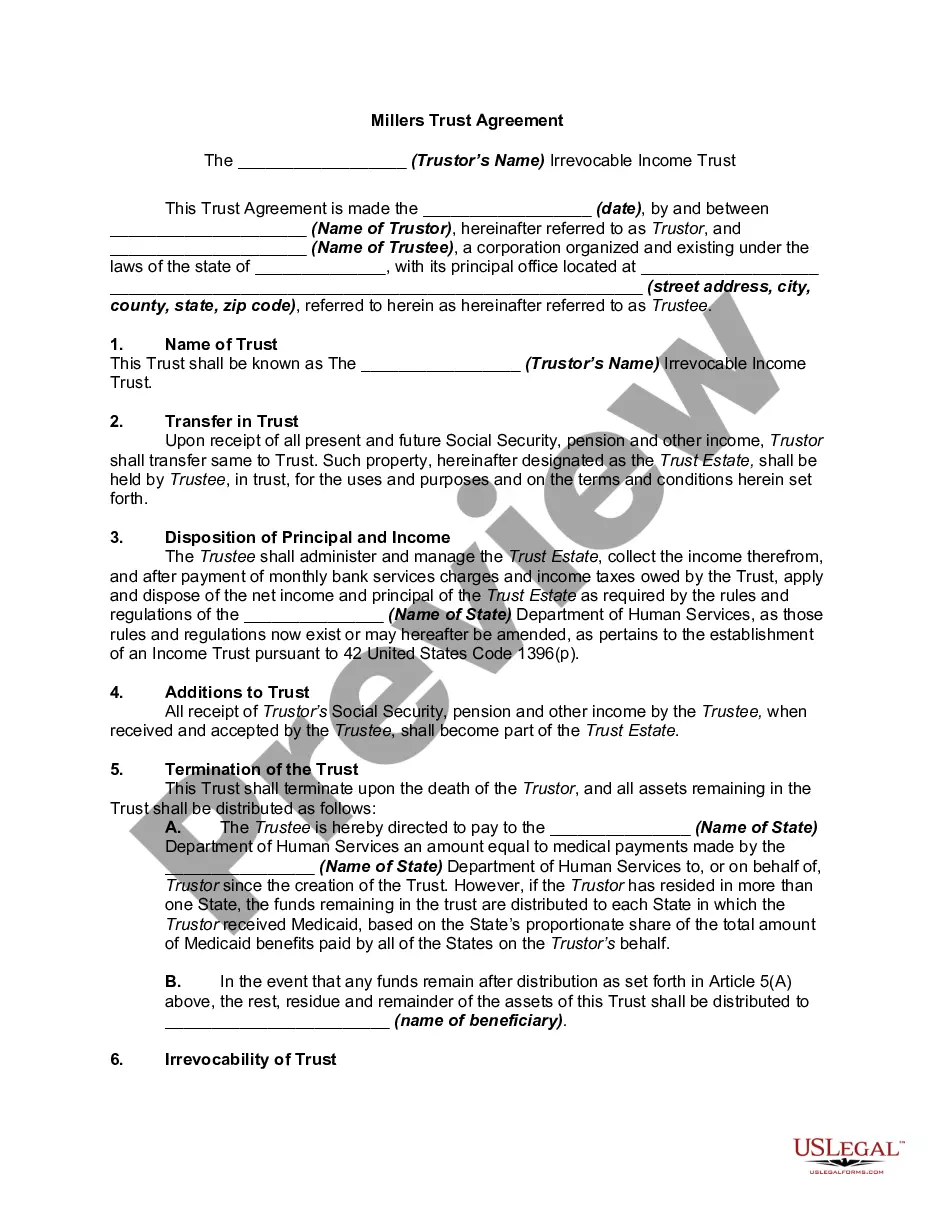
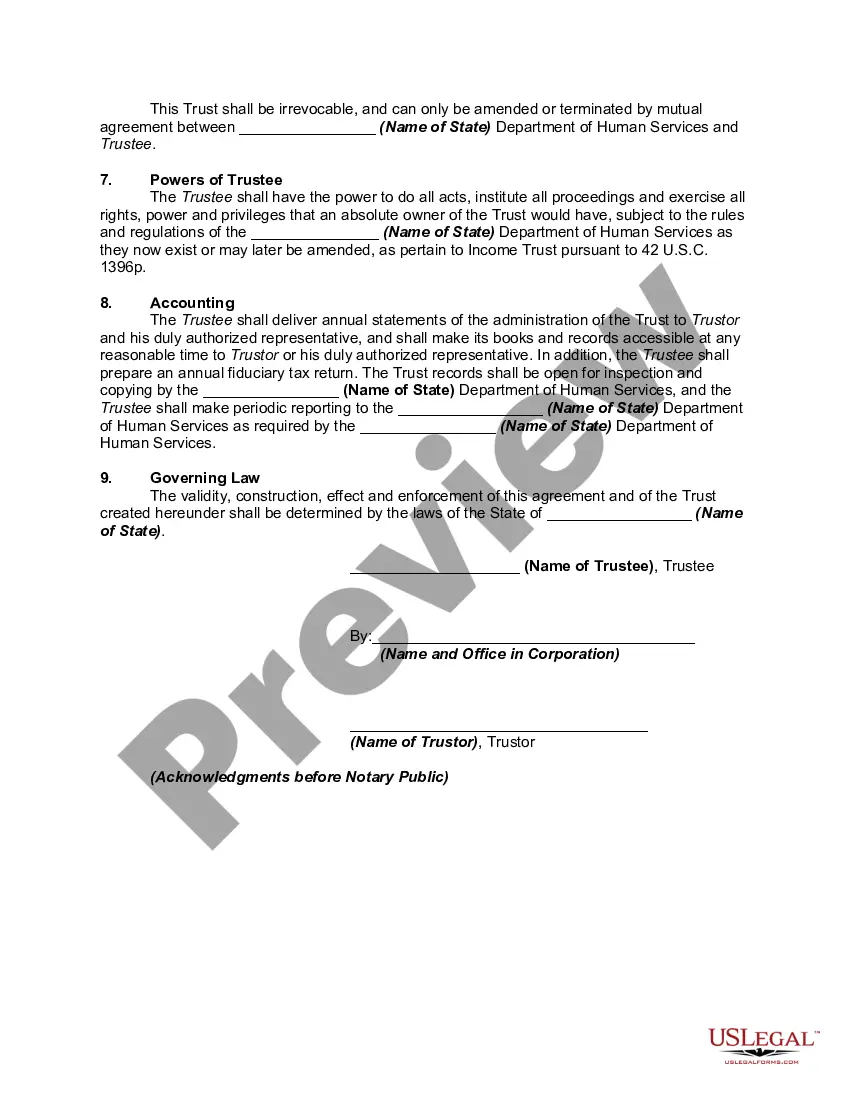
Delaware Miller Trust For Medicaid
Description

Get your form ready online
Our built-in tools help you complete, sign, share, and store your documents in one place.
Make edits, fill in missing information, and update formatting in US Legal Forms—just like you would in MS Word.
Download a copy, print it, send it by email, or mail it via USPS—whatever works best for your next step.
Sign and collect signatures with our SignNow integration. Send to multiple recipients, set reminders, and more. Go Premium to unlock E-Sign.
If this form requires notarization, complete it online through a secure video call—no need to meet a notary in person or wait for an appointment.
We protect your documents and personal data by following strict security and privacy standards.

Make edits, fill in missing information, and update formatting in US Legal Forms—just like you would in MS Word.

Download a copy, print it, send it by email, or mail it via USPS—whatever works best for your next step.

Sign and collect signatures with our SignNow integration. Send to multiple recipients, set reminders, and more. Go Premium to unlock E-Sign.

If this form requires notarization, complete it online through a secure video call—no need to meet a notary in person or wait for an appointment.

We protect your documents and personal data by following strict security and privacy standards.
Looking for another form?



How to fill out Qualified Income Miller Trust?
Finding a reliable location to obtain the latest and pertinent legal templates is half the battle when navigating bureaucracy.
Selecting the appropriate legal documents necessitates precision and meticulousness, which is why acquiring samples of the Delaware Miller Trust For Medicaid solely from trustworthy resources, such as US Legal Forms, is essential. An incorrect template will squander your time and delay your current situation.
Once you have the document on your device, you can modify it using the editor or print it out and complete it manually. Eliminate the hassle associated with your legal documentation. Explore the extensive catalog at US Legal Forms to discover legal samples, assess their relevance to your situation, and download them instantly.
- Utilize the library navigation or search function to find your template.
- Examine the form's description to determine if it meets the specifications of your state and area.
- Check the form preview, if available, to confirm that the template is the one you need.
- Return to the search and seek the correct document if the Delaware Miller Trust For Medicaid does not fulfill your requirements.
- Once you confirm the form's applicability, download it.
- If you're a registered user, click Log in to verify and access your selected forms in My documents.
- If you haven't created an account yet, click Buy now to purchase the template.
- Select the pricing plan that best suits your needs.
- Proceed with the registration to finalize your purchase.
- Complete your transaction by choosing a payment method (credit card or PayPal).
- Select the file format for downloading the Delaware Miller Trust For Medicaid.
Form popularity
FAQ
Setting up a Delaware miller trust for Medicaid involves several steps, starting with consulting a qualified attorney. They will guide you through the process, including drafting the trust document and transferring assets into the trust. Understanding the specific requirements for Medicaid eligibility is crucial; therefore, getting proper legal advice ensures you meet all necessary regulations.
While a Medicaid trust, such as a Delaware miller trust for Medicaid, offers protection, there are some disadvantages to consider. One major concern is the loss of control over your assets, as they are held in trust. Additionally, setting up these trusts can involve upfront costs and ongoing administrative responsibilities that may not suit every individual.
Placing your home in a Delaware miller trust for Medicaid can provide some protection against asset liquidation. However, it's important to note that not all trusts will fully shield your home from Medicaid claims. Typically, an irrevocable trust is more effective for this purpose, but always consult a legal professional to understand the nuances and find the best solution for your needs.
A Miller trust for Medicaid is designed to help individuals qualify for Medicaid benefits while retaining some income. Essentially, this trust holds excess income that would otherwise disqualify you from receiving Medicaid. Funds placed in the trust can cover qualified medical expenses, ensuring that you receive the care you need without losing your financial assets.
When it comes to asset protection, a Delaware miller trust for Medicaid stands out as an effective option. This trust allows you to qualify for Medicaid while preserving some of your assets, making it a strategic choice for many individuals. Choosing the right trust depends on your specific financial situation and long-term goals, so consulting with a legal expert can provide clarity.
A Delaware miller trust for Medicaid is designed to help individuals qualify for Medicaid benefits while managing their income. Essentially, this type of trust allows you to place excess income into the trust, making it unavailable for Medicaid eligibility calculations. By using this approach, you can protect your assets and ensure that you still receive essential healthcare services. If you're considering this option, US Legal Forms offers valuable resources to help you navigate the process effectively.
To legally protect your assets from Medicaid, consider establishing a Delaware Miller Trust for Medicaid. This trust can help you segregate income that exceeds the Medicaid limit and protect your assets from Medicaid's reach. Additionally, engaging with professionals who specialize in elder law can provide you with tailored strategies for your unique situation. Early planning is key to preserving your wealth while ensuring necessary coverage.
Yes, Medicaid can seek recovery from some trust assets under certain conditions. If a trust is deemed revocable or within a specific look-back period, Medicaid may pursue those funds. However, the Delaware Miller Trust for Medicaid is designed to protect your assets from being counted against you for Medicaid eligibility. It's wise to structure your trust properly to avoid asset recovery.
Medicaid verifies assets through a rigorous process involving documentation and assessments. This includes reviewing bank statements, property deeds, and trust documents, like the Delaware Miller Trust for Medicaid. It is critical to provide accurate information to avoid delays in your application. Transparency and thoroughness in your asset reporting are vital to this process.
Yes, you can utilize a Delaware Miller Trust for Medicaid to qualify when your income exceeds Medicaid's limits. This special kind of trust allows you to funnel excess income and maintain eligibility for essential healthcare benefits. By setting up this trust correctly, you can safeguard your resources while still gaining access to necessary funds for your care. Always consult with a legal expert to ensure compliance.