Real Property Interest With Monthly Contributions
Description

Get your form ready online
Our built-in tools help you complete, sign, share, and store your documents in one place.
Make edits, fill in missing information, and update formatting in US Legal Forms—just like you would in MS Word.
Download a copy, print it, send it by email, or mail it via USPS—whatever works best for your next step.
Sign and collect signatures with our SignNow integration. Send to multiple recipients, set reminders, and more. Go Premium to unlock E-Sign.
If this form requires notarization, complete it online through a secure video call—no need to meet a notary in person or wait for an appointment.
We protect your documents and personal data by following strict security and privacy standards.

Make edits, fill in missing information, and update formatting in US Legal Forms—just like you would in MS Word.

Download a copy, print it, send it by email, or mail it via USPS—whatever works best for your next step.

Sign and collect signatures with our SignNow integration. Send to multiple recipients, set reminders, and more. Go Premium to unlock E-Sign.

If this form requires notarization, complete it online through a secure video call—no need to meet a notary in person or wait for an appointment.

We protect your documents and personal data by following strict security and privacy standards.
Looking for another form?






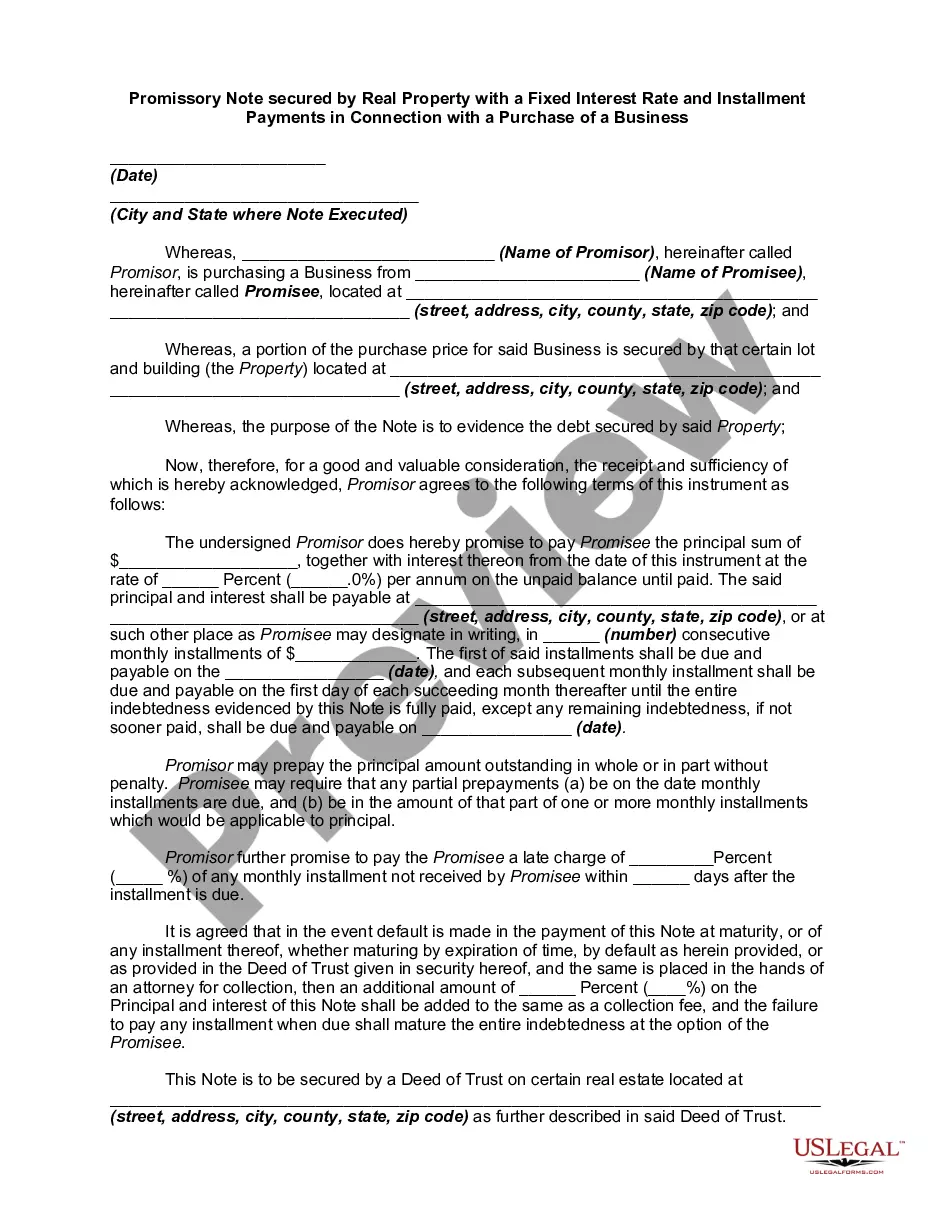
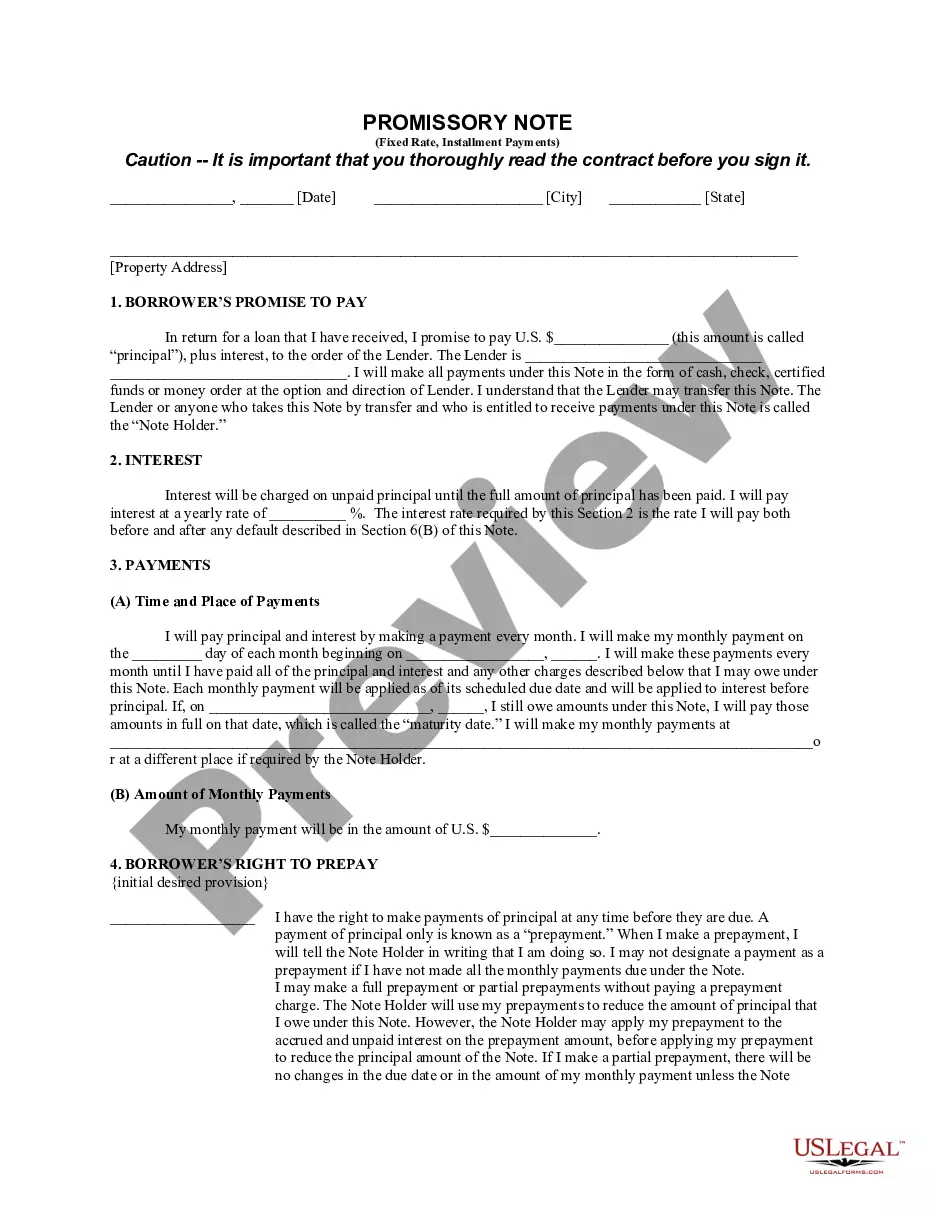
How to fill out Promissory Note Secured By Real Property With A Fixed Interest Rate And Installment Payments In Connection With A Purchase Of A Business?
Engaging with legal documents and processes can be a lengthy addition to your schedule.
Real Property Interest With Monthly Contributions and similar forms generally require you to locate them and navigate the most effective way to fill them out accurately.
Consequently, whether you are managing financial, legal, or personal affairs, utilizing a comprehensive and user-friendly online repository of forms available will be immensely beneficial.
US Legal Forms is the premier online resource for legal templates, offering over 85,000 state-specific forms and an array of tools to assist you in completing your documents with ease.
Is this your first time using US Legal Forms? Register and create a free account in just a few minutes to gain access to the form library and Real Property Interest With Monthly Contributions. Then, follow the steps outlined below to complete your document: Ensure you have the correct form by utilizing the Preview feature and reviewing the form details. Select Buy Now when you are ready, and pick the subscription option that best fits your needs. Click Download then fill out, eSign, and print the form. US Legal Forms has twenty-five years of experience aiding users in managing their legal documents. Find the form you need today and simplify any procedure effortlessly.
- Explore the collection of relevant documents accessible to you with just one click.
- US Legal Forms provides you with state- and county-specific forms available for download at any time.
- Protect your document management processes with a top-notch service that enables you to compile any form within minutes without any extra or concealed fees.
- Simply Log In to your account, locate Real Property Interest With Monthly Contributions and obtain it instantly in the My documents section.
- You can also retrieve previously downloaded forms.
Form popularity
FAQ
Yes, you can deduct interest on your rental property. This includes interest on loans used to acquire or improve the property, as well as any real property interest with monthly contributions. To take advantage of these deductions, maintain detailed records of your expenses. Using a platform like US Legal Forms can streamline the documentation process for rental properties.
You can generally deduct the interest on your mortgage for your primary residence and a second home, up to certain limits. The total amount you can deduct depends on the total mortgage amount and your real property interest with monthly contributions. Be sure to stay informed about current IRS limits to maximize your deduction. Consulting with a tax professional can also provide clarity on your specific situation.
Compounding interest with monthly contributions in Excel involves using formulas to calculate your investment growth. You can input your principal, interest rate, and monthly contribution into the spreadsheet. By setting up the formula correctly, you can visualize how real property interest with monthly contributions works over time, making it a valuable tool for tracking your investments.
To calculate the interest earned on $100,000 per month, you would apply the monthly interest rate to your principal amount. Depending on the terms of your investment, this could lead to substantial returns. Investing wisely in real property interest with monthly contributions can significantly enhance your financial portfolio and help achieve your long-term goals.
The 8 4 3 rule of compounding is a guideline that suggests doubling your investment in eight years with a consistent annual return. This rule emphasizes the importance of time in compounding growth. When you apply this rule to real property interest with monthly contributions, you can set realistic financial goals and understand the potential long-term benefits of your investments.
To compound interest with monthly contributions, start by determining your principal amount and the interest rate. Then, add your monthly contributions to the principal and recalculate the interest on the new total each month. This method effectively increases your real property interest with monthly contributions, enhancing your investment growth over time.
The formula for compound interest with monthly contributions combines the principal amount, the interest rate, and the total number of contributions made. You can express it as A = P(1 + r/n)^(nt) + PMT((1 + r/n)^(nt) - 1) / (r/n), where PMT represents the monthly contributions. This formula is particularly useful when exploring real property interest with monthly contributions, as it allows you to accurately calculate your future investment value.
To find out how much $1000 grows with a daily compounded interest rate of 6% over two years, you can use the formula for compound interest. This formula considers the principal amount, the interest rate, and the number of compounding periods. By applying this to the real property interest with monthly contributions, you will see your investment yield a significant return over time.
The formula for calculating simple interest with monthly contributions involves a few straightforward steps. First, you need to determine your principal amount, the interest rate, and the time period. Then, apply the formula: Interest = Principal x Rate x Time, adjusting for your monthly contributions. Understanding how this formula works is crucial when considering real property interest with monthly contributions, as it helps you plan effectively for your investments.