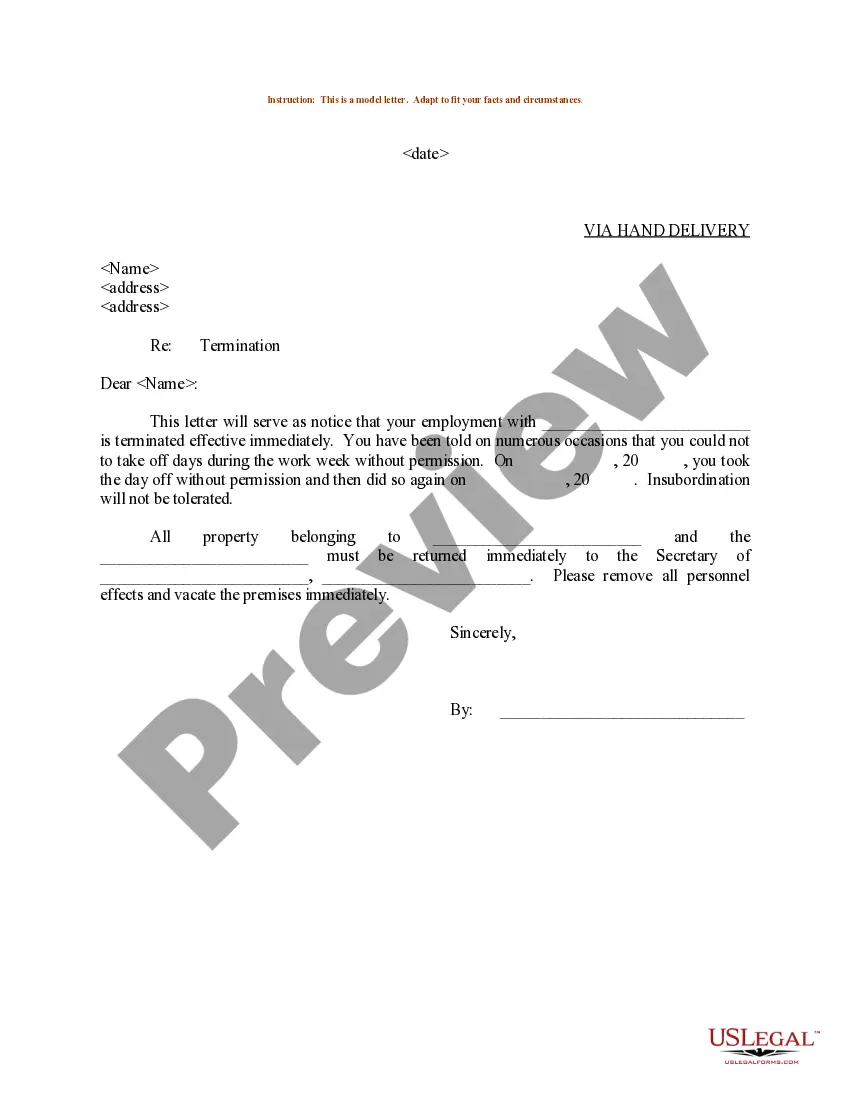
Termination Letter For Gross Misconduct
Description
Get your form ready online
Our built-in tools help you complete, sign, share, and store your documents in one place.
Make edits, fill in missing information, and update formatting in US Legal Forms—just like you would in MS Word.
Download a copy, print it, send it by email, or mail it via USPS—whatever works best for your next step.
Sign and collect signatures with our SignNow integration. Send to multiple recipients, set reminders, and more. Go Premium to unlock E-Sign.
If this form requires notarization, complete it online through a secure video call—no need to meet a notary in person or wait for an appointment.
We protect your documents and personal data by following strict security and privacy standards.

Make edits, fill in missing information, and update formatting in US Legal Forms—just like you would in MS Word.

Download a copy, print it, send it by email, or mail it via USPS—whatever works best for your next step.

Sign and collect signatures with our SignNow integration. Send to multiple recipients, set reminders, and more. Go Premium to unlock E-Sign.

If this form requires notarization, complete it online through a secure video call—no need to meet a notary in person or wait for an appointment.

We protect your documents and personal data by following strict security and privacy standards.
Looking for another form?
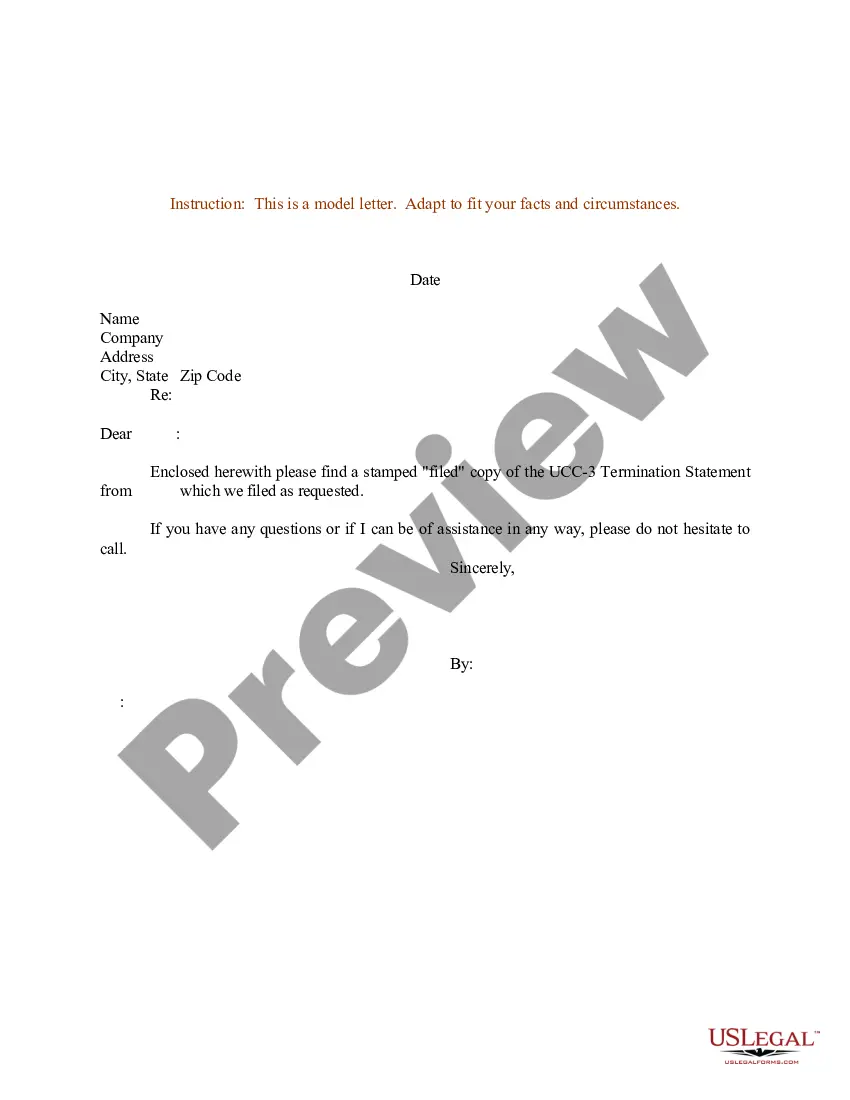
How to fill out Sample Letter For UCC-3 Termination Statement?
Whether for corporate objectives or for personal matters, everyone must confront legal issues at some stage in their life.
Filling out legal paperwork demands meticulous attention, starting with choosing the appropriate form sample.
With an extensive US Legal Forms catalog available, you do not have to waste time searching for the suitable sample online. Utilize the library’s straightforward navigation to find the correct template for any scenario.
- Locate the sample you require using the search box or directory navigation.
- Examine the form’s details to ensure it aligns with your situation, state, and locality.
- Select the form’s preview to review it.
- If it is the wrong form, return to the search function to find the Termination Letter For Gross Misconduct sample you need.
- Download the file if it satisfies your requirements.
- If you possess a US Legal Forms account, simply click Log in to access previously stored files in My documents.
- In case you do not have an account yet, you can acquire the form by clicking Buy now.
- Select the appropriate pricing option.
- Complete the profile registration form.
- Choose your payment method: you can utilize a credit card or PayPal account.
- Select the document format you prefer and download the Termination Letter For Gross Misconduct.
- Once it is downloaded, you can fill out the form using editing software or print it and complete it by hand.
Form popularity
FAQ
Not always; while gross misconduct can result in dismissal, it depends on the severity and context of the actions leading to the incident. Employers may consider several factors, such as past behavior, company policies, and potential remedies before making a final decision. However, in many cases, if the misconduct is severe, a termination letter for gross misconduct is likely to follow. It is wise to be aware of the possible consequences to avoid abrupt outcomes.
You may receive a final written warning after repeated misconduct or if a significant single incident occurs. This warning signals that your job is at risk should the behavior not improve. It is essential to take this warning seriously, as failure to address the issues could result in a termination letter for gross misconduct thereafter. Understanding the implications can help you navigate the situation better.
Generally, a first written warning for gross misconduct is uncommon, as gross misconduct typically warrants immediate dismissal or a final warning. However, some companies may choose to issue a first written warning in cases where the behavior is egregious yet not severe enough to bypass the step entirely. It is essential to document the reasons carefully in case a termination letter for gross misconduct becomes necessary later.
Yes, it is possible to receive a final written warning for gross misconduct. This usually occurs when an employee has had previous warnings or when the misconduct is severe but not immediately warranting termination. The final written warning aims to provide one last chance for the individual to correct their behavior. Remember that a termination letter for gross misconduct may be issued if there is no improvement.
A final warning for misconduct is a serious notification given to an employee after previous instances of inappropriate behavior. This warning indicates that any further misconduct may lead to immediate dismissal. If issued, it serves as a crucial step in the disciplinary process, outlining the expectations for future behavior. In case the situation escalates, a termination letter for gross misconduct may follow.
To write a termination letter for bad behavior, begin by addressing the letter formally. Clearly cite the specific incidents and behaviors leading to this decision. Additionally, reference any prior discussions about their behavior to strengthen your case.
When writing a termination letter for bad behavior, clearly state the actions that warranted termination. Include details that demonstrate the pattern of behavior, citing any previous warnings provided. This helps the employee understand the decision and maintain records.
Writing a termination letter for gross misconduct requires clarity and professionalism. Start by addressing the employee, then briefly explain the reasons for their dismissal. Ensure to reference any previous warnings and state the termination date to finalize the process.
To write a letter of dismissal for conduct, start with the employee’s details and the date. Clearly outline the specific conduct that led to the dismissal and reference any previous warnings. The letter should end with the effective termination date to ensure clarity.
Yes, you can terminate an employee for bad behavior if it violates company policies. It is crucial to document the behavior and provide a clear termination letter for gross misconduct, summarizing the reasons for dismissal. Consistency in applying these standards is essential to avoid potential disputes.