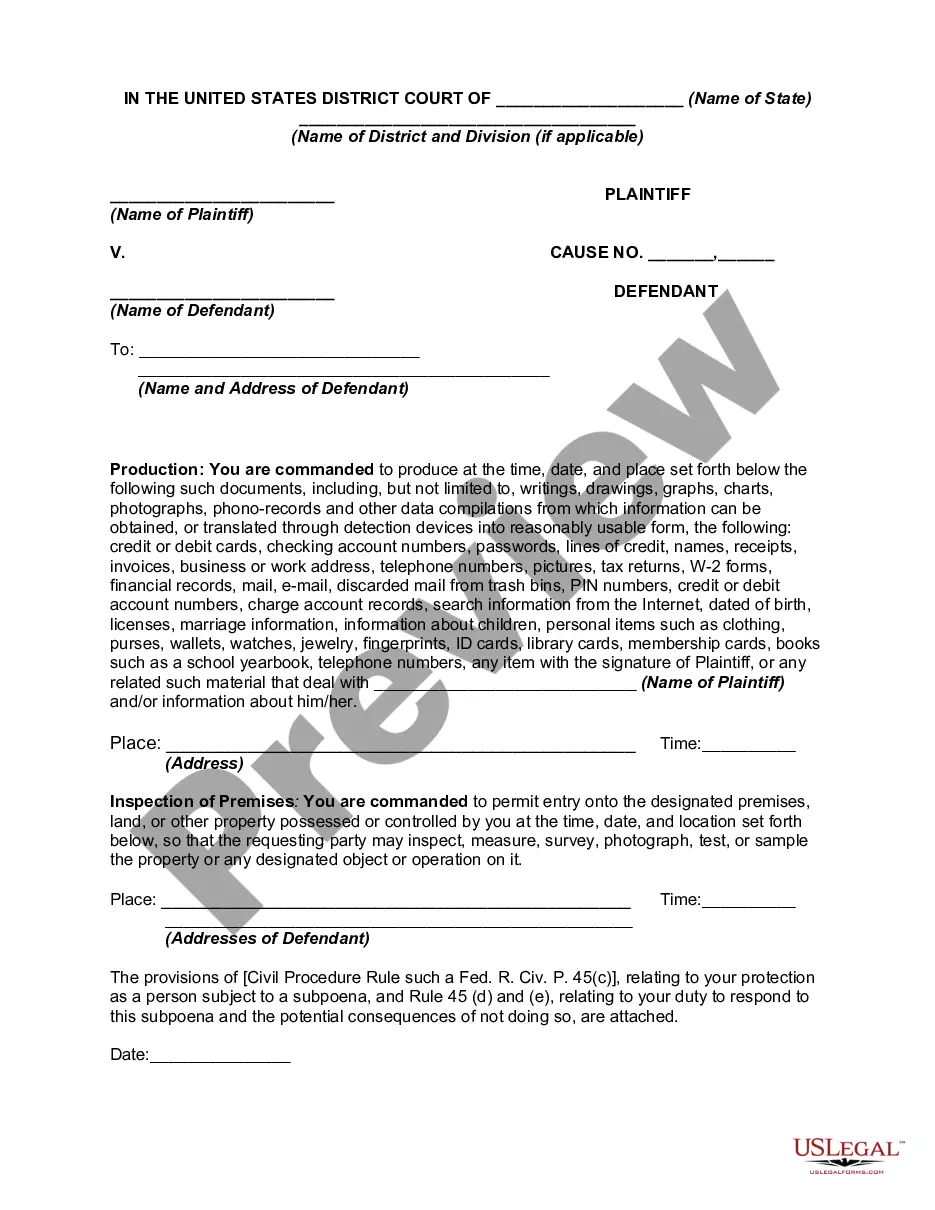
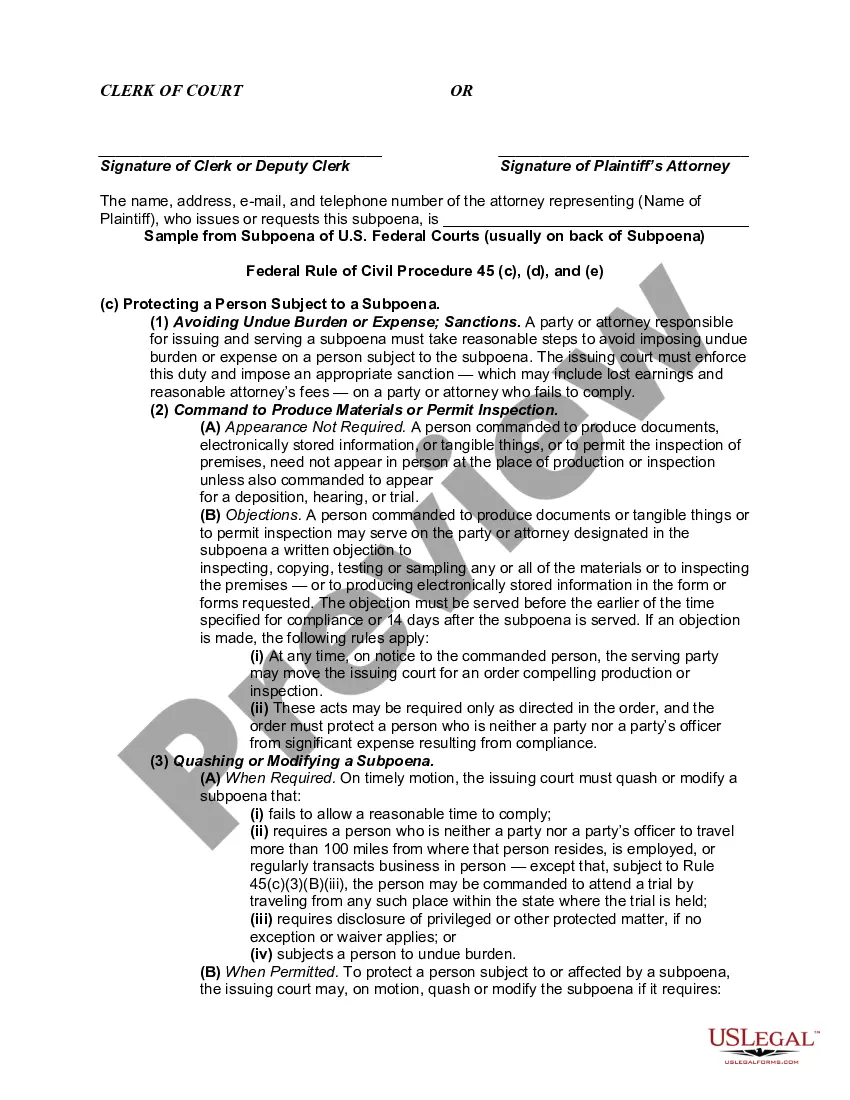
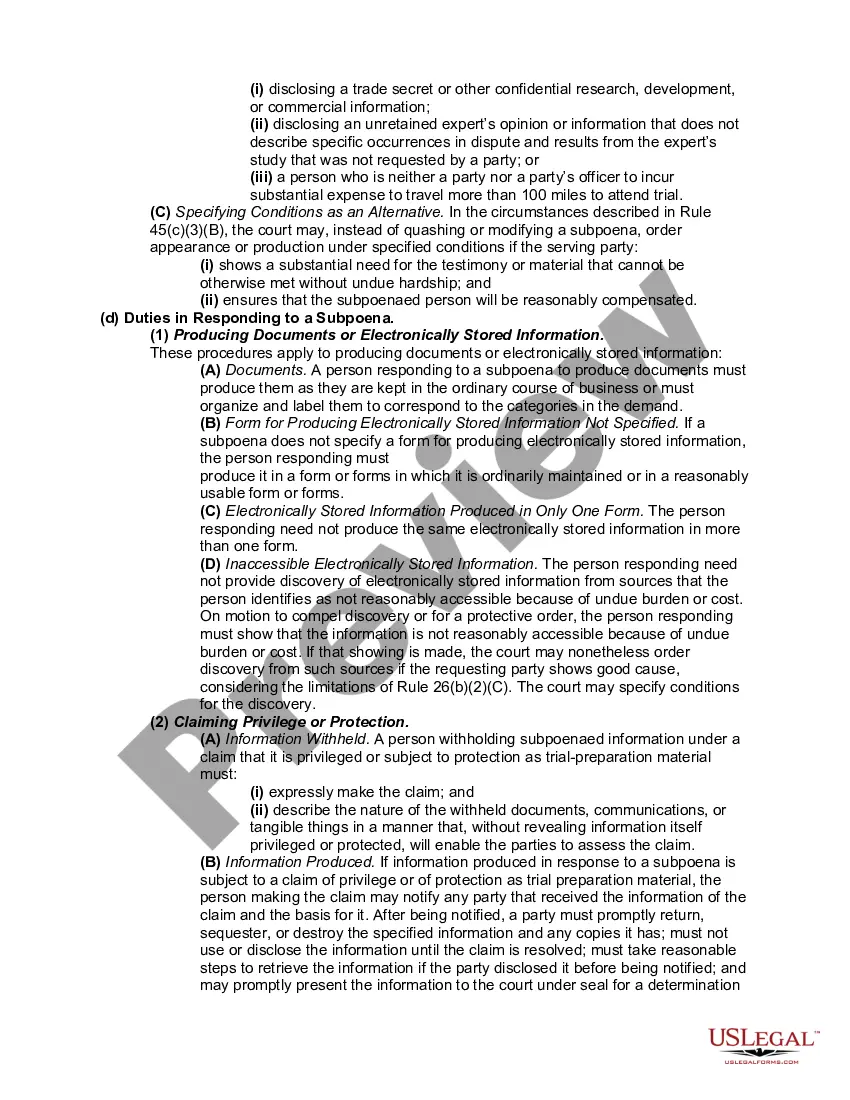
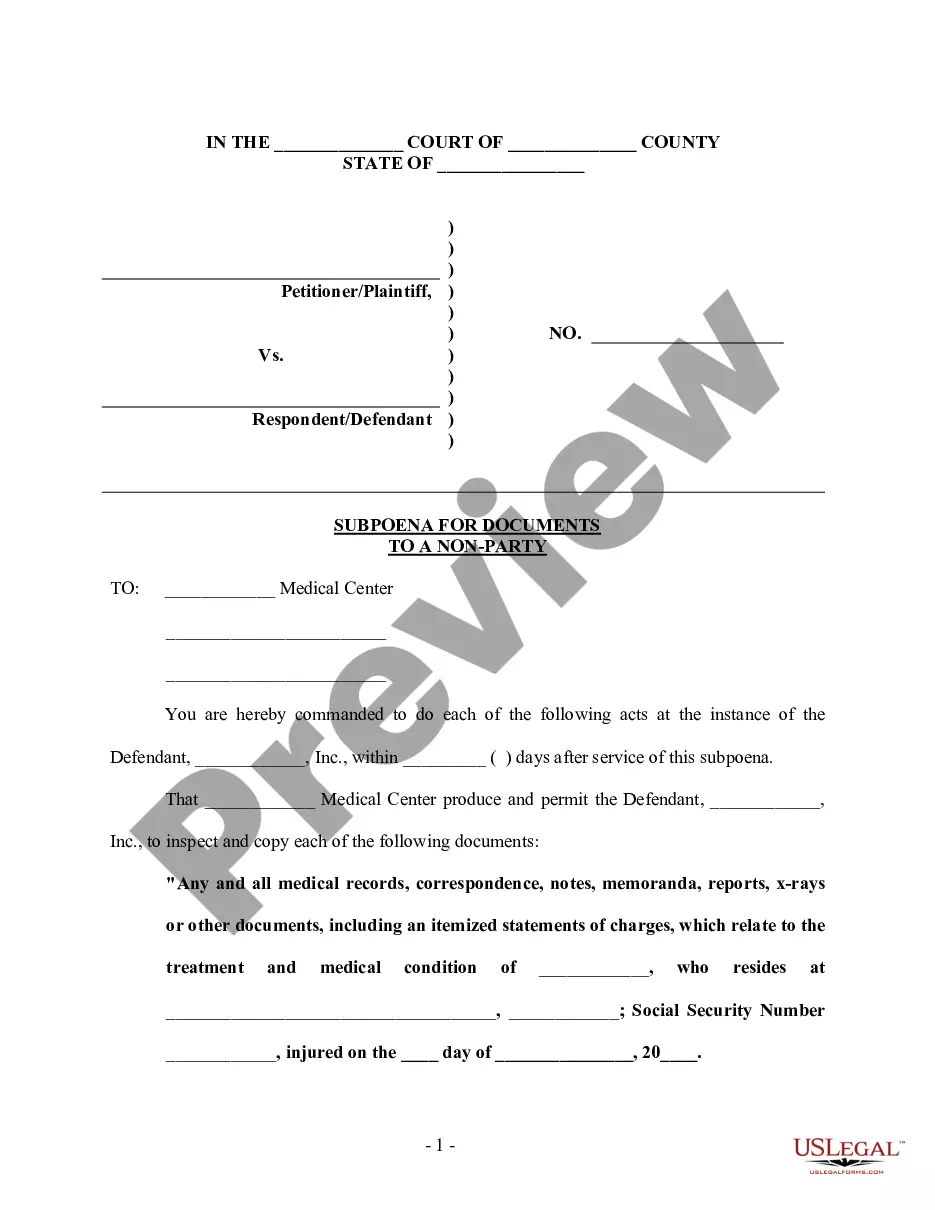
Subpoena Form For Federal Court
Description

Get your form ready online
Our built-in tools help you complete, sign, share, and store your documents in one place.
Make edits, fill in missing information, and update formatting in US Legal Forms—just like you would in MS Word.
Download a copy, print it, send it by email, or mail it via USPS—whatever works best for your next step.
Sign and collect signatures with our SignNow integration. Send to multiple recipients, set reminders, and more. Go Premium to unlock E-Sign.
If this form requires notarization, complete it online through a secure video call—no need to meet a notary in person or wait for an appointment.
We protect your documents and personal data by following strict security and privacy standards.

Make edits, fill in missing information, and update formatting in US Legal Forms—just like you would in MS Word.

Download a copy, print it, send it by email, or mail it via USPS—whatever works best for your next step.

Sign and collect signatures with our SignNow integration. Send to multiple recipients, set reminders, and more. Go Premium to unlock E-Sign.

If this form requires notarization, complete it online through a secure video call—no need to meet a notary in person or wait for an appointment.

We protect your documents and personal data by following strict security and privacy standards.
Looking for another form?


How to fill out Subpoena To Produce Documents, Information, Or Objects Or Permit Inspection Of Premises In A Civil Action Involving Identity Theft?
Whether for professional reasons or for personal matters, everyone must confront legal circumstances sooner or later in their lifetime.
Completing legal documents requires meticulous care, starting from choosing the appropriate form template.
With an extensive US Legal Forms catalog available, you will never need to waste time searching for the suitable template across the web. Utilize the library’s straightforward navigation to find the right template for any occasion.
- Locate the template you require by using the search bar or catalog browsing.
- Review the form’s details to confirm it corresponds with your case, state, and county.
- Select the form’s preview to inspect it.
- If it is the incorrect form, return to the search feature to find the Subpoena Form For Federal Court example you seek.
- Obtain the file if it fulfills your criteria.
- If you have a US Legal Forms account, click Log in to access previously saved documents in My documents.
- If you do not have an account yet, you can acquire the form by clicking Buy now.
- Select the appropriate pricing option.
- Complete the profile registration form.
- Choose your payment method: use a credit card or PayPal account.
- Select the document format you desire and download the Subpoena Form For Federal Court.
- Once it is downloaded, you can fill out the form using editing software or print it and complete it manually.
Form popularity
FAQ
To obtain a federal subpoena, you first need to prepare the subpoena form for federal court. This form is available through various online legal services, like US Legal Forms, which simplifies the process. After completing the form, you must file it with the appropriate federal court. Once the court issues the subpoena, you can serve it on the required parties to compel their attendance or production of documents.
In general, anyone can be subpoenaed as long as their testimony or documents are relevant to a legal case. This includes individuals and organizations. It is essential to use a properly completed subpoena form for federal court to ensure compliance. For further assistance in obtaining and filling out the necessary forms, consider using UsLegalForms for clarity and accuracy.
Subpoenaing the federal government is possible, but it requires specific procedures. You must file the correct subpoena form for federal court and meet all legal requirements. The government has special protections, so understanding these is critical. UsLegalForms can provide resources to help you navigate this complex process effectively.
Yes, a non-party can issue a subpoena under certain conditions. The individual must still complete and file the subpoena form for federal court with the appropriate court. This can be done if the non-party has relevant information to contribute to the case. Services like UsLegalForms can help you ensure that you follow all guidelines properly.
A regular person cannot directly issue a subpoena unless they are authorized by the court. To initiate this process, one must typically have a legal basis or involvement in a case. The subpoena form for federal court must be properly filled out and submitted according to court procedures. For those unfamiliar with this process, UsLegalForms offers guidance to help you navigate the necessary steps.
Yes, a regular person can file a subpoena by completing a subpoena form for federal court. This process typically involves filling out the correct form and filing it with the court. It is crucial to follow the court’s specific rules regarding the issuance of subpoenas. Using a reliable service like UsLegalForms can help ensure that you fill out the form correctly and understand your responsibilities.
The three main types of subpoenas are: subpoena ad testificandum, subpoena duces tecum, and grand jury subpoena. A subpoena ad testificandum compels a person to testify, while a subpoena duces tecum demands the production of documents. Grand jury subpoenas serve a specific investigatory purpose within criminal cases. By selecting the right subpoena form for federal court, you can ensure that you gather the necessary information to support your case effectively.
There are several types of subpoenas, including subpoenas for testimony, subpoenas duces tecum, and grand jury subpoenas. Each type serves a different purpose, but they all fall under the category of legal requests for information. A well-crafted subpoena form for federal court ensures compliance and effectively facilitates the discovery process. Utilizing the appropriate type of subpoena can significantly strengthen your legal strategy.
The primary difference between a subpoena duces tecum and a deposition subpoena lies in their purpose. A subpoena duces tecum requests documents or evidence to be presented in court, while a deposition subpoena requires a witness to provide testimony under oath. Both types utilize a subpoena form for federal court, but they cater to different aspects of legal evidence. Understanding this distinction can help you effectively prepare for your case.
The most common subpoena used in federal court is the subpoena duces tecum. This type of subpoena compels an individual or entity to produce specific documents or records relevant to a case. When using a subpoena form for federal court, individuals often need documents that can help establish facts in their favor. As a result, it serves as a critical tool for gathering evidence during legal proceedings.