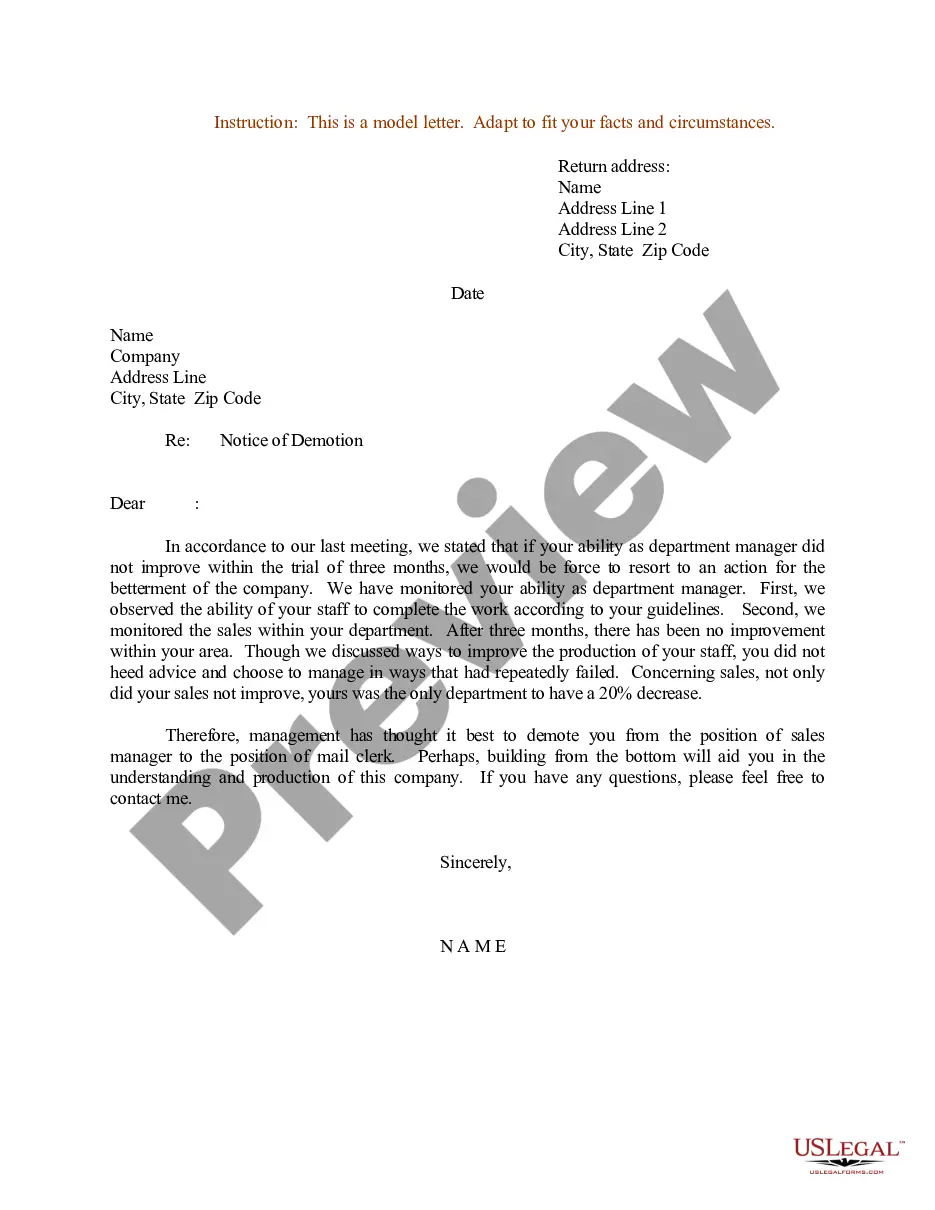
Notice Of Demotion Letter
Description
Get your form ready online
Our built-in tools help you complete, sign, share, and store your documents in one place.
Make edits, fill in missing information, and update formatting in US Legal Forms—just like you would in MS Word.
Download a copy, print it, send it by email, or mail it via USPS—whatever works best for your next step.
Sign and collect signatures with our SignNow integration. Send to multiple recipients, set reminders, and more. Go Premium to unlock E-Sign.
If this form requires notarization, complete it online through a secure video call—no need to meet a notary in person or wait for an appointment.
We protect your documents and personal data by following strict security and privacy standards.

Make edits, fill in missing information, and update formatting in US Legal Forms—just like you would in MS Word.

Download a copy, print it, send it by email, or mail it via USPS—whatever works best for your next step.

Sign and collect signatures with our SignNow integration. Send to multiple recipients, set reminders, and more. Go Premium to unlock E-Sign.

If this form requires notarization, complete it online through a secure video call—no need to meet a notary in person or wait for an appointment.

We protect your documents and personal data by following strict security and privacy standards.
Looking for another form?



Form popularity
FAQ
Announcing a demotion to your team requires sensitivity and clarity. Begin by addressing the team collectively, briefly explaining the situation and the rationale behind the decision, while referring to the Notice of demotion letter as a formal guideline. Emphasize the importance of teamwork during this time, and reassure everyone that the employee in question will continue to contribute positively to the team's goals. This method fosters understanding and maintains overall morale.
When explaining a demotion due to organizational restructuring, it's essential to be transparent and clear. Start by discussing the changes within the organization that have led to the decision, referencing the Notice of demotion letter as a formal communication. Share the benefits of these changes for the company and outline how the employee's new role still plays a vital part in the team's success. This approach will help the employee understand the context and feel valued despite the change.
When crafting an email for a demotion, begin with a clear subject line that reflects the message's purpose. Include a brief introduction that acknowledges the employee's contributions, then explain the reasons for the demotion using the format of a Notice of demotion letter. Ensure you maintain a respectful tone throughout the email. Remember to offer support and outline any future opportunities for the employee.
To ask for a demotion letter, approach your manager and express your desire for a change in position. Clearly explain your reasoning and the benefits of this change for both you and the company. Be sure your manager understands your intentions, and request formal documentation in the form of a demotion letter. This letter can support your discussion and tie into your Notice of demotion letter for clarity.
When announcing your intention to step down, consider a meeting with your supervisor before delivering a formal letter. During the meeting, clearly communicate your decision and share your reasons. Follow this with a formal announcement through an email or in a team meeting to ensure everyone is informed. A clear announcement paired with a Notice of demotion letter helps to maintain transparency.
In a letter of intent to step down, clearly state your position and the date you intend to step down. Explain your reasons briefly without going into too much detail; keeping it professional is key. Thank your employer for their support and the opportunities you've had. Make sure to reference the need for a Notice of demotion letter, particularly if it involves a formal process.
To write a letter of stepping down, start by stating your current role and your intention to step down. Make sure to mention the preferred date for this change to take effect, and express gratitude for your experiences in the role. This approach fosters a positive atmosphere and opens the door for future opportunities. Your Notice of demotion letter can be linked to this, as both documents share similar objectives.
A letter of demotion is a formal document that communicates an employee's change in job status, typically to a lower position. It outlines the reasons for the demotion, the new responsibilities, and the impact on compensation, if applicable. This letter is important for maintaining clarity and professionalism within the workplace. You may often need this letter to accompany your Notice of demotion letter.
Writing a letter requesting to step down from your position involves clear communication. Start by addressing your supervisor and stating your intention to step down. Be sure to include your current position, your effective date, and a brief explanation of your decision. This letter can serve as a basis for your Notice of demotion letter, ensuring that all parties are informed.
When you receive a demotion, it's vital to remain composed and positive. Acknowledge the decision and express your willingness to embrace the new role, focusing on growth opportunities. Remember that a Notice of demotion letter will clarify your new position and responsibilities, providing a sense of direction moving forward.