Workers Compensation For One Employee
Description
Get your form ready online
Our built-in tools help you complete, sign, share, and store your documents in one place.
Make edits, fill in missing information, and update formatting in US Legal Forms—just like you would in MS Word.
Download a copy, print it, send it by email, or mail it via USPS—whatever works best for your next step.
Sign and collect signatures with our SignNow integration. Send to multiple recipients, set reminders, and more. Go Premium to unlock E-Sign.
If this form requires notarization, complete it online through a secure video call—no need to meet a notary in person or wait for an appointment.
We protect your documents and personal data by following strict security and privacy standards.

Make edits, fill in missing information, and update formatting in US Legal Forms—just like you would in MS Word.

Download a copy, print it, send it by email, or mail it via USPS—whatever works best for your next step.

Sign and collect signatures with our SignNow integration. Send to multiple recipients, set reminders, and more. Go Premium to unlock E-Sign.

If this form requires notarization, complete it online through a secure video call—no need to meet a notary in person or wait for an appointment.

We protect your documents and personal data by following strict security and privacy standards.
Looking for another form?






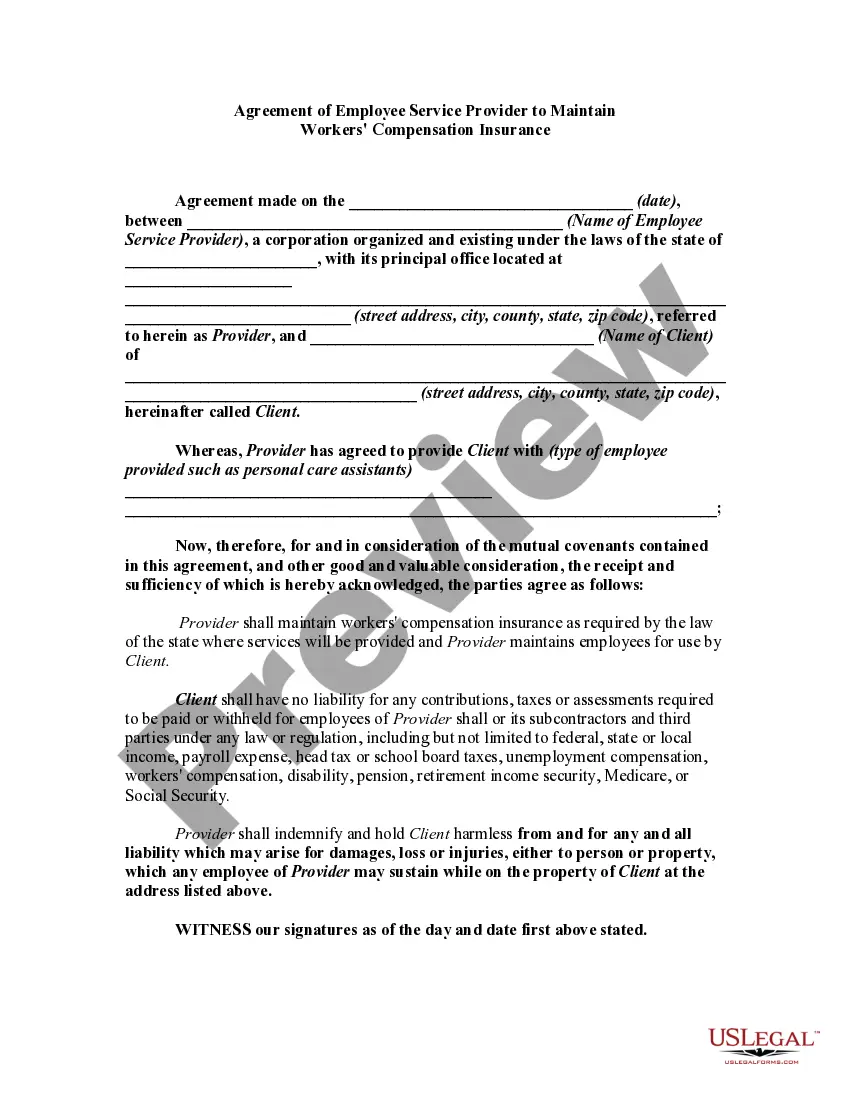
How to fill out Agreement Of Employee Service Provider To Maintain Workers Compensation Insurance?
- If you're a returning user, log in to your account and select the necessary form template. Ensure your subscription is active; if it's expired, renew to continue.
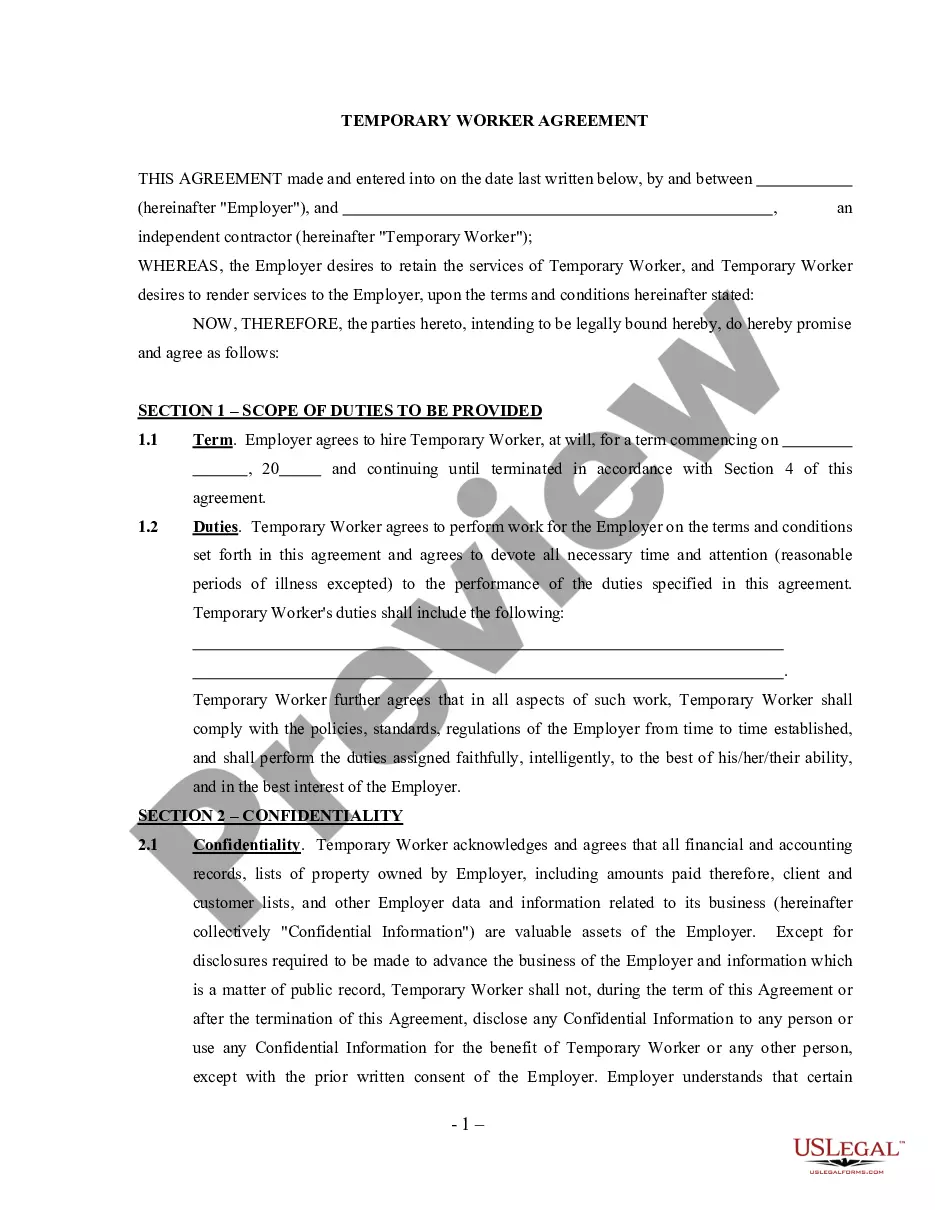
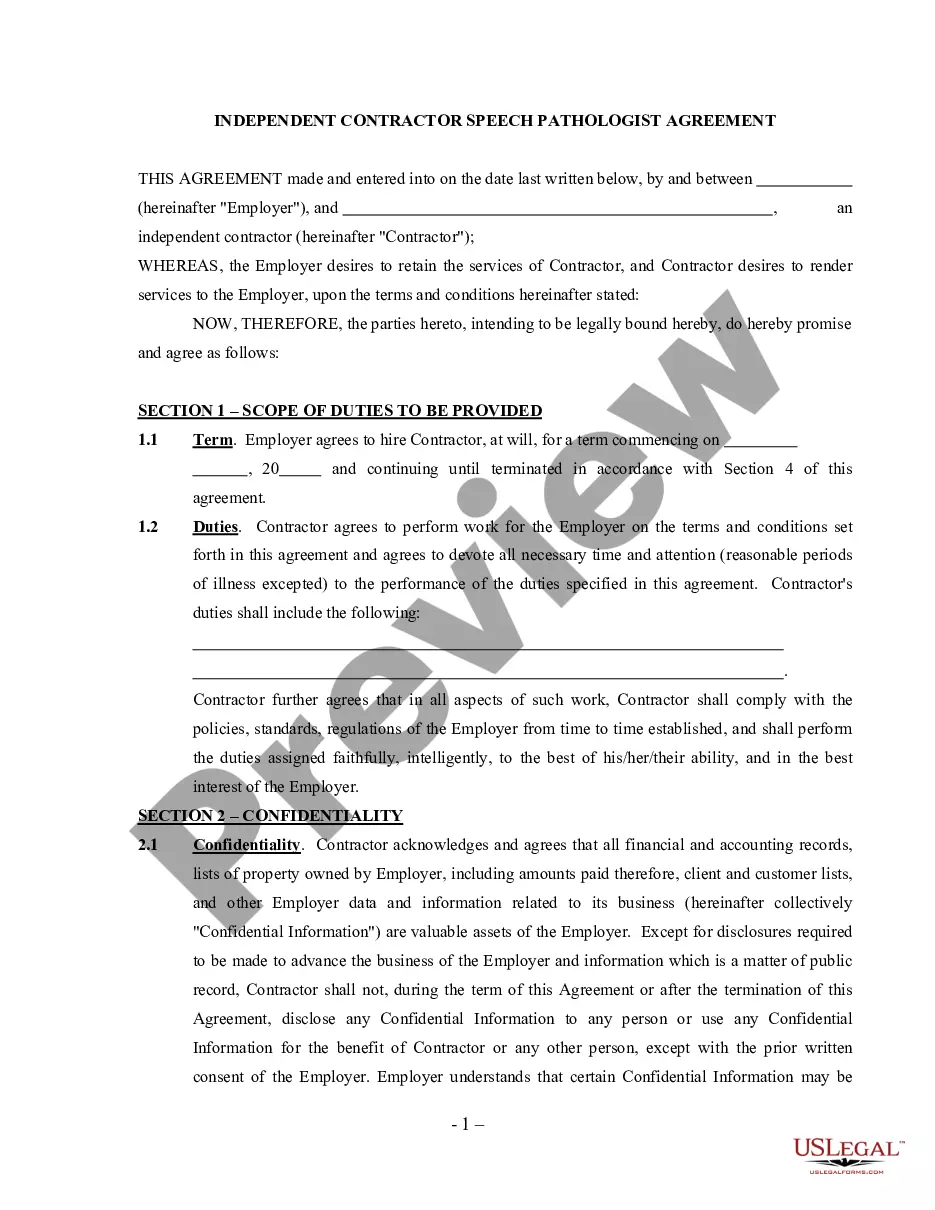
- For first-time users, start by browsing the preview mode and form description to choose the correct document that suits your needs.
- If the document doesn’t match your requirements, use the Search tab to find the right template that corresponds with your local jurisdiction.
- Select your desired document and click on the Buy Now button. Choose an appropriate subscription plan and create an account to access the form library.
- Complete your purchase by entering your credit card information or paying through PayPal.
- Once purchased, download the form to your device, and find it anytime in the My Forms section of your profile.
US Legal Forms sets itself apart by offering an extensive collection of legal forms—more than competitors at similar prices. With over 85,000 fillable options, you can easily navigate through necessary documents.
Additionally, users benefit from access to premium experts to ensure that their forms are filled out accurately and are legally sound. Start your journey with US Legal Forms today for your workers compensation needs.
Form popularity
FAQ
When speaking with your workers' comp doctor, it’s vital to avoid exaggerating or minimizing your symptoms. Be honest but concise about your condition. Clear and accurate communication is essential in workers compensation for one employee to ensure you receive the appropriate care and documentation for your case.
No, workers comp does not follow you around in a literal sense. However, surveillance and information gathering can happen if there are doubts about a claim. Being aware of your rights and the rules regarding workers compensation for one employee helps you navigate these situations confidently.
When discussing your case with workers' comp, avoid making statements that could unintentionally undermine your claim. Steer clear of admitting fault or downplaying your injuries. Remember, workers compensation for one employee can be a complex process, so be cautious about the information you share.
Workers' comp lawyers may not always disclose how the insurance companies benefit from your claim. They often focus on winning your case rather than educating you about the full process. Understanding your rights and the ins and outs of workers compensation for one employee is crucial, so ensure you ask questions and seek clear guidance.
In Ohio, the calculation of workers' compensation settlements typically considers factors such as the severity of the injury, wages lost, ongoing medical expenses, and permanent impairments. For Workers compensation for one employee, insurers generally follow a structured process to evaluate these elements thoroughly. Engaging with professionals can be advantageous in ensuring fair compensation. Using resources like US Legal Forms can simplify the process and provide the necessary documentation.
Filing a workers' compensation claim can be beneficial, especially for those affected by work-related injuries or illnesses. For Workers compensation for one employee, claiming provides access to medical benefits, partial wage replacement, and recovery support. It's essential to evaluate the costs of your injury against the potential recovery benefits. Many find that the assistance is worth the effort and helps them return to work safely.
In South Dakota, employees must report their work injury to their employer within three days of the incident to qualify for Workers compensation for one employee. This timely reporting is crucial, as delays can jeopardize benefits and compensation. After reporting, you will gain access to necessary medical care and assistance in filing your claim. Be proactive; early communication ensures you receive essential support.
In Ohio, workers' compensation provides benefits to employees who suffer injuries or illnesses related to their job. For Workers compensation for one employee, the state requires employers to contribute to a fund that offers medical benefits, wage loss compensation, and support for retraining or rehabilitation. It's important to report your injury promptly, as this initiates the claims process. Understanding your rights can make a critical difference in securing the necessary support.
In Illinois, workers compensation for one employee protects workers injured on the job by covering their medical bills and lost income. Employers are required to carry this insurance, offering peace of mind to both parties. If an employee suffers a work-related injury, they can promptly file a claim to access benefits. For assistance with forms and requirements, USLegalForms offers tailored services to help you comply with state laws.
Workers compensation for one employee in Washington covers medical expenses and wage loss for those injured on the job. This system operates on a no-fault basis, meaning employees receive benefits regardless of who caused the injury. Employers must register with the state's Department of Labor and Industries to ensure their workers receive appropriate care. For guidance on the process, USLegalForms can provide valuable resources and templates.