Attorney Client Privilege With Former Employees
Description


Get your form ready online
Our built-in tools help you complete, sign, share, and store your documents in one place.
Make edits, fill in missing information, and update formatting in US Legal Forms—just like you would in MS Word.
Download a copy, print it, send it by email, or mail it via USPS—whatever works best for your next step.
Sign and collect signatures with our SignNow integration. Send to multiple recipients, set reminders, and more. Go Premium to unlock E-Sign.
If this form requires notarization, complete it online through a secure video call—no need to meet a notary in person or wait for an appointment.
We protect your documents and personal data by following strict security and privacy standards.

Make edits, fill in missing information, and update formatting in US Legal Forms—just like you would in MS Word.

Download a copy, print it, send it by email, or mail it via USPS—whatever works best for your next step.

Sign and collect signatures with our SignNow integration. Send to multiple recipients, set reminders, and more. Go Premium to unlock E-Sign.

If this form requires notarization, complete it online through a secure video call—no need to meet a notary in person or wait for an appointment.

We protect your documents and personal data by following strict security and privacy standards.
Looking for another form?










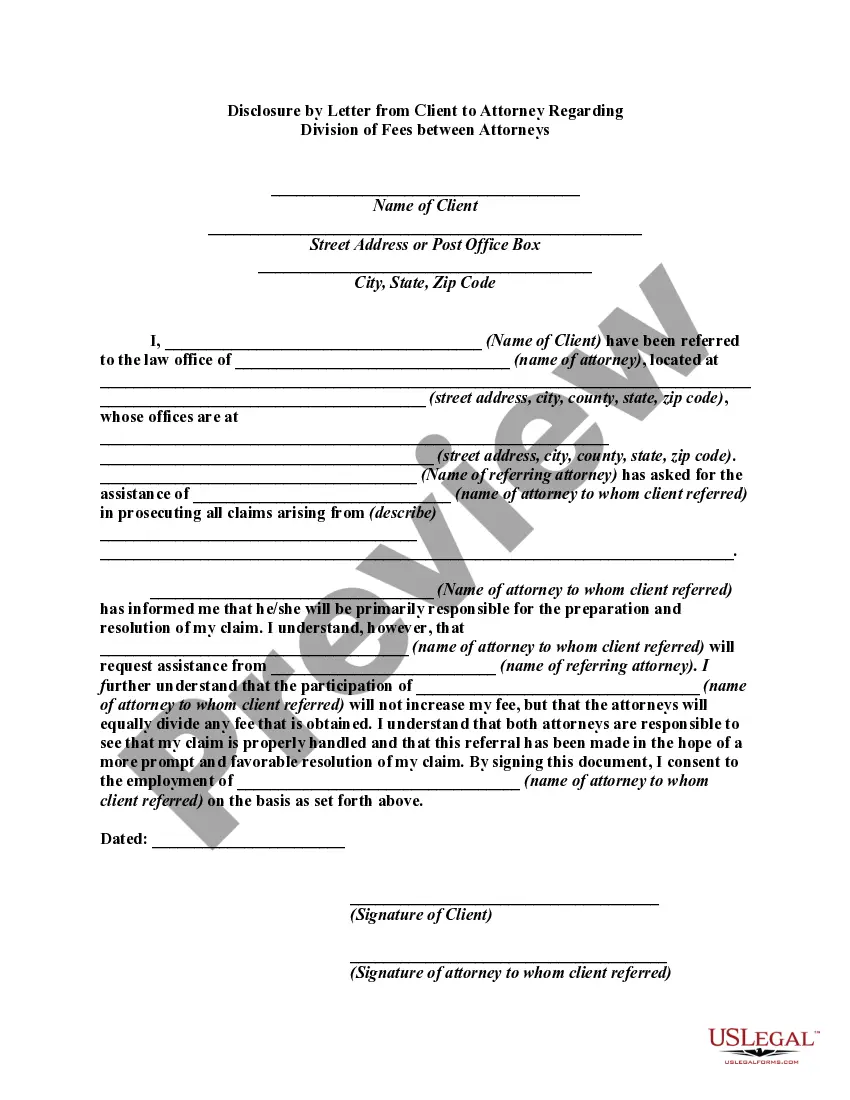
How to fill out Disclosure By Letter From Client To Attorney Regarding Division Of Fees Between Attorneys?
Dealing with legal documents and protocols can be a labor-intensive addition to the daily routine.
Attorney Client Privilege With Former Employees and similar forms typically require you to search for them and navigate the optimal method to fill them out accurately.
Consequently, whether you are managing financial, legal, or personal issues, utilizing a thorough and functional online directory of forms when required will be extremely beneficial.
US Legal Forms is the leading online resource for legal templates, offering over 85,000 state-specific documents along with various tools to help you complete your paperwork seamlessly.
Is this your first time using US Legal Forms? Register and create your account in just a few minutes, and you will gain access to the form directory and Attorney Client Privilege With Former Employees. After that, follow the steps outlined below to complete your form: Ensure you have the correct document using the Review feature and examining the form description. Choose Buy Now when ready, and select the monthly subscription plan that suits your requirements. Click Download, then complete, eSign, and print the document. US Legal Forms has 25 years of experience assisting clients with their legal paperwork. Locate the form you need today and streamline any process effortlessly.
- Browse the inventory of pertinent documents available to you with just one click.
- US Legal Forms provides you with state- and county-specific papers accessible at any time for download.
- Protect your document management processes using a premium service that enables you to assemble any form within moments without additional or concealed fees.
- Simply Log In to your account, locate Attorney Client Privilege With Former Employees, and obtain it immediately from the My documents section.
- You can also retrieve forms you have downloaded previously.
Form popularity
FAQ
If a client seeks advice from an attorney to assist with the furtherance of a crime or fraud or the post-commission concealment of the crime or fraud, then the communication is not privileged.
Thus, the attorney-client privilege will generally protect pre-advice communications between non-attorney employees if the purpose of the communication was to facilitate the provision of legal advice and the information obtained in response to the communication was promptly provided to counsel.
2 Although the conditions underlying communications with former employees are different, several courts have held the privilege applies to former employees in the same way it applies to current employees, while other courts have universally rejected any extension of the privilege.
Also known as a corporate Miranda warning. The notice in-house or outside counsel provide a company employee to inform them that counsel represents only the company and not the employee individually (see Practice Note, Internal Investigations: Giving Upjohn Warnings: When to Give an Upjohn Warning).
Upjohn draws no distinction between current and former employees; instead, it requires courts to balance a number of factors in determining whether the privilege applies, including whether the communications: (a) were at the request of management; (b) concerned issues within the scope of employment; and (c) provided ...