Release Personal Property Without Homeowners Insurance
Description
Get your form ready online
Our built-in tools help you complete, sign, share, and store your documents in one place.
Make edits, fill in missing information, and update formatting in US Legal Forms—just like you would in MS Word.
Download a copy, print it, send it by email, or mail it via USPS—whatever works best for your next step.
Sign and collect signatures with our SignNow integration. Send to multiple recipients, set reminders, and more. Go Premium to unlock E-Sign.
If this form requires notarization, complete it online through a secure video call—no need to meet a notary in person or wait for an appointment.
We protect your documents and personal data by following strict security and privacy standards.

Make edits, fill in missing information, and update formatting in US Legal Forms—just like you would in MS Word.

Download a copy, print it, send it by email, or mail it via USPS—whatever works best for your next step.

Sign and collect signatures with our SignNow integration. Send to multiple recipients, set reminders, and more. Go Premium to unlock E-Sign.

If this form requires notarization, complete it online through a secure video call—no need to meet a notary in person or wait for an appointment.

We protect your documents and personal data by following strict security and privacy standards.
Looking for another form?
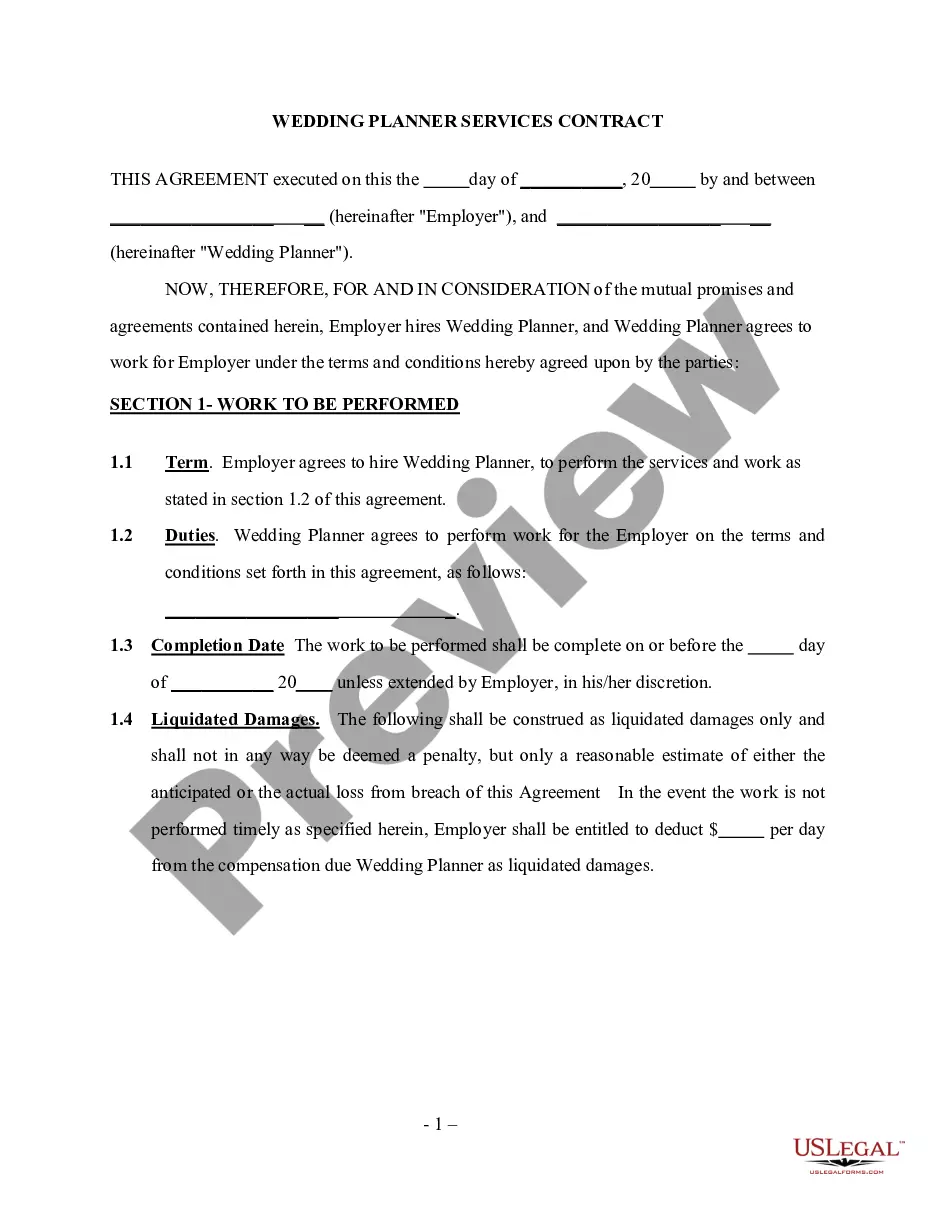





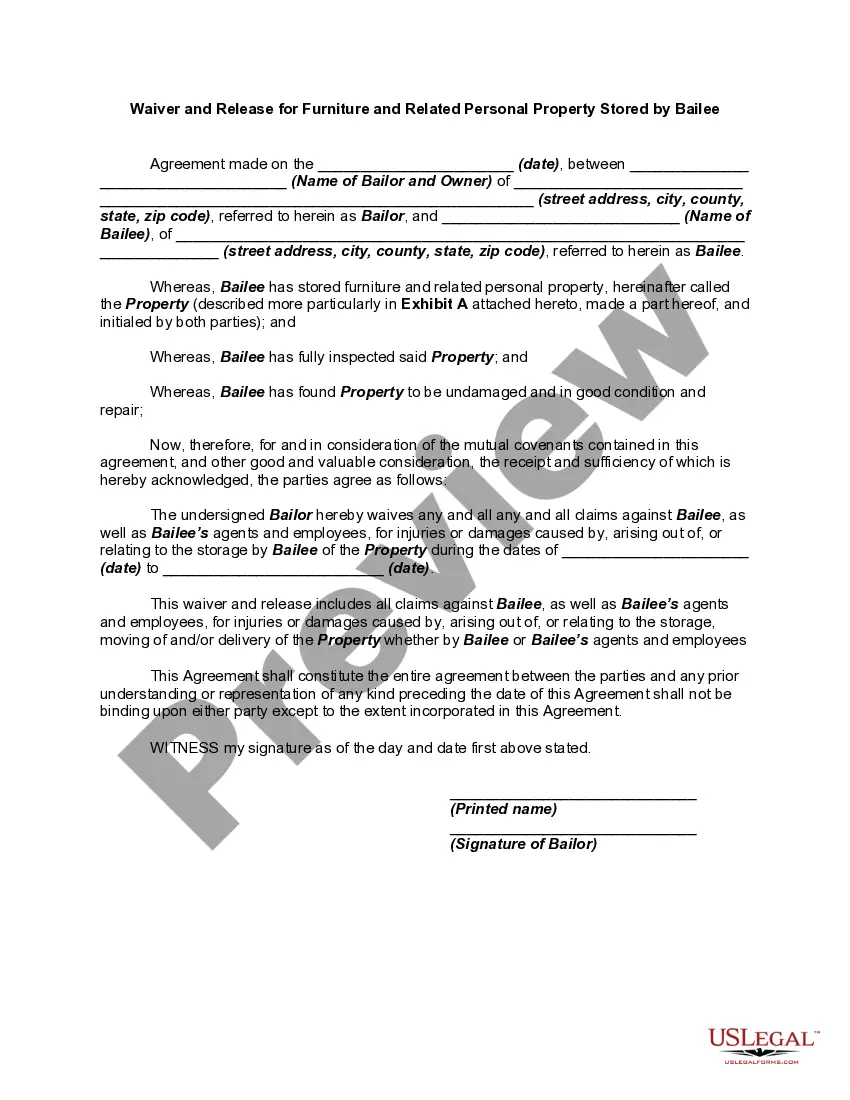
How to fill out Waiver And Release For Furniture And Related Personal Property Stored By Bailee?
Individuals typically link legal documentation with a form of complexity that only an expert can manage.
In a sense, this is accurate, as formulating a Release Personal Property Without Homeowners Insurance demands considerable knowledge in relevant topics, including state and regional regulations.
Nevertheless, with US Legal Forms, the process has become simpler: ready-made legal documents for various personal and business needs tailored to state laws are compiled in a single online directory and are now accessible to all.
All templates in our catalog are reusable: once purchased, they are saved in your profile. You can access them whenever necessary via the My documents section. Take advantage of all the benefits of using the US Legal Forms platform. Sign up today!
- US Legal Forms offers over 85,000 current documents categorized by state and application area, making it easy to search for Release Personal Property Without Homeowners Insurance or any specific template in just minutes.
- Registered users with an active subscription must Log In to their account and click on Download to obtain the document.
- New users will be required to create an account and subscribe before downloading any documents.
- Here is a detailed guide on how to obtain the Release Personal Property Without Homeowners Insurance.
- Review the page content thoroughly to confirm it meets your requirements.
- Read the form description or review it using the Preview function.
- If the selected sample does not meet your needs, search for another through the Search field above.
- Once you identify the appropriate Release Personal Property Without Homeowners Insurance, click Buy Now.
- Select a subscription plan that aligns with your preferences and financial situation.
- Log In or create an account to advance to the payment stage.
- Complete your payment through PayPal or with a credit card.
- Choose the format for your document and click Download.
- Print your form or transfer it to an online editor for an expedited fill-out.
Form popularity
FAQ
If you no longer have a homeowners insurance policy, you are not covered if something happens to your home. As a result, you will end up having to pay repair or replacement costs out of pocket.
Why? Without coverage, you're at higher risk of defaulting on your loan if disaster strikes. Without homeowners insurance, you'll need to pay for any major damages or to rebuild your home out of pocket. In this scenario, few people would be able to pay off their mortgage as well as rebuild.
Building coverage may insure items that are permanently attached to the building itself, while personal property coverage includes property that is not part of the building. Building and personal property coverage exclude land, water, plants, roadways, crops, shrubs, money, accounts, instruments, or trees.
Personal property coverage is usually included under most homeowners, renters, and condo policies. The coverage is usually a percentage of your total homeowners' policy. The percentage can range from about 20-50% of your total coverage limits. For example, your homeowners home structure coverage is $500,000.
To calculate the actual cash value, or ACV, of an item, take the replacement cash value, or RCV, which is the cost to purchase the item now, and multiply it by the depreciation rate, or DPR, as a percentage, and the age of the item. Then, subtract that value from the RCV. ACV=RCV - (RCVDPRAGE).